
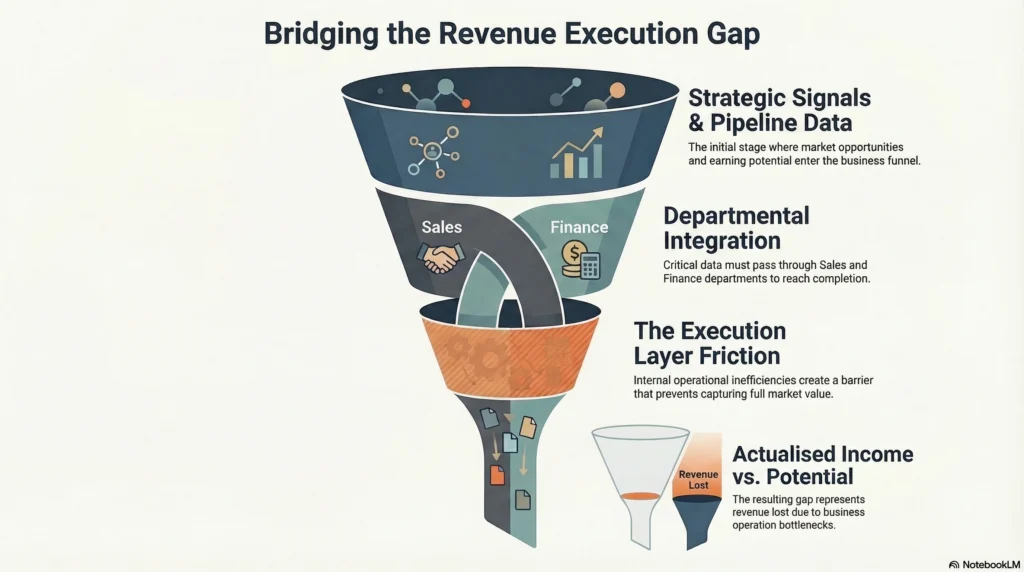
The Revenue Execution Gap: Where Deals Actually Start Slipping
In the modern C-suite, the quarterly board meeting has developed a predictable, if painful, cadence. The Chief Revenue Officer (CRO) presents a robust pipeline; the CMO highlights a surge in high-intent signals; and the CEO expresses cautious optimism. Yet, six weeks later, the post-mortem tells a different story. The targets were missed – not by a fraction, but by a canyon. The data suggests we are living through a “Missed Target Epidemic.” According to executive research from Forbes, Forrester and Gong: When these misses happen, the traditional reflex is to blame the “macro”, point to a “weak top-of-funnel,” or overhaul the sales compensation plan. But the reality is far more clinical. Companies aren’t missing revenue because of bad strategy or inferior products. They are missing revenue because of hidden execution gaps. Deals rarely die because of a sudden lack of interest. They slip because execution falters after the signal is received. This is the Revenue Execution Gap and it is the silent killer of the modern enterprise. What is the Revenue Execution Gap? To solve the crisis, we must first define it with precision. The Revenue Execution Gap is the delta between Revenue Potential – the signals, intent and pipeline momentum generated by your GTM engine – and Revenue Realized. It is the organizational friction that prevents a high-intent signal from becoming a closed-won contract. To understand what it is, we must differentiate it from the “usual suspects” of business failure. The Revenue Execution Gap is: It is, fundamentally, a signal-to-action failure across the cross-functional funnel. Where Deals Actually Start Slipping: A Stage-by-Stage Autopsy ? The gap is not a single hole; it is a series of micro-fractures across the revenue lifecycle. To fix it, we have to perform a clinical autopsy on where momentum actually dies. 1. Top-of-Funnel: The Signal Ignored The gap begins long before a deal is “created” in the CRM. In the age of “Dark Social” and 6-sense intent data, signals are everywhere, but execution is nowhere. 2. Mid-Funnel: The Momentum Black Hole This is where the majority of slippage hides. Modern Go-To-Market (GTM) motions have over 40 operational growth drivers, yet most leaders only measure 10. 3. Late-Stage: The Finance & Deal Desk Blind Spot Research indicates that 3–5% of total revenue leakage stems from weak coordination between Finance, Product, Sales and Contracting. 4. Post-Sale: The Expansion Paradox Perhaps the most egregious execution gap exists after the initial win. 73% of B2B revenue comes from existing customers, yet only 23% of companies effectively enable expansion. The Root Cause: The Go-To-Market Complexity Explosion Why is the Execution Gap widening now? Because the GTM environment has hit a “Complexity Wall.” The modern revenue engine is: This creates a Decision-Heavy environment. Every day, your team is making thousands of micro-decisions. Yet, our measurement systems remain backward-looking. We look at what happened last month to guess what will happen next month, while the execution gaps of today go unaddressed. Why Traditional Revenue Management Misses the Gap? The market has attempted to solve this with software, but we’ve been buying tools that provide Visibility without providing Velocity. 1. Revenue Intelligence (e.g., Gong, Clari) These tools are excellent at forecasting and deal scoring. They use AI to tell you a deal is “at risk.” 2. Revenue Operations (RevOps) Software RevOps aligns systems, cleans data and standardizes processes. It creates a beautiful “map” of the journey. 3. Revenue Operations Platforms These provide a unified view across CRM, Marketing and Finance. The Three Executive Blind Spots If you are a CEO, CFO, or CRO, you likely have three major blind spots regarding your revenue engine: Blind Spot 1: Are Our Targets Even Measuring Execution? Traditional KPIs are “Outcome Metrics”: Revenue, Win Rate, Retention, Pipeline Coverage. What’s Missing: “Input Metrics” or “Execution Drivers.” Blind Spot 2: Are We Pulling the Right Growth Levers? When targets are missed, the standard “Playbook” is: Blind Spot 3: Who Owns Execution Across the Funnel? Sales owns the pipeline. Marketing owns demand. Customer Success owns retention. Finance owns cash. But who owns revenue realization? In most companies, the answer is “no one.” It falls into the gaps between the silos. The Signal-to-Action Gap: The Pulse of Execution This brings us to the core of the SpurIQ philosophy. To close the Revenue Execution Gap, we must solve the Signal-to-Action Gap. Definition: The Signal-to-Action Gap is the latency and inconsistency between a revenue signal and the action required to convert it. Without orchestration, signals just become dashboards. And dashboards don’t close deals. Revenue Execution vs. Revenue Performance It is a common mistake to conflate these two terms. Performance is a lagging indicator. Execution is the only leading indicator that actually matters. What Closing the Revenue Execution Gap Actually Requires? To move from a “Forecast-driven” culture to an “Execution-driven” culture, an organization requires four pillars: 1. Signal Consolidation You cannot execute on what you cannot see. You must unify signals across CRM, Marketing, Finance and Product into a single, real-time “Stream of Truth.” 2. Orchestrated Action Triggers In the old world, a signal created an “Alert” (an email or a Slack ping). In the new world, a signal must trigger a Play. Not a notification, but a cross-functional workflow that moves the deal forward automatically. 3. Cross-Functional Enforcement Execution cannot be optional. If a deal is stalled, the system must enforce multi-threading or trigger a Finance-led pricing review. The alignment between Sales, Finance and CS must be embedded in the workflow, not discussed in a weekly sync. 4. Closed-Loop Accountability You must track the execution itself: How Revenue (Action) Orchestration Solves the Crisis? This is where the category of AI Revenue Action Orchestration comes into play. It is the evolution of the GTM stack. Revenue Orchestration converts signal detection into coordinated, automated action flows across systems and functions. It is the “Execution Owner” that sits on top of your CRM and RevOps tools. The SpurIQ Mechanism: Signal > Prioritization > Automated Play > Ownership > Outcome Tracking. SpurIQ’s role is to