Why AI Revenue Action Orchestration Beats Platform-Led RevOps Tools in 2026
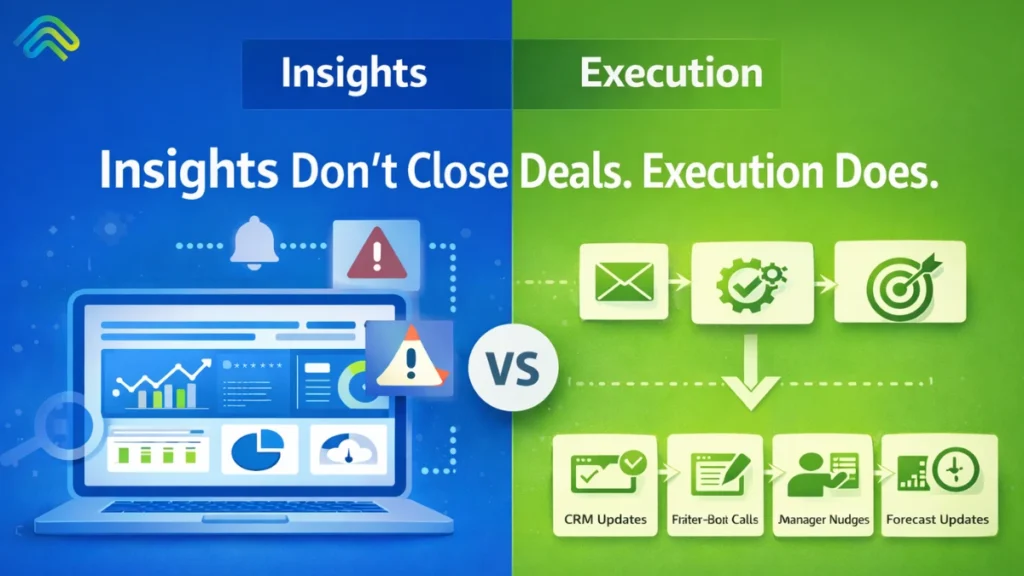
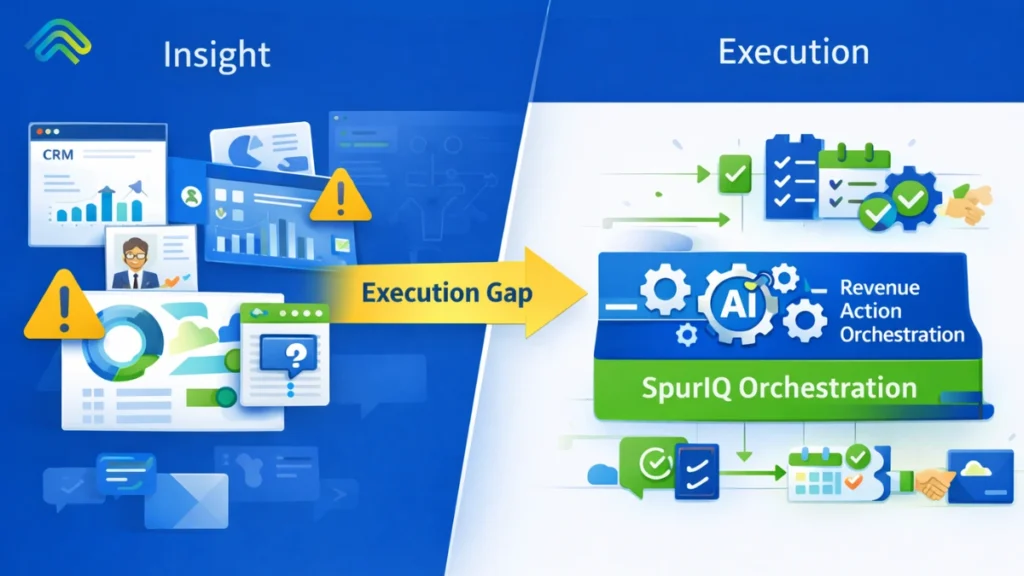
Most B2B teams believe their revenue engine is in good shape. They have RevOps, CRM, dashboards, and AI insights. On paper, everything looks aligned. Yet revenue still slips. Deals don’t usually fail during calls, they fail between them. Follow-ups get delayed, risks stay hidden, CRM falls behind, and opportunities quietly lose momentum. Not because teams lack data, but because no one truly owns execution after buyer interactions. This is the gap AI Revenue Action Orchestration is designed to close. SpurIQ takes ownership of revenue execution, ensuring the right actions happen at the right time across the funnel. Instead of showing problems or suggesting tasks, it makes sure follow-through actually happens, so revenue doesn’t fade after the call. The RevOps Illusion: Why “Alignment” Still Leaks Revenue? For the last decade, RevOps has been sold as the fix for broken revenue performance. Align sales, marketing, and finance. Centralize data in CRM. Add dashboards, forecasts, playbooks, and AI-driven insights. On paper, everything looks “in sync.” Yet in practice, revenue keeps slipping. Most B2B companies today have strong revenue orchestration in theory, well-defined processes, reporting layers, and tools that show what should happen next. But when you look closely at what happens after a buyer interaction, things quietly fall apart. Follow-ups don’t go out on time. Deals sit idle for weeks. CRM updates happen late or not at all. Risks show up only when the quarter is already lost. This is why, despite heavy investment in RevOps tools and revenue orchestration software, companies still lose an estimated 20–30% of potential revenue every year. The common assumption is that the problem is insight: “If only we had better data, better dashboards, better AI.” But most teams already have enough information. Calls are recorded. Emails are logged. Pipelines are visible. Forecasts exist. What’s missing isn’t knowledge, it’s follow-through. Revenue doesn’t leak because teams lack intelligence. It leaks because no one owns execution once the call ends. Dashboards can flag a stalled deal. Playbooks can recommend the next step. Managers can point out a risk in pipeline review. But none of those things guarantee action. The burden still falls on humans to remember, prioritize, and manually execute, often across ten different tools. When they don’t, revenue simply decays without being marked as lost. This is the core flaw in traditional revenue orchestration: it coordinates systems, but it doesn’t ensure outcomes. Fixing this doesn’t require another dashboard or a better report. It requires a new layer in the revenue stack, one that doesn’t just surface signals, but turns them into actions automatically. That gap is exactly why AI revenue action orchestration exists. What Is Revenue Orchestration? (And Why Most Definitions Fall Short) If you search what is revenue orchestration, most definitions point to the same idea: coordinating systems, data, and workflows across go-to-market teams. In simple terms, revenue orchestration is meant to bring sales, marketing, and customer success onto a shared operating rhythm, using CRM, automation tools, analytics, and RevOps processes to keep everyone “aligned.” And to be fair, this approach did fix real problems. Before revenue orchestration became common, teams worked in silos. Data lived in disconnected tools. Sales didn’t trust marketing numbers, finance didn’t trust the forecast, and leadership had no single view of the pipeline. Modern revenue orchestration platforms solved much of that by centralizing data and making revenue activity visible. But visibility is where most revenue orchestration software stops. These systems are excellent at showing what’s happening: which deals are stalled, which leads went cold, where risk exists in the pipeline. They can even suggest best practices or recommended next steps. What they don’t do is make those steps happen. Execution is still manual. Reps are expected to remember to send follow-ups. Managers must chase updates before forecast calls. RevOps teams spend hours policing CRM hygiene. Even the most advanced AI revenue orchestration tools still rely on humans to turn insight into action and that’s where things break down. When execution depends on memory, discipline, and spare time, it’s inconsistent by default. Deals don’t die loudly; they fade. Revenue doesn’t collapse in one moment; it leaks quietly over weeks of inaction. This is the gap most definitions ignore. Revenue orchestration coordinates systems and signals, but it does not own outcomes. It aligns teams, yet leaves execution to chance. In practice, that makes it a passive layer in the revenue stack. Revenue orchestration without execution is still passive. That’s exactly where Revenue Action Orchestration emerges. What Is AI Revenue Action Orchestration? AI Revenue Action Orchestration is the continuous, autonomous conversion of revenue signals into executed actions across the funnel, without relying on human memory, manual follow-ups, or CRM hygiene. This is not about more insights. It’s about ownership. Instead of stopping at visibility or recommendations, AI revenue action orchestration ensures that critical revenue actions actually happen. At its core, the model rests on four pillars. 1. Signal ingestion Every meaningful revenue signal is captured automatically. Sales calls, email threads, CRM activity, buyer responses, and deal movement all flow in as raw inputs. Nothing depends on reps remembering to log activity or summarize calls. The system observes revenue as it unfolds. 2. Contextual understanding Signals alone are meaningless without context. AI revenue orchestration evaluates activity in relation to deal stage, buyer behavior, previous interactions, and known risk patterns. A missed follow-up early in the cycle doesn’t carry the same weight as silence after pricing or security review and the system knows the difference. 3. Decisioning Once context is clear, the system determines what must happen next. That includes identifying the right next step, assigning ownership, and setting urgency. This is not a generic recommendation engine; it is a judgment layer built around revenue outcomes. 4. Execution This is the defining difference. Actions are not left as tasks or reminders. Follow-ups are sent, CRM updates are made, risks are surfaced, and deal movement is enforced. Execution is no longer optional or dependent on human discipline, it is built into the revenue flow. This is why revenue action orchestration is fundamentally different from existing categories: In other words, traditional revenue technology observes revenue. Revenue action orchestration runs it. Why Gartner Says Revenue Action Orchestration Is Inevitable? The