
What Is Revenue Execution? (And Why B2B Teams Lose 30% Without It)
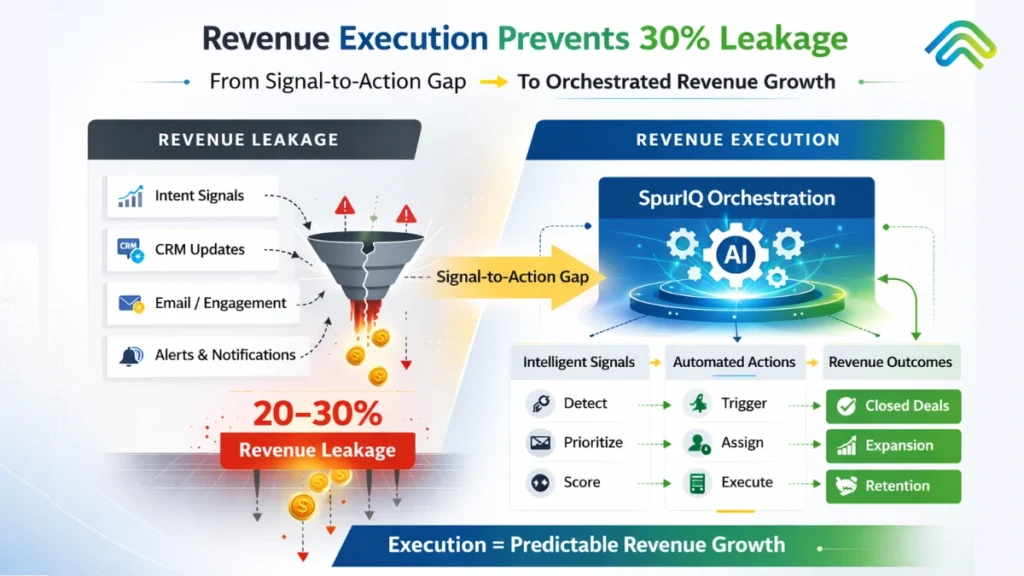
The 30% Problem: The Silent Killer of B2B Growth If you ask most sales leaders why they missed their quarter, you will hear a familiar refrain: “We didn’t have enough pipeline.” It is the standard diagnosis. The knee-jerk reaction is predictable: hire more SDRs, increase the paid search budget, and demand more activity. But for mature B2B organizations, this diagnosis is frequently wrong. B2B teams rarely lose revenue because they lack pipeline. They lose it because they fail to execute after the buyer interacts. Consider the reality of your current tech stack. It is likely overflowing with intelligence. You have intent data showing who is researching you. You have marketing automation tracking whitepaper downloads. You have product telemetry showing usage dips. The signals exist. However, the actions tied to those signals are inconsistent, delayed, or reliant on manual human memory. This phenomenon is known as the Signal-to-Action Gap. When a buying signal flashes but the corresponding sales action is delayed by 24 hours (or missed entirely), revenue leaks. Industry analysis suggests that this operational friction costs B2B organizations between 20% and 30% of their potential revenue. The uncomfortable truth? Your revenue strategy isn’t broken. Your execution is. What Is Revenue Execution? To fix the leak, you must first define the system required to plug it. Revenue Execution is the operational discipline that ensures every revenue signal – a pricing page visit, a stalled contract, a usage drop – triggers the right action, at the right time, with clear accountability across the entire funnel. It is not a philosophy. It is an operating system. And to understand it, we must ruthlessly distinguish it from the noise of general sales management. What Revenue Execution Is Not? ✗ It is not better forecast alignment meetings. Discussing a stalled deal on a Monday morning Zoom call does not move the deal. That is inspection, not execution. ✗ It is not colorful dashboards.Dashboards are passive. They depend on a human choosing to look, interpreting correctly, and then deciding to act. Dashboards observe. They do not execute. ✗ It is not a checklist of best practices.A playbook sitting in a Google Doc is not execution. If the process depends on human memory to function, it is already broken. ✗ It is not retrospective RevOps reporting.Telling a CRO they missed the quarter because pipeline velocity slowed in Week 8 is an autopsy. Revenue Execution is the intervention that prevents the death in Week 8. What are The True Essence of Revenue Execution? 1. Operationalized Action Ownership AI Revenue Execution eliminates the bystander effect inside your CRM. It removes ambiguity about who owns a signal. When a signal fires, the system explicitly assigns the ball to a specific player – an SDR, an AE, or a CSM. No handoff confusion. No diffusion of responsibility. 2. Automated Signal-to-Action Orchestration It bridges the gap between your tech stack’s intelligence and your team’s workflow – and removes the latency of human reaction time. If a buyer signals intent at 2:00 PM, the orchestration layer ensures the response happens at 2:01 PM. Not three days later when the rep clears their inbox. 3. Closed-Loop Accountability It tracks whether the action was completed – and critically, what the outcome was. If a high-priority signal goes unaddressed, the system doesn’t just log it. It escalates to management automatically. Also Read: Why AI Revenue Action Orchestration Beats Platform-Led RevOps Tools in 2026 The Core Distinction: Activity vs. Outcome Many competitors and legacy tools define execution as “managing revenue-generating activities.” That is a 2010 mindset. It focuses on logging calls, tracking email volume, and recording meeting notes. It measures effort. We define it differently. Revenue Execution is the science of converting revenue signals into accountable actions – without manual dependency. We measure outcomes. It is the difference between asking “Did you make 50 calls today?” and asking “Did we successfully engage every account that entered the buying window today?” Why B2B Teams Lose 20–30% Without AI Revenue Execution? Revenue leakage isn’t usually caused by one catastrophic event. It is death by a thousand cuts – hundreds of missed micro-moments across the customer lifecycle. Here is where the 30% disappears: 1. Post-Intent Inaction (Top of Funnel Leakage) 2. Pipeline Stagnation (Mid-Funnel Slippage) 3. Renewal & Expansion Blind Spots (Bottom of Funnel Leakage) 4. Fragmented Signal Systems Also Read: Revenue Intelligence vs Revenue Orchestration: Why Insights Alone No Longer Close Deals Revenue Execution vs. Revenue Operations (Critical Distinction) A common objection is: “We have a RevOps team, so we are already doing this.” This is a category error. Revenue Operations (RevOps) is the architect; Revenue Execution is the general contractor ensuring the work gets done. Feature Revenue Operations (RevOps) Revenue Execution Primary Goal Aligns teams, data, and processes. Ensures specific actions happen in real-time. Function Manages structure and strategy. Enforces accountability and speed. Output Creates visibility (Dashboards/Reports). Triggers execution (Plays/Tasks). Outcome Reports on past performance. Prevents future revenue leakage. The Bottom Line: RevOps optimizes the structure of your GTM motion. Revenue Execution optimizes the outcomes of that motion by engaging directly with the workflow. The Anatomy of the Execution Gap Why is this gap widening now? We identify five root causes that plague modern B2B teams: What True Revenue Execution Looks Like? To close the gap, organizations must shift from a passive data architecture to an active Execution Architecture. This involves four distinct stages: Stage 1: Signal Aggregation The system acts as a central nervous system, ingesting data from all sources: 6sense/Bombora (intent), Salesforce/HubSpot (CRM updates), Outreach/Salesloft (engagement), and product telemetry. Stage 2: Revenue Intelligence Layer The system applies logic to the noise. It evaluates buying probability and risk. It asks: Is this signal actionable? Is it high-priority? It filters out the noise so reps focus only on the signal. Stage 3: Automated Orchestration This is the engine of execution. Based on the intelligence, the system automatically triggers: Stage 4: Closed-Loop Accountability The system watches the watcher. Did the action happen? If not, the system identifies the