
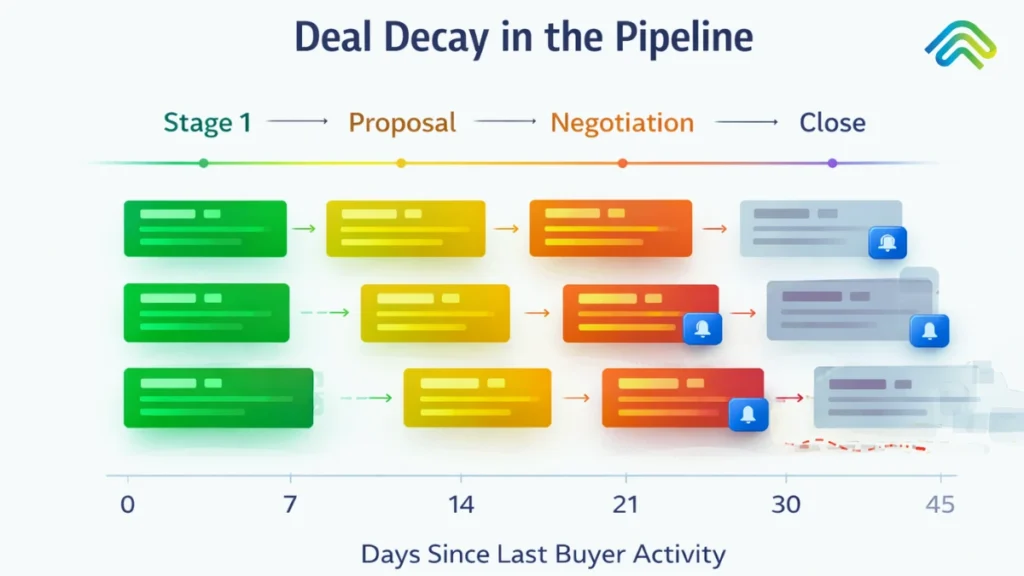
Why Most Deals Don’t Get Lost — They Quietly Decay (And How to Stop It in 2026)
86% of B2B deals decay before they close. Most never formally die — they slowly lose momentum, one missed signal at a time, until the buyer quietly moves on. This is deal decay. And your pipeline is full of it right now. It’s week eleven of a thirteen-week quarter. You pull up the CRM. The pipeline looks respectable — $4.2 million across sixteen active deals. Seven of them are sitting in Proposal Sent or Negotiation. You scroll through. Something bothers you, but you can’t quite name it. Deal number three: last rep activity was a follow-up email, sent eleven days ago. No reply. Proposal was opened twice in the first 48 hours after delivery. Not once since. Deal number seven: champion’s last response was seventeen days ago. Before that, she replied within a few hours. The deal is still marked ‘on track.’ Deal number twelve: close date was pushed back for the second time last week. No reason logged. The rep notes say ‘waiting on procurement.’ Nobody in your system sent an alert. No escalation fired. No recovery play activated. From the outside, these deals look alive. From the inside, they’ve been deteriorating for weeks. This is deal decay and it’s the silent, invisible force behind most missed quarters in B2B sales. Not a competitor wins. Not a budget cut. Not a bad fit. Just a slow, quiet erosion of momentum that nobody’s system is built to catch. The deals killing your quarter aren’t the ones you lost. They’re the ones that are still technically open — and haven’t moved in three weeks. The uncomfortable truth is that most B2B revenue teams are extraordinarily good at diagnosing deal decay after it kills a deal. The CRM closed-lost data, the QBR postmortem, the manager coaching session — all useful, all retrospective. What very few teams have is a system that detects the early signals of decay and converts them into an automatic recovery action before the window closes. That’s what this piece is about. Not motivation. Not methodology. The execution architecture that stops deal decay before it costs you the quarter. What Is Deal Decay? A Definition Worth Owning Most sales vocabularies don’t have a clean word for this. You’ll hear ‘stalled deal,’ ‘stuck pipeline,’ ‘deal slippage,’ ‘pipeline rot.’ All of them gesture at the same phenomenon. None of them name it precisely enough to fix it. Here’s the definition: Deal decay is the gradual, often invisible deterioration of a sales opportunity — caused not by a formal rejection or competitive loss, but by the accumulation of small execution failures: missed follow-ups, stalled engagement, unanswered signals and the slow erosion of buyer momentum over time. A decayed deal never says no. It simply stops moving. That last line is the one that matters. A decayed deal never says no. There’s no rejection email. No ‘we’re going with a competitor.‘ Just silence and then more silence and then a close date that gets pushed again and then one day the deal is so cold that closing it would require starting over. And here’s what makes deal decay so dangerous: it looks fine in the CRM. The stage is still accurate. The dollar value is still in the forecast. The rep still believes it’ll close, maybe next quarter. The pipeline review passes it without a flag. And all the while, the deal is quietly dying. Deal Decay vs. Deal Loss — Why the Distinction Saves Revenue? This distinction matters more than most revenue leaders realize, because the two problems have completely different solutions. Deal Loss Deal Decay What happened? The buyer made an active decision — chose a competitor, cut the budget, or concluded it wasn’t the right fit. The buyer never made a decision. Momentum eroded. Nobody intervened. The deal quietly died of inaction. Who caused it? Often genuinely out of your control — pricing, product gap, competitive dynamics. Almost always a preventable execution failure. The signal existed. The action did not follow. How it shows up A clear closed-lost reason in the CRM. A conversation that ended. A deal stuck in a late stage for 30+ days. A forecast that never materializes. The fix Better positioning, qualification, competitive strategy. Execution infrastructure — a system that detects the decay signal and automatically recovers the deal before it’s terminal. Most revenue teams treat both as losses. They run the same postmortem, apply the same coaching, adjust the same qualification criteria. This is why pipeline stagnation is so persistent, the diagnosis is wrong, so the treatment doesn’t work. Deal decay isn’t a qualification problem or a rep performance problem. It’s an execution architecture problem. The Scale of the Problem Is Larger Than Most Teams Acknowledge 86% of B2B deals stall at some point during the buying process — not from competitive loss, but from momentum failure. (Forrester, 2024) That number should make you pause. Not 20%. Not 40%. Eighty-six percent. More than eight in ten deals experience a meaningful stall. And for the majority of those deals, the stall isn’t caused by a competitor, it’s caused by a gap in execution between a buyer signal and a corresponding action from the selling team. Consider the revenue math directly: if your team has $5M in active pipeline and your average deal touches at least one meaningful stall point, the question isn’t whether deal decay is affecting your number. It’s how much of your pipeline is already in decay right now and whether you have any system that’s watching. Why Deals Decay: 5 System Failures Nobody Talks About Most conversations about deal stagnation end up in the same place: ‘The rep needs to follow up more aggressively.‘ It’s the easiest diagnosis and it’s usually the wrong one. Deal decay is systemic. It happens across teams, across deal sizes, across industries. When something is that consistent, the cause is structural, not personal. Here are the five structural reasons deals decay and why better rep coaching doesn’t fix any of them: 1. Your CRM Records Activity. It