
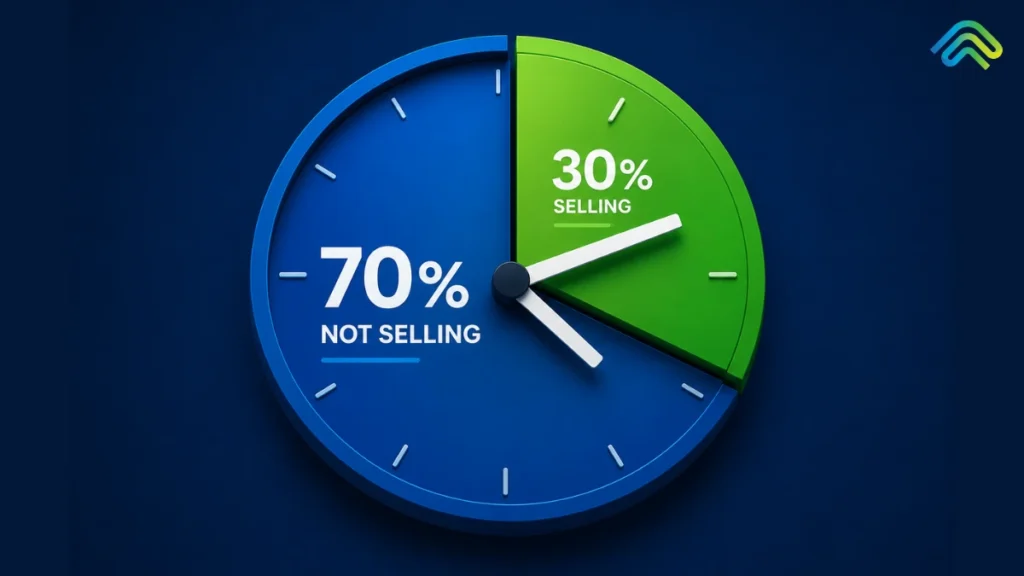
Why Sales Reps Spend 70% of Their Time Not Selling (And the Fix)
Run the numbers on your sales team’s week. A standard 40-hour week. Your reps spend roughly 11.2 of them actually selling on calls, in demos, pushing deals forward, and closing. The other 28.8 hours? CRM updates. Account research. Internal meetings. Chasing bad data. Scheduling. Email triage. You hired good people. You bought good tools. You ran training cycles, built playbooks, and brought in enablement. Even after investing in tools and training, your reps are still spending under 30% of their week actually selling. Here is where it shows up: according to Ebsta x Pavilion 2025 GTM Benchmarks, 78% of sellers missed quota in 2025, up from 69% the year before. That is not a talent problem. That is sales rep time wasted, 28.8 hours per rep per week, compounded across a full year, finally surfacing in the revenue numbers. These two statistics are not a coincidence. They are the same problem, measured from different angles. This guide answers four questions. Where does the 70% actually go? Why has every fix made it worse? What separates the top 14% of sales reps from everyone else? And what does a real structural fix look like in 2026? Where do the 28.8 Non-Selling Hours Actually Go? The Forrester Activity Study tracked 3,031 sales reps across industries and found the average rep burns nearly two full days every week on administrative work alone. According to Salesforce’s 2025 State of Sales report, when you ask how much time do sales reps spend selling, the answer is only 28 to 30% of their week on direct selling activities. Add account research, internal meetings, and tool navigation, and the picture gets considerably worse. Here is what a realistic 40-hour week looks like for a mid-market B2B rep: Activity % of Week Hours/Week Revenue Impact Active selling (calls, demos, negotiations) 28% 11.2 hrs Direct Account research and call prep 14% 5.6 hrs Indirect CRM data entry and pipeline updates 17% 6.8 hrs None Internal meetings and syncs 15% 6.0 hrs Minimal Email triage and admin 14% 5.6 hrs None Scheduling and logistics 12% 4.8 hrs None That is 28.8 hours per week producing zero direct revenue. Over a full year, each rep loses the equivalent of 37 selling weeks to work that does not move deals forward. Multiply that across a 20-rep team, and you are burning 740 selling weeks of revenue capacity every single year. The Bad Data Tax One of the quietest drains in any sales organisation is data quality. Research from ZoomInfo and Everstage shows how much time sales reps waste on admin connected to inaccurate contact data: 27.3% of their working week. That works out to roughly 546 hours per year per rep spent dialing wrong numbers, emailing bounced addresses, and researching contacts who left their company months ago. This is not a minor inconvenience. It is the single largest hidden cost in most sales organisations, and it never appears on any P&L line. When a rep spends two hours researching a prospect only to discover their champion has already left, they have not just lost those two hours. They have lost the momentum, the preparation, and the motivation that come with genuinely productive work. The Meeting Trap According to Salesmotion, Internal meetings take up nearly 15% of a typical sales rep’s workweek. Some are worth it: deal reviews that surface blind spots, coaching sessions that sharpen skills, pipeline inspections that improve forecasting. However, most are not. Standing syncs with no agenda, cross-functional updates that should have been an email, and forecast reviews where reps read CRM data aloud into a screen; all of these are structured time theft dressed up as work. Though it is not to cancel every meeting, you need to apply some standard to internal time that good sales leaders apply to customer-facing time. Every recurring meeting needs a clear output requirement. If a standing meeting has not produced a decision, a coaching moment, or a concrete next action in its first two occurrences, cancel it. Why Every Previous Fix Failed? Every leader reading this has tried at least one of these. Most have tried all four. Here is why each one falls short of the actual problem. Fix 1: “We’ll Buy a Tool for That” The reflex when reps are drowning in admin is to buy technology that handles it. A new sequencer. New conversation intelligence. New data enrichment. New CRM. The instinct is always the same: when the problem gets louder, add a tool. It sounds logical. But it delivers consistently poor results. Salesforce data shows the average rep now uses eight different tools to close a single deal. Gartner’s September 2024 survey of 1,026 sellers found that 72% feel overwhelmed by the number of tools they are expected to use. Sellers who feel overwhelmed by their tools are 45% less likely to hit quota. The math is uncomfortable. Every individual tool comes with a defensible ROI story. But the cumulative cost of switching between eight systems, managing separate logins, learning interface updates that arrive every quarter, and mentally reconciling conflicting data across platforms quietly erases most of those individual gains. Every tool added to reduce workload has also added a new layer of tool-management workload on top. For a closer look at how stack complexity compounds this problem, see how tool sprawl drains revenue capacity. Fix 2: “We’ll Hire More Enablement” Enablement teams write playbooks. They build training programmes. They produce battle cards, call frameworks, and objection-handling guides. None of it changes where the time goes. A rep with a perfect playbook still spends 17% of their week on CRM data entry, as the Forrester Activity Study of 3,031 reps and Salesforce’s 2025 State of Sales both confirm. The playbook does not enter the data. Here is the precise limit of what enablement can do: Companies with best-in-class enablement strategies see 84% of reps achieve quota (CSO Insights, 5th Annual Sales Enablement Study). Win rates improve. Onboarding shortens. Coaching conversations get sharper. Those are real gains,