SpurIQ

Revenue Operations

sales rep time wasted
Revenue Operations, Thought Leadership

Why Sales Reps Spend 70% of Their Time Not Selling (And the Fix)

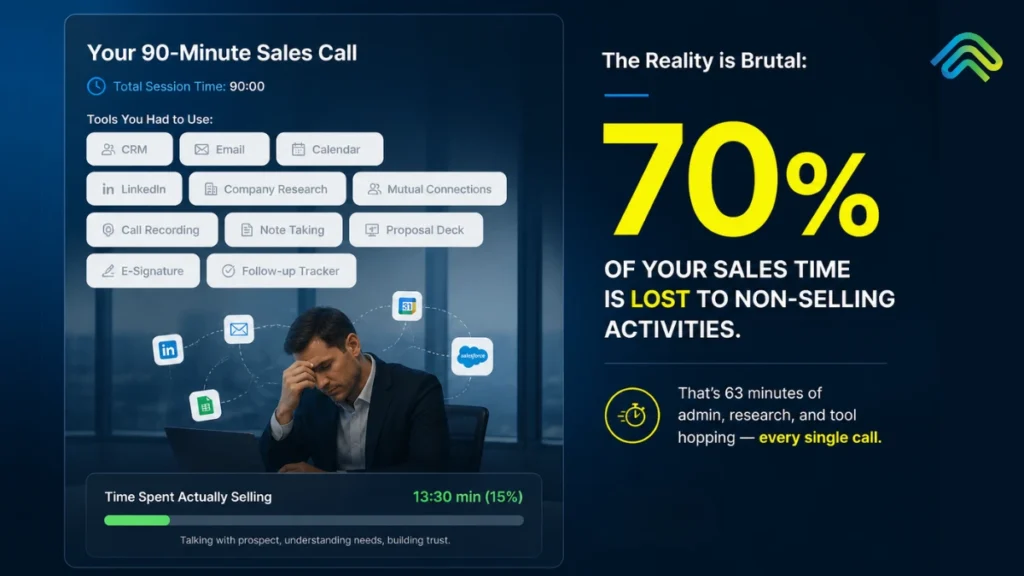
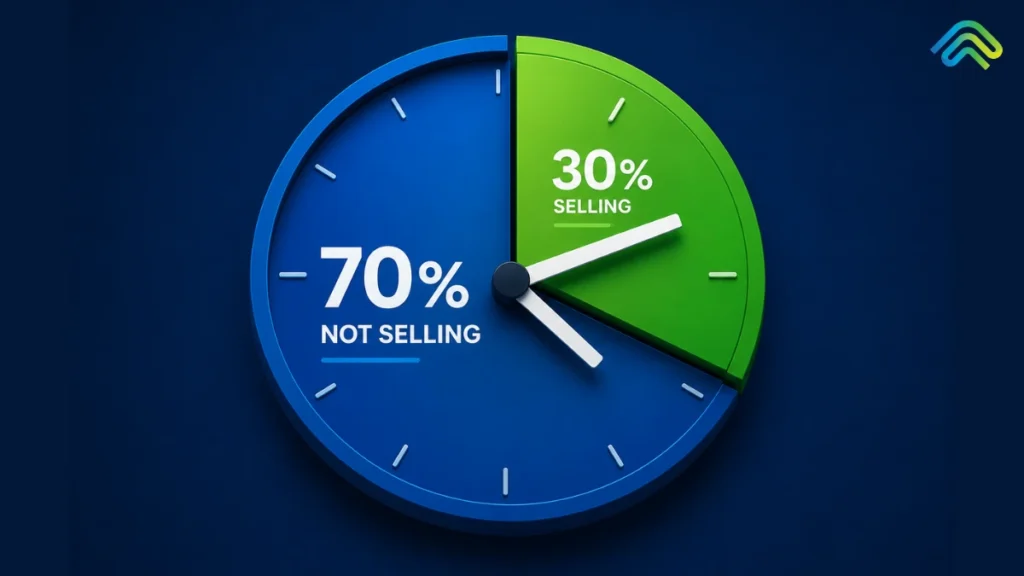
Run the numbers on your sales team’s week. A standard 40-hour week. Your reps spend roughly 11.2 of them actually selling on calls, in demos, pushing deals forward, and closing. The other 28.8 hours? CRM updates. Account research. Internal meetings. Chasing bad data. Scheduling. Email triage. You hired good people. You bought good tools. You ran training cycles, built playbooks, and brought in enablement. Even after investing in tools and training, your reps are still spending under 30% of their week actually selling. Here is where it shows up: according to Ebsta x Pavilion 2025 GTM Benchmarks, 78% of sellers missed quota in 2025, up from 69% the year before. That is not a talent problem. That is sales rep time wasted, 28.8 hours per rep per week, compounded across a full year, finally surfacing in the revenue numbers.  These two statistics are not a coincidence. They are the same problem, measured from different angles. This guide answers four questions. Where does the 70% actually go? Why has every fix made it worse? What separates the top 14% of sales reps from everyone else? And what does a real structural fix look like in 2026? Where do the 28.8 Non-Selling Hours Actually Go? The Forrester Activity Study tracked 3,031 sales reps across industries and found the average rep burns nearly two full days every week on administrative work alone. According to Salesforce’s 2025 State of Sales report, when you ask how much time do sales reps spend selling, the answer is only 28 to 30% of their week on direct selling activities. Add account research, internal meetings, and tool navigation, and the picture gets considerably worse.  Here is what a realistic 40-hour week looks like for a mid-market B2B rep: Activity % of Week Hours/Week Revenue Impact Active selling (calls, demos, negotiations) 28% 11.2 hrs Direct Account research and call prep 14% 5.6 hrs Indirect CRM data entry and pipeline updates 17% 6.8 hrs None Internal meetings and syncs 15% 6.0 hrs Minimal Email triage and admin 14% 5.6 hrs None Scheduling and logistics 12% 4.8 hrs None That is 28.8 hours per week producing zero direct revenue. Over a full year, each rep loses the equivalent of 37 selling weeks to work that does not move deals forward. Multiply that across a 20-rep team, and you are burning 740 selling weeks of revenue capacity every single year. The Bad Data Tax One of the quietest drains in any sales organisation is data quality. Research from ZoomInfo and Everstage shows how much time sales reps waste on admin connected to inaccurate contact data: 27.3% of their working week. That works out to roughly 546 hours per year per rep spent dialing wrong numbers, emailing bounced addresses, and researching contacts who left their company months ago.  This is not a minor inconvenience. It is the single largest hidden cost in most sales organisations, and it never appears on any P&L line. When a rep spends two hours researching a prospect only to discover their champion has already left, they have not just lost those two hours. They have lost the momentum, the preparation, and the motivation that come with genuinely productive work. The Meeting Trap According to Salesmotion, Internal meetings take up nearly 15% of a typical sales rep’s workweek. Some are worth it: deal reviews that surface blind spots, coaching sessions that sharpen skills, pipeline inspections that improve forecasting. However, most are not. Standing syncs with no agenda, cross-functional updates that should have been an email, and forecast reviews where reps read CRM data aloud into a screen; all of these are structured time theft dressed up as work. Though it is not to cancel every meeting, you need to apply some standard to internal time that good sales leaders apply to customer-facing time. Every recurring meeting needs a clear output requirement. If a standing meeting has not produced a decision, a coaching moment, or a concrete next action in its first two occurrences, cancel it. Why Every Previous Fix Failed? Every leader reading this has tried at least one of these. Most have tried all four. Here is why each one falls short of the actual problem. Fix 1: “We’ll Buy a Tool for That” The reflex when reps are drowning in admin is to buy technology that handles it. A new sequencer. New conversation intelligence. New data enrichment. New CRM. The instinct is always the same: when the problem gets louder, add a tool. It sounds logical. But it delivers consistently poor results. Salesforce data shows the average rep now uses eight different tools to close a single deal. Gartner’s September 2024 survey of 1,026 sellers found that 72% feel overwhelmed by the number of tools they are expected to use. Sellers who feel overwhelmed by their tools are 45% less likely to hit quota. The math is uncomfortable. Every individual tool comes with a defensible ROI story. But the cumulative cost of switching between eight systems, managing separate logins, learning interface updates that arrive every quarter, and mentally reconciling conflicting data across platforms quietly erases most of those individual gains.  Every tool added to reduce workload has also added a new layer of tool-management workload on top. For a closer look at how stack complexity compounds this problem, see how tool sprawl drains revenue capacity. Fix 2: “We’ll Hire More Enablement” Enablement teams write playbooks. They build training programmes. They produce battle cards, call frameworks, and objection-handling guides. None of it changes where the time goes. A rep with a perfect playbook still spends 17% of their week on CRM data entry, as the Forrester Activity Study of 3,031 reps and Salesforce’s 2025 State of Sales both confirm. The playbook does not enter the data. Here is the precise limit of what enablement can do:  Companies with best-in-class enablement strategies see 84% of reps achieve quota (CSO Insights, 5th Annual Sales Enablement Study). Win rates improve. Onboarding shortens. Coaching conversations get sharper. Those are real gains,
what is revenue operations
Revenue Operations, AI Strategy

What is Revenue Operations? The Complete 2026 Guide for B2B Teams

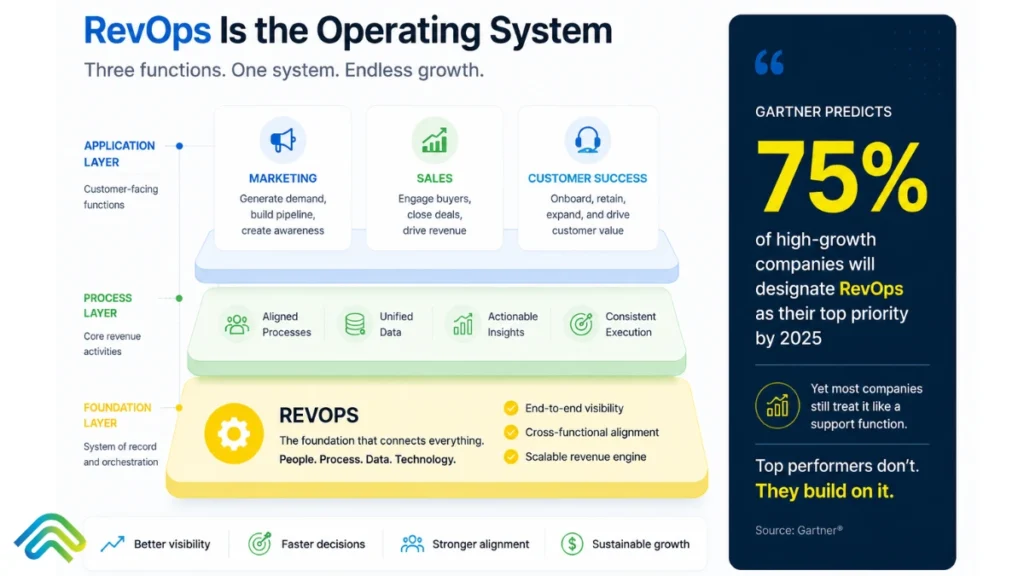
A Series B founder hears the phrase “revenue operations” three times in a single week. Once, a board member asked why the forecast keeps missing. Once on a podcast where a CRO credits RevOps for a successful IPO. And once from a recruiter pitching a VP RevOps hire as the solution to every GTM problem. Each person used the same two words. Each meant something slightly different. The founder walks away more confused than before, wondering whether RevOps is a real function, a philosophy, or simply the latest B2B buzzword. Here is the answer: revenue operations is a real, measurable function, and the data on its impact is unambiguous. Companies with mature RevOps grow revenue 19% faster. Organisations that achieve cross-functional alignment see 36% higher revenue growth and 28% higher profitability, as per Forrester. And public companies with strong RevOps programmes outperform peers by 71% in stock performance over five years. This guide answers four questions in order: what RevOps is, why it emerged when it did, how it actually works, and whether your team needs it. It is the foundational reference. If you want the implementation framework, the full strategy guide is at /revenue-operations-strategies. What is Revenue Operations?  Revenue operations (RevOps) is a B2B business function that aligns sales, marketing, and customer success teams around shared revenue accountability, with shared data, shared metrics, and shared execution standards.  This revenue operations definition holds across several companies, GTM motion, and industry: RevOps is the operating system underneath the revenue function, not a tool, a title, or a department rename. Where sales, marketing, and customer success have historically operated as three separate teams with three separate targets, three separate dashboards, and three separate definitions of success, RevOps consolidates them into one coherent system. The goal is simple: to drive revenue growth by eliminating the friction that siloed teams create across the entire customer journey.  What RevOps Does  What RevOps is NOT Common synonyms: Revenue operations strategy, RevOps function, revenue operations team. “Ops revenue” is sometimes used as shorthand but is technically inverted and best avoided in professional contexts.  Why RevOps Emerged: A Brief History RevOps didn’t appear overnight. It evolved in direct response to how B2B selling broke, scaled, and demanded more. Here is how the function evolved, year by year, from a fragmented back-office role to a boardroom priority. Sales ops, marketing ops, and customer success ops existed as separate functions. Each owned its own metrics, tooling, and pipeline version. Forecasts didn’t reconcile across functions. Handoffs broke routinely, and nobody owned the gaps. SaaS companies began consolidating these three ops revenue functions into a single team to solve the handoff problem. The label “revenue operations” became dominant around 2017 to 2019. Salesforce, HubSpot, and Outreach all formalised RevOps roles during this period. RevOps mainstreamed during the SaaS boom. The function exploded in headcount as companies scaled fast and needed cross-functional discipline to manage growth without chaos. Average RevOps team sizes roughly doubled. Capital efficiency stopped being optional. Median CAC payback stretched to 20 to 23 months (Benchmarkit 2025), more than double the previous benchmark. RevOps became the function responsible for delivering the efficiency that investors were now demanding. With a sharper focus on customer acquisition cost, net revenue retention, and annual recurring revenue as the primary indicators of health.  AI-driven execution emerged as the missing layer. The strategy frameworks were largely solved. The execution gap, the distance between a RevOps plan and reliable rep behaviour, became visible. The teams that closed it pulled away from the rest. By 2026, 75% of B2B SaaS leaders name RevOps as a top-3 strategic priority (Gartner 2025). The Scope of Revenue Operations Understanding what RevOps owns versus what adjacent functions own is where most organisations get confused. Blurring these boundaries leads to duplicated effort, unclear accountability, and a RevOps leader who ends up as a catch-all inbox for GTM problems nobody else wants to own.  What RevOps Owns Shared ICP, shared lifecycle definitions, and shared metrics across sales, marketing, and CS. RevOps is the function that forces three teams to agree on what “qualified” means, what “closed” means, and what “at risk” means, before those terms appear in a board deck. A single source of truth in the CRM, integrated with marketing automation platforms, sales engagement, CS platforms, billing/ERP, and product usage data. RevOps does not just own the CRM; it owns the logic that connects everything to it. Lifecycle stages, qualification frameworks, handoff SLAs, deal desk management, RACI matrices, and governance rituals. These are the behaviour standards that make the rest of the function operational rather than theoretical. Forecasting, attribution, capacity planning, territory design, compensation plan input, and board-level revenue reporting. RevOps translates pipeline data into the language leadership uses to make decisions. CRM administration, GTM tool selection, integration design, and data warehouse decisions. RevOps owns the system, not just the tools inside it. What RevOps Does NOT Own The Four Pillars of Revenue Operations Every mature RevOps function is built on four pillars. Each one is described here at a conceptual level. The revenue operations framework below is the conceptual foundation. Let’s have a look: Shared definitions, metrics, and accountability across sales, marketing, and CS. The work of getting three functions to operate as one coherent revenue system. Without this pillar, every other investment in data, process, and tooling collapses into siloed efforts that never reconcile. A single source of truth, integrated tooling, and working attribution across the full funnel. This is the plumbing under everything else. The scale of the problem is often underestimated: 45% of B2B contacts are never logged in CRM today (Salesforce 2025). Customer data quality is the foundation of everything that follows. Fixing this is most of the foundational work.  Documented playbooks, qualification frameworks, lifecycle stage definitions, and governance rituals. The behaviour standards that make consistency possible across reps, quarters, and GTM motions. Without this pillar, alignment becomes aspiration rather than operation. The system that turns the first three pillars into reliable behaviour at the precise moment

revenue ops vs sales ops
Revenue Operations, AI Strategy

Revenue Operations vs Sales Operations: Understanding the Key Differences and Choosing the Right Strategy

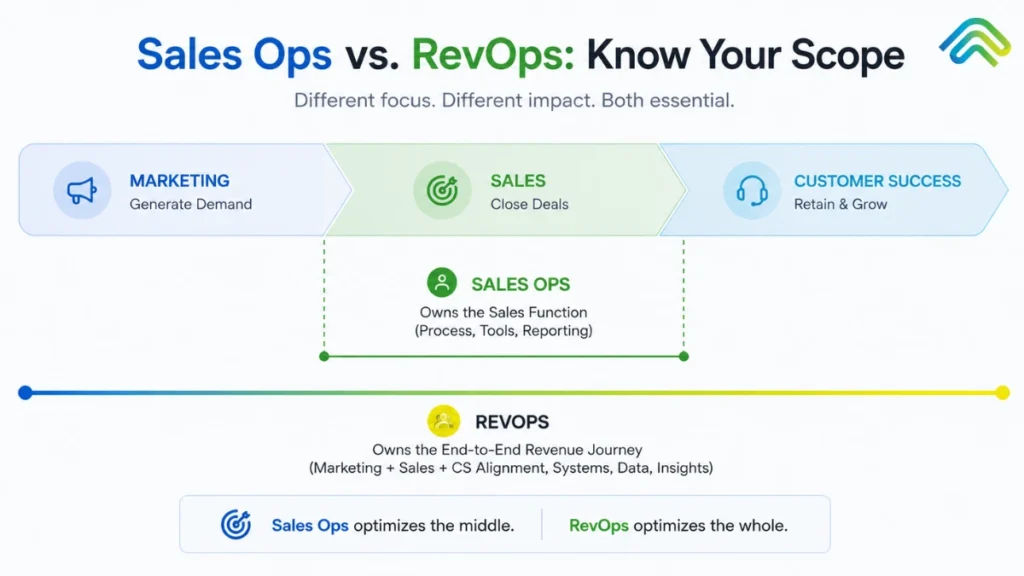
If you’re a Series B founder sitting at your desk, reviewing two resumes your recruiter just forwarded, you might be asking yourself the critical question of revenue ops vs sales ops. The first profile is a “Sales Operations Manager” and the second one a “Revenue Operations Lead.” Both candidates boast about improving CRM hygiene, tightening forecast accuracy, and optimizing the tech stacks that support your business operations. You have a critical decision: which function does the business actually need to scale sustainable growth and drive predictable revenue growth? Since 2022, search volume for “revops vs sales ops” has tripled, reflecting widespread confusion across B2B SaaS companies striving to align their sales functions and customer success processes. As businesses scale past early startup stages, the cracks in their go-to-market motions start to show, and leadership reflexively looks to operations professionals to fix them. However, most resources answer this query as a simple glossary definition. The real question isn’t just what these terms mean – it is which function your specific business needs, when to hire for it, and how to evolve your operational structure to maximize annual recurring revenue and improve customer retention. This guide breaks down exactly what you need to know. We will cover: So, without wasting time, let’s dive into the blog! What Is Sales Operations? Sales operations, often simply referred to as sales ops, is the functional backbone designed to improve the productivity, efficiency, and effectiveness of the sales team specifically. While it originated in the 1970s with Xerox’s pioneering efforts, it matured into a standard sales department pillar by the early 2000s as CRMs became the “system of record.” The sales operations team focuses on the “how” of selling. They are the mechanics of the overall sales engine, ensuring that sales representatives aren’t bogged down by friction. Their key functions and core responsibilities include: Typically, sales ops professionals report to a VP of Sales or a Chief Revenue Officer (CRO). In the traditional model, this function sits firmly inside the sales org. When sales operations initiatives are successful, you’ll see a direct impact on sales performance: sales reps spend less time on administrative tasks, sales productivity climbs, and sales metrics like forecast accuracy finally stabilize. The sales team begins to operate as a productive engine, rather than a collection of individual heroes. However, there is a historic limit: sales ops focuses almost exclusively on the sales funnel from the moment a lead is qualified until the deal is won. It doesn’t own the customer journey before the SQL handoff, nor does it manage existing customers after the closing deals phase. In this siloed model, marketing and customer success run their own ops in parallel, and the handoffs between them are frequently where revenue leaks occur. What Is Revenue Operations? Revenue operations, or RevOps, is the strategic function that aligns sales, marketing, and customer success around shared revenue accountability. While sales ops is primarily about the sales reps, a revenue operations team is obsessed with the entire customer journey. Revenue operations vs sales isn’t just a rebranding. This function emerged between 2017 and 2019 and became mainstreamed during the 2020–2022 SaaS boom when companies realized that “growth at all costs” was no longer a viable strategy. A revenue operations strategy focuses on the full revenue generation lifecycle. Rather than looking at a single department, RevOps looks at the entire buyer journey. Core responsibilities include: Who reports into RevOps? Usually, a Chief Revenue Officer or a COO/CEO. RevOps spans the organization rather than sitting inside any one department. The goal of successful revenue operations is to ensure that revenue teams operate as one cohesive system. Why did RevOps emerge so rapidly? The SaaS economics that made strategic alignment optional in the 2010s broke. Capital efficiency stopped being a suggestion and became a requirement. With customer lifetime value (CLV) becoming the primary metric of company health, businesses realized they couldn’t afford a disjointed customer experience. According to Benchmarkit (2025), median CAC payback has stretched to 20–23 months. Companies that couldn’t make their marketing teams, sales teams, and customer success departments operate as one fell behind. Forrester reveals that companies with mature RevOps functions grow revenue 19% faster and achieve 15% higher profitability than their peers.  Key Differences Between RevOps and Sales Ops The main difference is scope. Sales operations is a specialized tool; Revenue operations is the entire toolbox. While sales ops focuses on the sales cycle length and rep behavior, RevOps looks at market trends and customer success metrics to see how the top of the funnel impacts the bottom. Dimension Sales Operations Revenue Operations Operational Scope Exclusively sales-focused. Supports SDRs, Account Executives, and Sales Leadership. Cross-functional. Encompasses Marketing, Sales, and Customer Success teams. Core Problem Solved Inefficient sales cycles, low rep productivity, and poor pipeline visibility. Misaligned departmental silos, leaky handoffs, and unpredictable revenue growth. Reports To VP of Sales or Chief Revenue Officer (CRO). Chief Revenue Officer (CRO), Chief Operating Officer (COO), or directly to the CEO. Primary Metrics Quota attainment, win rate, sales cycle length, pipeline coverage. Net New ARR, Net Revenue Retention (NRR), CAC payback, Customer Lifetime Value (CLV). Data Ownership Sales pipeline data. Focuses on CRM opportunity stages and individual rep activity metrics. Full-funnel unified data. Tracks the journey from anonymous website visitor to multi-year renewal. Tooling Focus CRM architecture, sales engagement (sequencing), and forecasting/pipeline dashboards. Integrating the CRM, marketing automation, CS platforms, and centralized BI/analytics. Process Scope Active sales motion only. From opportunity creation to the Closed-Won handshake. End-to-end lifecycle. From top-of-funnel lead generation through customer satisfaction retention and expansion. Forecasting Approach Sales-only forecast. Based on active opportunities, pipeline coverage, and historical rep win rates. Revenue-wide forecast. Combines new sales pipeline, expected cross-sell/upsell expansion, and projected churn. Attribution Model Pipeline-stage or single-touch. Focuses on last-touch or “opportunity source” (e.g., cold call vs. inbound). Multi-touch attribution. Sophisticated models (W-shaped, U-shaped) tracking all touches across the buyer journey. Customer Success Ops Strictly outside of scope. A core pillar of the function, ensuring smooth

revenue operations strategies
Revenue Operations, AI Strategy

Revenue Operations Strategies That Actually Work in 2026: The Four-Pillar Framework for Predictable B2B Growth

Every working RevOps strategy eventually faces the same uncomfortable truth. Most B2B revenue operations strategies don’t fail because the framework was wrong. They fail because the framework never made it out of the wiki. In 2025, SpurIQ fixed a Series C SaaS company that missed its Q2 ARR target by 18%. They had world-class RevOps dashboards, clean CRM data, and documented playbooks in Notion. The problem wasn’t strategy. The problem was that reps weren’t consistently following through on signals, and nobody noticed until the quarter was already lost. This is the execution gap that kills revenue operations strategies. Most B2B companies in 2026 don’t suffer from a lack of frameworks, they suffer from “slideware strategy” that lives in wikis and decks but never makes it into daily workflows. A strategic framework is essential for aligning teams such as marketing, sales, and finance, driving cohesive growth, and streamlining processes. Organizations often face communication breakdowns between departments, which can impede growth and lead to missed opportunities. A dedicated revops team is crucial for streamlining revenue-related processes, improving workflows, and ensuring compliance across functions. Business leaders play a key role in facilitating strategic execution, accountability, and cross-functional management within revenue operations. By Q1’s end, even the most sophisticated plans have decayed into good intentions. The distinction matters: system-embedded strategy means playbooks wired directly into tools and triggers. Revenue operations strategy must extend beyond alignment and metrics into an execution layer that turns every insight into a tracked action. This guide walks through the four pillars that separate RevOps strategies that compound from RevOps strategies that stay theoretical. The first three pillars are well-trodden ground; alignment, data architecture, process discipline. The fourth, the execution layer, is where the winning teams have started spending their attention in the past eighteen months. It’s also where most teams are still leaking revenue without realising why. What a Revenue Operations Strategy Actually Means A revenue operations strategy is an operational blueprint for how revenue is generated, monitored, and improved across the entire customer lifecycle. It’s not just about org charts or team structure. It’s a set of decisions about data management, processes, governance, and execution spanning marketing, sales, customer success teams, and finance. The key components of a revenue operations strategy include data, metrics, and analytics, which are essential for accurate sales forecasting, reporting, and performance tracking. The scope includes lead routing rules, ICP and qualification standards, lifecycle stages, handoff SLAs, compensation guardrails, and feedback loops from first touch to renewal. A revenue operations strategy connects teams, systems, and processes to ensure effective execution of go to market plans, allowing every function to work from the same structure and definitions. Integrating and sharing accurate customer data across marketing and sales tools is crucial for better decision-making and delivering seamless customer experiences. This contrasts with traditional go to market strategy, which focuses on who you sell to, what you sell, and why it matters. Revenue operations strategy answers the “how”: how does the system actually run day to day, and what happens when it doesn’t? Establishing clear principles helps reinforce the decision making process and shapes the company’s culture and structure. A well-structured revenue operations strategy provides a framework that defines how teams interact, what systems they use, and how information flows between groups. Successful revenue operations strategies can enhance collaboration across departments by aligning revenue teams around shared goals, breaking down silos, and improving the buyer experience. This alignment can be achieved through regular meetings and collaborative projects. Avoiding poor customer experiences is a critical goal, as managing the entire customer journey ensures a seamless experience and prevents revenue loss. Here’s a concrete example: in 2024, a B2B infrastructure startup cut their quote-to-close cycle from 56 to 34 days by redesigning approval workflows and SLAs under a unified RevOps strategy. Revenue operations strategies can lead to predictable business growth by ensuring consistent inputs, shared systems, and repeatable actions. Governance and processes are supported by business rules, with automated checks helping maintain compliance standards and protect profit margins. Also Read: Deal Risk Scoring: How AI Detects Stalled Deals Before Leadership Notices The 4 Pillars of a Working RevOps Strategy Most mature RevOps models converge on four practical pillars that connect strategy to outcomes. These pillars transform abstract alignment into measurable results. Today, a new framework—such as the CAT4 framework—replaces fragmented processes with centralized, real-time visibility and accountability, enabling better decision-making and operational excellence. The four pillars are: Pillars 1–3 dominated RevOps content and tooling from 2018–2024. But pillar 4, the Execution Layer, is where outperformance comes from in 2026. Companies can have clean CRMs but inconsistent follow-up. Detailed playbooks that reps don’t use. Great board metrics that don’t change field behavior. Implementing standardized processes and clear ownership within teams can significantly enhance collaboration and ensure all departments are aligned towards common goals. Marketing operations, in particular, transforms marketing from a cost center into a revenue driver by connecting every campaign directly to business outcomes, ensuring that marketing efforts contribute to growth. Pillar 1 — Data Management and Systems Foundation The data foundation establishes a single source of truth for all revenue operations. Without it, every downstream process breaks down into data silos and conflicting reports. Integrating customer data across marketing and sales tools is essential for providing real-time insights that drive better decision-making and personalized engagement. What belongs in this pillar: In 2025, a PLG SaaS company unified Segment events, Stripe billing, and Salesforce into a single account 360 view. This enabled usage-based expansion plays that lifted NRR by 15–20%. Coordinating efforts across multiple departments ensures seamless data flow and campaign execution, supporting consistent processes and resource management. The non-glamorous work matters most: deduplication (often reducing 15–25% duplicates), enrichment rules, field governance (RevOps approves new fields to prevent sprawl), and change management for new integrations. The adoption of new systems streamlines revenue operations and improves forecasting accuracy. Automating routine tasks and repetitive tasks in these processes improves workflow efficiency and frees up time for strategic activities. Pillar 2

deal risk scoring
AI Strategy, Revenue Operations

Deal Risk Scoring: How AI Detects Stalled Deals Before Leadership Notices

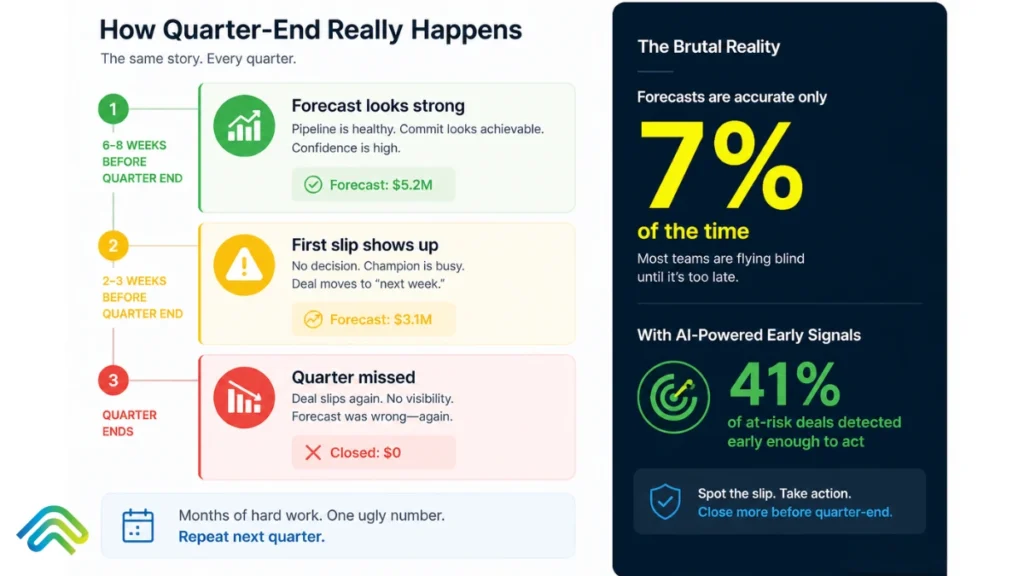
It’s the second Friday of the third month of the quarter. Your forecast says you’ll hit 102% of the plan. By the following Wednesday, three deals have slipped to next quarter. By Friday, that’s seven. The forecast was built on rep optimism, last week’s activity logs, and a CRM that updated when someone remembered to update it. Nobody saw the deal stall. Nobody could. Your VP Sales says it’s a timing issue. The reps say the buyer went quiet. The CRO knows what really happened: the deals were dying for weeks. Nobody had the system to see it. This quarter-end scramble is a universal pain point, and the data proves it. Only 7% of sales organizations achieve 90%+ forecast accuracy (Gartner Research). The median sits dangerously at 70–79%, and 69% of sales operations leaders say forecasting is becoming harder, not easier. Meanwhile, AI deal risk scoring – when properly implemented – flags at-risk deals 41% earlier than manual reviews and identifies up to 89% of deal failures before they happen. In this guide, we will break down exactly how this works. We will cover what deal risk scoring actually is, the hidden signals AI tracks that humans consistently miss, the proven framework for implementing it, and what separates the platforms that simply score risk from the platforms that actually save deals. What Is Deal Risk Scoring? (And Why Static Scoring Stopped Working) Deal risk scoring is a data-driven, systematic method for evaluating the health of sales opportunities. It assigns a numerical score to each open deal based on weighted indicators of risk, moving forecasting away from subjective rep gut-feel to an objective, evidence-based assessment. To understand where we are today, you have to look at the three generations of scoring approaches: Generation 1: Rep Gut-Feel Forecasting (1990s–2010s) For decades, forecasting relied on salespeople assigning probability percentages to deals (“I feel 70% confident this will close”). Managers would interrogate these numbers weekly in pipeline reviews, adjusting them up or down based on experience. The forecast accuracy rarely broke 50–60%. The core failure mode here is human nature: account executives are systematically, inevitably over-optimistic about their own deals. They have to be to survive in sales, but that optimism destroys pipeline predictability. Generation 2: Rule-Based CRM Scoring (2010s–early 2020s) As CRMs matured, RevOps teams tried to enforce logic. They built rule-based automation: If a deal has been in Stage 3 for 30 days, reduce probability by 10%. If there has been no logged activity in 14 days, flag the deal as yellow. While a step forward, this approach was brittle. It relied entirely on reps manually logging data. Reps quickly learned to “game” the system by sending a meaningless check-in email simply to reset the 14-day activity timer, creating a false sense of deal health. Generation 3: AI-Driven Deal Risk Scoring (2024–2026) Modern deal risk scoring doesn’t ask the rep for input; it passively ingests truth. AI models connect directly to the execution layer – email inboxes, calendar systems, Zoom recordings, and marketing engagement platforms. It analyzes the unstructured data (what the buyer is actually saying and doing) to assess risk objectively, in real time. Why the shift matters now: By 2026, over 60% of B2B sales teams use ML-derived intent and risk scoring as a core component of pipeline qualification (Gartner Market Prediction for Revenue Intelligence Platforms). The shift from rep self-reporting to evidence-based scoring isn’t a future trend – it is the new baseline for any competitive revenue organization. How AI Actually Detects Stalled Deals (The Six Mechanisms) The reason AI vastly outperforms human managers in pipeline reviews isn’t magic; it is processing capacity. A sales manager can review the last three emails on a deal. An AI model can review the last three years of successful deal patterns and cross-reference them against every micro-interaction happening today. Here are the six mechanisms AI uses to detect risk: Mechanism 1: Engagement Velocity Tracking AI doesn’t just look at whether an email was sent; it looks at the pace of the response. If a prospect historically replies to emails within 4 hours, and that response time slowly stretches to 12 hours, then 24 hours, then 48 hours – the AI flags the velocity decay weeks before the rep realizes they are being ghosted. Mechanism 2: Multi-Threading Analysis Enterprise deals require consensus. AI maps the communication graph to identify single-threaded vulnerabilities. If a $150K software deal only features back-and-forth communication with a mid-level manager, and the VP or IT Director hasn’t been cc’d or attended a meeting in three weeks, the AI spikes the risk score. It knows the historical win rate for deals with only one active stakeholder. Mechanism 3: Stage Progression Pattern Matching Every organization has an ideal deal velocity. AI analyzes your historical closed-won and closed-lost data to build a predictive timeline. If a deal sits in “Technical Validation” for 18 days, and the AI knows that 92% of deals that sit there for more than 14 days eventually fail, it immediately surfaces the risk. Mechanism 4: Sentiment and Urgency Tracking Using Natural Language Processing (NLP), AI reads the emotional and linguistic shifts in buyer communication. It detects when collaborative language (“how do we implement this?”) shifts to defensive or evasive language (“we are still reviewing internally”). It also tracks urgency decay – noticing when a buyer stops using time-bound words and starts using passive deferrals. Mechanism 5: Close Date Reliability Scoring Sales reps are notorious for pushing close dates to the last day of the month or quarter. AI evaluates the probability of that close date based on the remaining steps required. If the close date is in 10 days, but the AI sees that security review hasn’t started and legal hasn’t received a contract, it marks the close date as mathematically impossible and adjusts the forecast. Mechanism 6: Buyer Process Monitoring AI watches the buyer’s internal mechanics. Did they bring in procurement at the expected milestone? Have they shared the technical documentation internally? By monitoring document views

Sales Tool Sprawl
Revenue Operations, AI Strategy

Tool Sprawl is Killing Your Sales Team: How to Fix It 

Your SDR has 11 tabs open: Salesforce, Outreach, LinkedIn Sales Navigator, ZoomInfo, Gong, Slack, Notion, Calendly, Salesloft, Apollo, and Chili Piper. They have been at their desk for 90 minutes. Total time spent actually selling: 14 minutes. This is not an edge case. It is the average workday for B2B sales reps in 2026. Salesforce’s State of Sales 2026 report found that reps spend only 30% of their week actually selling, with the rest consumed by admin work, data entry, and navigating platforms that were bought to speed things up. The average B2B sales team now uses 5 to 8 disconnected tools, while some enterprise teams run 12 or more.  Reps lose 2 or more hours every day just to context switching. Half of all sellers say they feel overwhelmed by the number of platforms required to do their job. And according to Gartner research, 30-50% of subscription costs are wasted on tools nobody actively uses. At SpurIQ, this post covers the following things: why tool sprawl got this bad, what it is actually costing your team, how to consolidate without breaking deals or losing capability, and the consolidation framework that works in 2026. What is Tool Sprawl? Tool sprawl is the excessive accumulation of disconnected software tools that create more friction than value, slowing down workflows instead of improving productivity. It is a system failure, not a headcount problem. It occurs when a sales tech stack grows without architectural intent, resulting in redundant data flows, broken handoffs, and integration debt that compounds with every new addition. When the cost of maintaining tool interoperability exceeds the value each tool contributes, the stack stops being an enabler and becomes operational overhead.  Furthermore, it is also worth separating tool sprawl from healthy stack growth. A team running five well-integrated tools with clean handoffs will outperform a team on three tools that cannot talk to each other. The number is not the issue. The architecture is. In 2020, the average B2B sales team ran on three or four tools. By 2026, that number has climbed to five to eight active tools for most teams, with enterprise orgs regularly peaking at twelve or more. The math compounds fast. Why did it happen? Every new pain point triggered a new vendor purchase. Outbound lagging? Add an intent data tool. Call quality low? Add a conversation intelligence platform. Pipeline visibility off? Add a forecasting layer. Nobody owned the stack as a whole, and slowly, one purchase at a time, teams built themselves into the mess they are now trying to get out of. According to Salesforce’s State of Sales report, 84% of sales teams without a consolidated platform are already planning to address their tech stack in the coming year, and 42% of reps say they feel overwhelmed by the number of tools required to do their job. That is not a technology problem. That is an architecture problem hiding inside a technology budget. The 5 Hidden Costs of Tool Sprawl  Most RevOps leaders can feel these costs. Few have added them up. Here is what tool sprawl is actually taking from your team. Cost 1: Lost Selling Time  As per SpurIQ research, reps spend roughly 70% of their day on non-selling tasks, leaving less than 30% for actual selling. That translates to about two hours of selling per day, with admin alone consuming roughly one of those hours. A mid-market AE can burn 45 minutes every morning just reconstructing yesterday across Gong, Outreach, Salesforce, and Apollo before typing a single word to a prospect. Cost 2: Data Silos  Customer data sits fragmented across five to eight disconnected systems with no real-time sync. The CRM does not see what Outreach sees. “Outreach” does not see what “Gong” heard. The manager sees nothing in real time.  According to Gartner, 49% of CSOs say their definition of a qualified lead differs greatly from marketing’s. That is not a strategy problem. That is a data problem.  Cost 3: Subscription Bloat  30% to 50% percent of tool spend is wasted on unused or duplicate-function tools. The average sales team is quietly carrying 2 to 3 ghost subscriptions, paying for tools no one actively uses. Those subscriptions accumulate silently, auto-renewing every quarter with no one watching the utilisation data.  One $4M ARR company found four overlapping enrichment tools running simultaneously, three of them at below 20% usage. According to Gartner, organisations that actively audit and optimise licenses cut software costs by 30% on average within the first year. Cost 4: Adoption Decay  Reps avoid tools they do not need to use, and the pattern is consistent: adoption rates for non-CRM tools routinely fall to 30 to 50% within six months of rollout. The rep stops logging in. The invoice does not stop arriving.  According to Salesforce’s 40 Sales Statistics 2026, 42% of reps already report feeling overwhelmed by too many tools, which means the new platform you rolled out last quarter is likely already on its way to becoming shelfware. Cost 5: Burnout and Quota Risk  According to our survey, 50% of sellers feel overwhelmed by tool count, and that overwhelm has a direct cost: overloaded reps are 45% less likely to hit quota.  Why Most Consolidation Advice Fails Most guides about tool sprawl tell you to rip out your stack and replace it with something cleaner. Buy the all-in-one. Standardise on one platform and shut everything else down. Problem solved. Except for one thing – it does not work. Here is why: Failure Mode 1: The All-in-One Trap Big platforms promise to do everything. And they do. Just not particularly well. For examples; HubSpot is a great marketing tool and a decent CRM. It is not a best-in-class sequencer. Salesforce is the system of record for most enterprise teams. It is not where your reps want to live their day. When you consolidate onto an all-in-one, you trade tool sprawl for capability gaps. Your team goes from too many mediocre handoffs to one platform that does most things adequately

signal-based outbound
Revenue Operations, Thought Leadership

Signal-Based Outbound vs Cold Outbound: The 2026 Shift Every Sales Team Needs

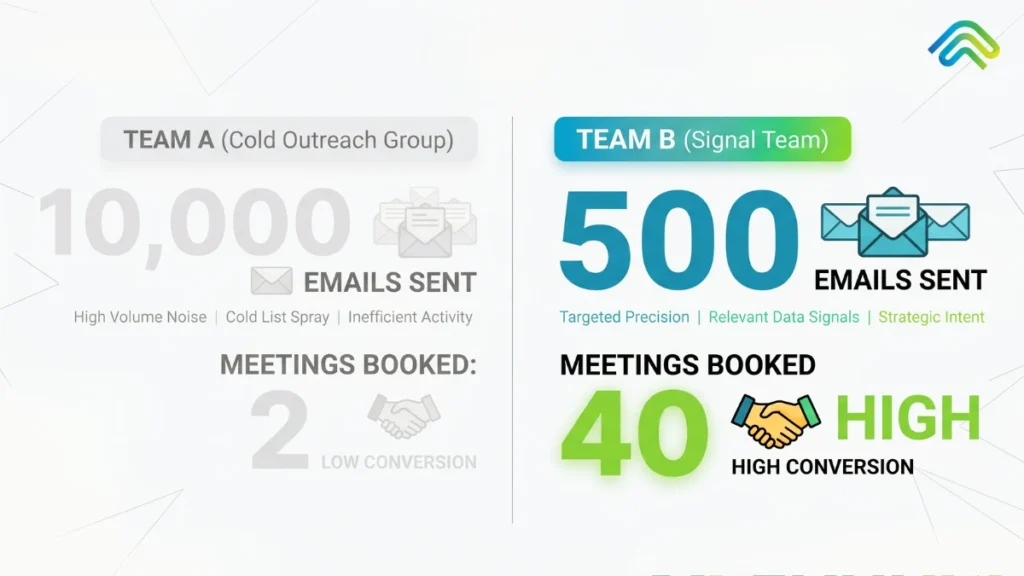
Two SDR teams. Same ICP. Same target market. Same week. Team A sends 10,000 cold emails to VP Sales contacts at SaaS companies. They book 23 meetings. Team B sends 500 emails, but only to people whose company raised funding last week, just hired a new CRO, or visited the pricing page that morning. They book 47 meetings. Same offer. Same copy structure. 20x times fewer emails. More than 2x the meetings. That gap isn’t a quirk of one quarter. It’s the shape of B2B outbound in 2026. Cold email reply rates have collapsed to an average of 3.43%, according to Instantly’s 2026 Benchmark Report, the lowest figure on record since they started tracking it. Signal-based outbound, in the same year, consistently lands between 15 and 25%, with elite teams pushing past 30%. That’s not a gradual decline of one approach and a slow rise of another. That’s a category shift. The teams winning outbound in 2026 aren’t the ones sending more emails. They’re the ones sending fewer, better-timed ones. In this guide, we are going to break down four critical things you need to know: the hard data behind this market shift, the underlying mechanics of how each sales motion works, exactly when each approach still makes sense (because cold outreach isn’t entirely dead, it is just narrower), and the one defining factor that dictates whether a signal-based motion will actually work for your sales floor. What Is Cold Outbound? (And Why It Stopped Working) Cold outbound is the traditional method of reaching out to a static list of prospects matched purely on firmographic and demographic data. You filter by industry, company size, and job title, build a list, and hit send. In this model, there is no underlying indication that the prospect is actively in the market for your solution. It is a volume-driven, spray-and-pray mechanism. The entire foundation of cold outbound is built on a mathematical assumption: if you contact a large enough pool of qualified-on-paper prospects, a predictable percentage will inevitably respond. For a long time, that math worked. Today, the math is fundamentally broken. The Numbers in 2026 If you want to understand the state of outbound, look at the telemetry data across the industry. The benchmarks tell a story of an infrastructure pushed beyond its limits: What are the 3 Structural Reasons Cold Outbound Failed? The collapse of cold outbound didn’t happen overnight. It was driven by three compounding structural failures. 1. Inbox Saturation: The barrier to entry for sending a thousand emails dropped to zero. With the proliferation of cheap data providers and automated sequencing tools, every company on earth scaled their volume. When buyers receive 120+ pitches a week, cognitive fatigue sets in. Buyers no longer read cold emails; they pattern-match them and mass-delete them based on subject lines alone. 2. Deliverability Collapse: Spam filters didn’t just get smarter; they got militant. Following the aggressive Google and Yahoo sender guidelines enforced in 2024, the infrastructure for mass emailing shattered. You can no longer blast thousands of identical emails from a primary domain without destroying your domain reputation. The technical overhead required to manage burner domains, warm-up pools, and IP rotations simply to achieve a 3% reply rate has made the ROI of cold outbound increasingly negative. 3. The 95:5 Problem: Research from the B2B Institute has long shown that only 5% of your total addressable market is actively looking to buy at any given time. The other 95% is out of market. Cold outbound, by definition, targets 100% of the list with equal aggression. You are inevitably burning brand equity by annoying the 95% who don’t care, just to blindly stumble across the 5% who might. What Is Signal-Based Outbound? (The 2026 Definition) Signal-based outbound (frequently referred to as signal-led outbound, intent-driven outbound, or a cold outbound alternative) is outreach triggered by a real-time event that indicates an emerging business need. It is not triggered by a static list. In signal-based selling, the trigger comes first. The list is built dynamically, minute-by-minute, around buyers who fit your ICP and have just done something that suggests genuine buying intent. To master signal-based prospecting, you must understand the triggers. The Three Categories of Signals How a Signal-Based Motion Actually Runs Moving from static lists to signal-led outbound requires a complete rewiring of how an SDR works. Here are the actual mechanics: The theory is straightforward. The execution is where most teams collapse, and we’ll cover why later. Signal-Based Outbound vs Cold Outbound – Side-by-Side Comparison in 2026 To clearly understand the operational differences between these two motions, look at how they stack up across critical sales dimensions in 2026. Dimension Cold Outbound Signal-Based Outbound Trigger Based on a fixed list of company traits. Based on a recent action or sign of interest. Approach High volume, hoping for a match (“spray and pray”). Highly targeted with precise timing. List Building Made once, reused all month. Updated constantly as new actions happen. Personalization Basic templates (swapping name/company). Deeply customized to the specific recent action. Reply Rate (2026) 1–5% (3.43% average). 15–25% (up to 40% for top performers). Meeting Rate 3–6 meetings. 12–32 meetings. Volume Very high (10,000+/month per team). Low (200–500/month per team). Domain Reputation High risk of being blocked or marked as spam. Safe, due to low sending volume. Sales Cycle Length Standard speed. Up to 40% faster. Key Risk Annoying people, getting blocked, low replies. Acting too slowly and missing the window of interest. Best For Brand awareness, market testing, cheaper products (<$1K). Medium to large businesses, expensive products ($5K+). Cost per Meeting $50–$100 (just for software tools). Practically free (no extra costs per meeting). Reply rate scales with signal precision, not message volume. While pure cold outreach hovers around 3.43%, signal-based outreach jumps to 15-25%, and multi-signal stacked outreach (where a company raises funding AND visits a pricing page) pushes past 30%. Why the Shift Is Happening Right Now If signal-led outbound is so much better, why didn’t the entire industry switch

Common CRM Problems
Revenue Operations, AI Strategy

The Death of Legacy CRM: Why Salesforce and HubSpot Are Losing the Revenue Execution War

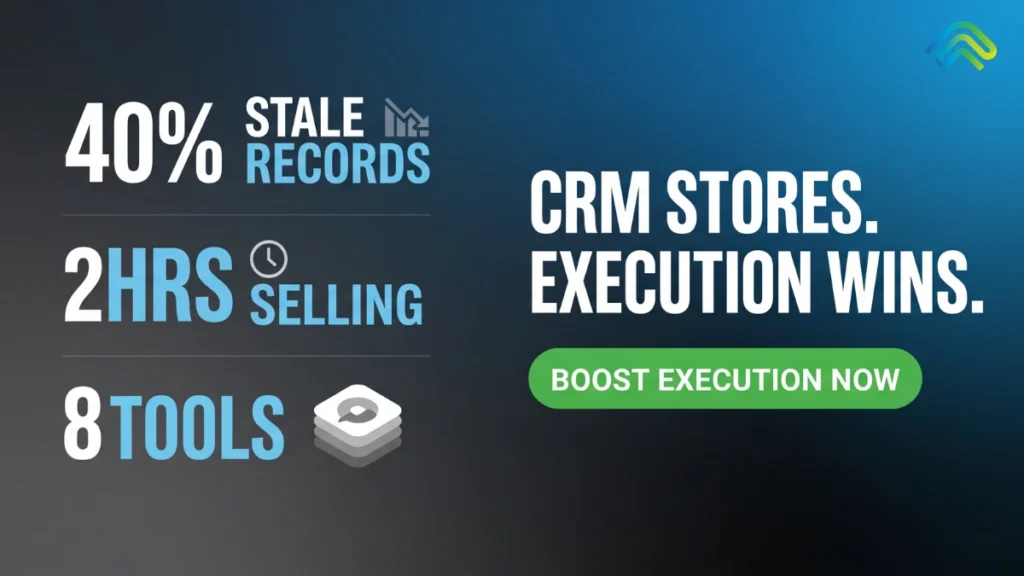
“In the next era of B2B, the winners won’t be the ones with the best database, but the ones with the best process for acting on that database.”                                                              ~ Aaron Ross (Author of Predictable Revenue) A trader once said, “You can have all the ships, the maps, and the cargo. If you never sail, the port stays empty.” Today, the same story is playing out inside every B2B revenue team.  Revenue leaders are finally starting to admit a truth that has been whispered in boardrooms for years: their CRM is the most expensive address book in the company. B2B teams spend millions of dollars every year on Salesforce and HubSpot, yet an estimated 20 to 30% of potential revenue still leaks after the first buyer interaction. The tools are not broken. The problem is that they were never built for what matters most: execution. CRM systems were designed to record relationships, log calls, and track deals. In 2026, deals are not lost because of missing data. They are lost because no one acted on the data that was already there. People had notes, timelines, and contact history. They just never turned that information into timely, coordinated actions. This signals a massive shift in the market. CRM is not necessarily dying; it has evolved. The real power in the tech stack is moving to the Execution Layer that sits above the database. Legacy CRMs are losing the war because they are trying to solve an execution problem with a storage solution. How Salesforce and HubSpot Became the Center of Every Sales Org (And Why That Era Is Over) Twenty years ago, customer data lived in a hundred places: spreadsheets, email threads, sticky notes, and hazy memory. Then Salesforce came along and said, ‘’Put it all in one place.’’ Slowly but surely, it became the default system that every serious sales organization was expected to run on. The promise was to give every rep a single source of truth, and your team would finally see the whole pipeline, not just a fragmented view.  HubSpot followed a similar path but with a different mission. While Salesforce leaned into the enterprise, HubSpot focused on SMBs and marketers. It offered a free CRM as a gateway to its marketing‑first stack, then built workflows that let growing teams track leads, touch points, and revenue in one interface. Within a few years, what started as a marketing tool quietly became a core CRM for thousands of companies. At first, this was a clear win. Centralized data helped leaders see pipelines, forecast revenue, and measure performance in ways that simply weren’t possible before. But somewhere along the way, the magic faded. What was built as a system of action turned into a system of record: a place reps updated because leadership demanded it, not because it helped them close. The very thing meant to drive revenue became the chore no one wanted to do. One revenue‑focused discussion put it clearly: “The CRM is not broken; your process is. You built a system to track leads, but you never built a system to follow up on them.” In that gap, the problems of CRM deepen: incomplete entries, missing context, and forecasts that feel like hopeful guesses rather than grounded predictions. That’s the quiet reality of the Salesforce‑and‑HubSpot era. They succeeded in becoming the center of the sales org, and in doing so, they also became the center of friction. What started as a solution to the common CRM problems of the early 2000s, over time, has become a legacy CRM that is no longer enough for the execution-first world of 2026. That’s how the era where CRM was the undisputed center is ending! The power is shifting now.  5 Core Reasons Why Businesses Are Leaving Legacy CRMs in 2026 In the early days of enterprise software, management thinker Peter Drucker said, “You can’t manage what you can’t measure.” For decades, CRM systems have given teams the ability to measure. However, the 2026 update is that you can’t execute what you don’t automate.  That’s because businesses are realizing that knowing where every lead sits is no longer enough. Visibility isn’t the real challenge; it’s turning that visibility into coordinated and timely action. Legacy CRM systems were built to answer the question “What happened?” But B2B revenue teams are asking a new question: “What should happen next, and who is responsible for it?” Simply put, legacy CRM systems are not dying because they are broken. They are being replaced because they were built for a world that no longer exists. As B2B selling becomes more complex, distributed, and signal-driven, the old playbook starts to crack. Here are five reasons teams are quietly moving away from Salesforce and HubSpot as their revenue core: Failure 1: Data Graveyards, Not Decision Engines Legacy CRMs are fantastic at collecting data. They log calls, store notes, track stages, and centralize customer history. But they rarely turn that data into decisions. In practice, this looks like a rep opening a spreadsheet every morning and sorting leads by hand because the CRM doesn’t surface what really matters. Here’s how that gap usually shows up: Case Studies in the AI‑CRM space show that modern systems that surface intent signals can cut rep analysis time by 50–60% compared to traditional CRM‑only workflows. As a Revenue Ops podcast host once put it, ‘You’re not paying for data. You’re paying for the ability to act on it. If your CRM doesn’t tell you what to do next, it’s a data graveyard, not a decision engine.’ This is one of the biggest problems with CRM: rich data, weak action.  Failure 2: Manual Hygiene Dependency The quality of your CRM data rests almost entirely on your reps tying the right fields at the right time. That’s a tough bet. CRM deployment landscapes suggest that 40-60% of CRM records are incomplete or stale at any given time. Meaning that, half of your pipeline, give or take, is built on guesswork, not facts. And, forecasts based

Buying Signals vs Intent Data
Revenue Operations, AI Strategy

Buying Signals vs Intent Data: What Actually Triggers a Sale in 2026

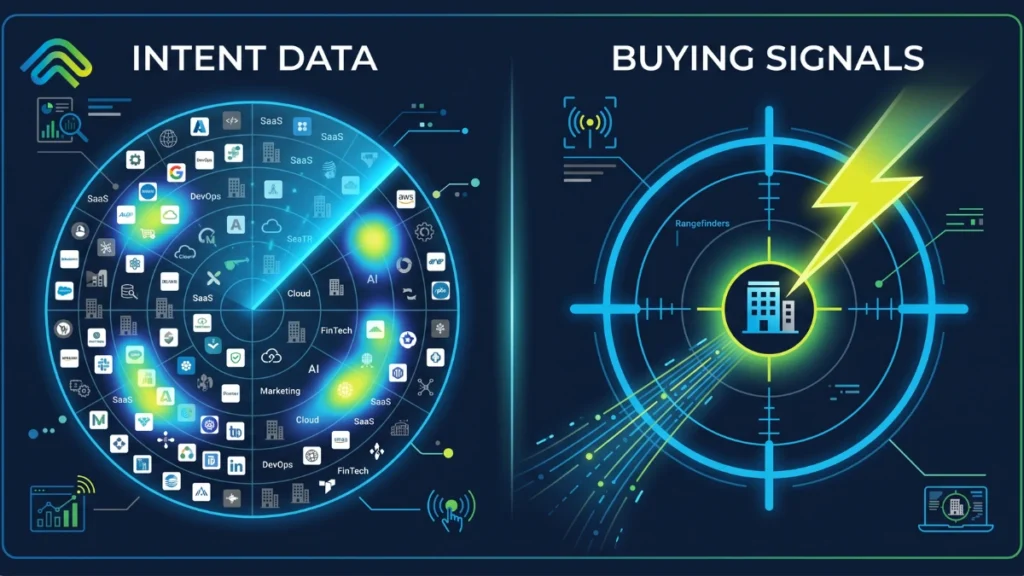
Most sales leaders have everything in line: Bombora for intent; ZoomInfo for contact information; a CRM system full of behavioral data. And still, the pipeline is empty. If you look closely, most sales reps are cold-calling accounts that haven’t responded in 3 months. Simply, the timing of the outreach is just wrong! Even after having all essential and relevant data – what’s the result? Missed quarters. Longer sales cycles. Reps are burning out on effort that never converts. The problem is not a shortage of data. The problem is that most B2B sales teams treat buying signal and intent data as interchangeable. But, they are not. One tells you where to look. The other tells you when to move. Confuse between these two, and it is impacting your overall quarter sales. You are guessing in a well-dressed spreadsheet (in the era of Artificial Intelligence).  While you can efficiently use buying signals and intent data together to increase your overall revenue. This guide draws a clean line between the two and shows how modern B2B revenue teams are using them together to build a faster, more predictable pipeline in 2026. What are Buying Signals in Sales?  A buying signal is a real, measurable action or behavioral shift in a target account that indicates a prospect may be moving toward a purchase decision. To understand what makes these signals valuable, it helps to look at the level of certainty they provide. The key idea here is clarity. A buying signal is not a hunch or an account simply “looking active.” It is a concrete event that has already happened.  For example, a decision-maker visiting your pricing page multiple times, a company announcing a new funding round, or a new VP of Sales joining and likely re-evaluating tools. These signals indicate that priorities are shifting and a buying window may have just opened. For a seller who is paying attention, this creates a clear and time-sensitive opportunity to act. What is B2B Intent Data in Sales?  B2B intent data is behavioral information collected about companies based on their online research activity. It captures the digital trail a business leaves behind when employees research topics, compare vendors, read review content, or consume educational material related to your product category.  There are two types worth knowing:  1. First-Party Intent Data  First-party intent data is generated from your own digital properties. It is reliable because it reflects direct interaction with your brand. You own it, you can act on it immediately, and there is no middleman interpreting it for you.  Common first-party signal sources include: 2. Third-Party Intent Data  Third-party intent data is aggregated from external sources that track which companies are engaging with relevant topics across thousands of properties. When a cluster of employees at a target account starts consuming content around “sales automation” or “CRM integration,” that creates a third-party intent surge worth paying attention to.  Some of the most significant third-party signal sources include: The Leading Intent Data Vendors  When evaluating the best intent data providers, most B2B teams rely on a mix of trusted platforms. The honest limitation of intent data:  It is probabilistic. It tells you someone at a company has been researching a topic. It does not tell you who, what their budget looks like, whether they hold any authority, or how close they are to a decision. That gap is exactly where buying signals become essential.  What is the Difference Between Buying Signal and Intent Data?  Intent data tells you who might be interested. On the other hand, buying signals tell you what just happened and why you should be on the phone right now. Intent data is probabilistic. It is built from patterns of content consumption across publisher networks, review sites, and third-party content hubs. It flags that something might be happening within an organization, but it does not confirm that a decision has been made, a budget has been approved, or that the person conducting the research has any buying authority.  On the other hand, buying signals are deterministic. A new VP of Sales joining, a funding round closing, and a competitor’s contract lapsing. These are facts, not patterns. They tell you a window just opened, and that window closes fast. Research shows that vendors who reach out to a newly funded company within 48 hours see conversion rates four times higher than those who wait. There is also a critical identity gap most teams ignore.  Intent data tells you the company, not the person. A topic surge at a 2,000-person enterprise confirms that someone inside is researching your category, but it stops there. You do not know if it is the CFO evaluating a budget shift or an intern writing a market report.  Buying signals cut through that ambiguity. A named decision-maker visiting your pricing page three times this week is not a pattern. It is a person with a clear intent you can act on today. The table below draws the line: Factor Buying Signals Intent Data Nature Deterministic: something happened Probabilistic: something might be happening Buyer Stage Mid-to-late funnel Early funnel Actionability Act within hours Needs scoring and interpretation first Identity Contact or company-specific Account-level, often anonymous Risk if Used Alone Misses the early pipeline Creates noise; many accounts are not ready But here is what most comparison guides miss: neither intent data nor buying signals create revenue on their own. They create opportunity. What happens in the next 15 minutes decides whether that opportunity becomes a pipeline or leaks. So, you must be quick with your execution to actually move forward the revenue. Why Buying Signals Matter to Modern B2B GTM Teams  Here is a hard truth most sales leaders already feel but rarely say out loud: by the time a prospect fills out your demo form, you are probably already too late. Gartner research confirms that B2B buyers spend only 17 percent of their total buying time in direct contact with potential vendors, meaning 80 percent of the journey happens entirely

lead response time
Revenue Operations, AI Strategy

Speed-to-Lead in 2026: Why Response Time Still Wins (And How AI Fixes It)

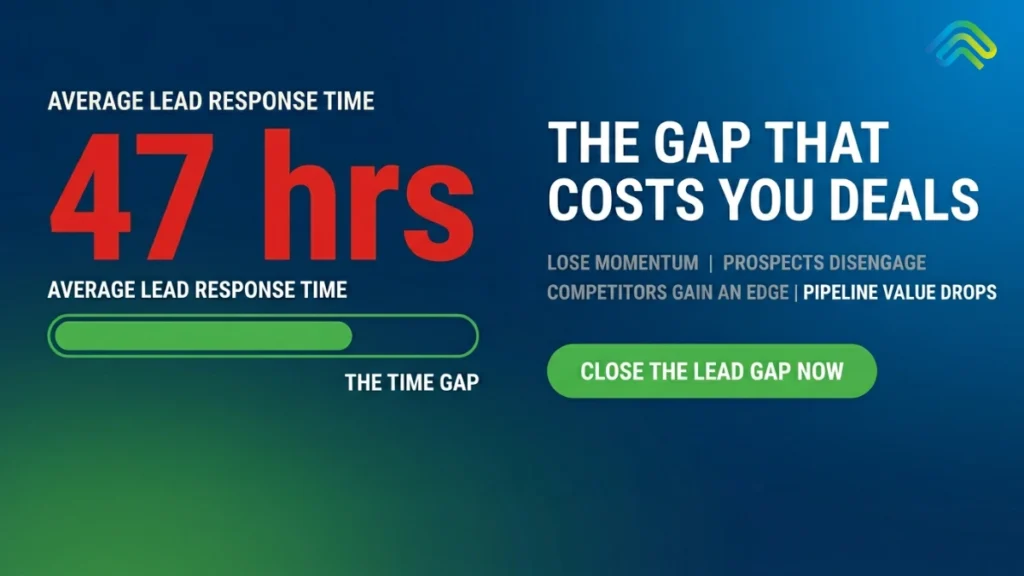
Speed-to-lead in 2026 is still the simplest and most overlooked predictor of revenue performance. It’s Monday morning. You sit down with your coffee, log into your CRM, and see the damage: there are 47 demo requests from the weekend sitting untouched. The oldest one came in on Friday evening. It was a VP of Operations filling out your high-intent form while actively comparing three different vendors. That was 63 hours ago. By the time your SDR sends the first “Just following up” email, she’s already taken two meetings and signed a contract with a competitor. Everyone in B2B sales knows that speed-to-lead matters. It is not a new concept. The data proving that faster response times equal higher conversion rates has been consistent for more than 15 years. And yet, the reality on the ground is astonishing: the average B2B lead response time is still 47 hours, according to the Optifai 2026 Pipeline Study. Only 23% of companies manage to respond within 5 minutes, while a staggering 63% never respond to an inbound lead at all. In this guide, we are going to break down exactly what is happening. We will share the 2026 data that proves why response time still dictates who wins the deal. We will unpack the structural, systemic reasons most revenue teams fail at this despite knowing better. Finally, we will show you how AI-driven revenue execution finally fixes this gap – not by hiring a massive army of new SDRs, but by fundamentally owning the signal-to-action moment. What Is Speed-to-Lead? (And What It Really Measures) If you ask ten sales leaders, “What exactly does ‘speed to lead’ mean?”, you might get ten slightly different answers. Let’s define it in plain, operational language. Speed-to-lead is the exact measurement of time between a prospect submitting an lead form (such as a demo request, a contact form, a pricing enquiry, or a chat initiation) and the moment your sales team makes their first deliberate contact with that prospect by phone, email, or direct messaging. To build a system that works, it is crucial to distinguish speed-to-lead from other related metrics that often get incorrectly lumped together: Most importantly, you have to understand what speed-to-lead actually measures. It does not measure how fast an individual human can type an email. It measures execution discipline. If you achieve a 5-minute response time, it means your entire pipeline machinery – the form submission, the routing logic, the data enrichment, the rep notification, the rep availability, and the first dial – worked flawlessly end-to-end in under 300 seconds. A 47-hour response time means that pipeline broke somewhere along the way, or most likely multiple times. The 2026 Speed-to-Lead Statistics That Should Terrify You If you think your team is immune to the speed-to-lead problem, the industry benchmarks tell a different story. The data for 2026 is unambiguous. When we look at speed to lead statistics, they group naturally into three terrifying narratives: how teams actually perform, what that performance costs in revenue, and what modern buyers expect. The Performance Gap: What Teams Actually Deliver We have more sales technology than ever before, yet our baseline execution remains shockingly slow. The Revenue Impact: What Speed-to-Lead Is Actually Worth  Every minute a lead sits in a queue, the probability of closing that deal plummets. How does speed to lead impact revenue generation? The Expectation Gap: What Buyers Now Demand The consumerization of B2B is complete. Buyers no longer tolerate the “we will get back to you in 1-2 business days” auto-responder. Why Most Teams Fail – And Why It’s Structural, Not Motivational When leaders see the data above, the initial reaction is usually to call a high-urgency sales meeting, yell at the SDR team, and demand they move faster. But this is the wrong approach. The failure is not motivational; it is entirely structural. Speed-to-lead can’t be fixed with a pep talk. To understand why deals decay in a B2B pipeline, we have to look at the five structural failure modes of modern sales environments. Failure Mode 1: Reps Don’t Have 5 Minutes The modern SDR is drowning in administrative tasks. Studies show that SDRs spend only 30% of their actual workday on active selling. The other 70% goes to manual CRM updates, internal meetings, account research, and inbox management. Even the most highly motivated rep cannot physically respond to an inbound demo request in 5 minutes if they are buried inside Salesforce, manually logging detailed notes from their previous discovery call. Speed-to-lead isn’t failing because your reps don’t care. It’s failing because the system they work inside is not built for speed. Failure Mode 2: Routing Logic Breaks When a lead arrives, a massive amount of invisible logic has to execute perfectly. The lead needs to be enriched with external data, scored for qualification, assigned to the correct geographic or vertical territory, and finally routed to a rep who is actually online and available. If even one step breaks – perhaps a routing rule relies on stale territory logic, or the assigned rep is out sick, or an enrichment API times out – the lead drops into a holding queue. Companies with a rigorously defined SLA respond within 15 minutes at nearly double the rate of those without (54.9% vs 29.5%, Blazeo 2026). But in most companies, these SLAs exist on a PDF, not in the actual routing infrastructure. Failure Mode 3: Data Quality Kills Speed Imagine achieving a 3-minute response time, only to dial a disconnected phone number and send an email that hard-bounces. A 5-minute response to a bad record is a 5-minute response to nobody. Currently, 20–35% of B2B contact records contain outdated or entirely incorrect information. Every time a rep rushes to follow up on a bad record, it burns their time and their motivation. Consequently, the next lead in the queue gets less energy and urgency than the last. Fast execution on terrible data is not a strategy. Failure Mode 4: After-Hours and Weekends As noted in

Scroll to Top