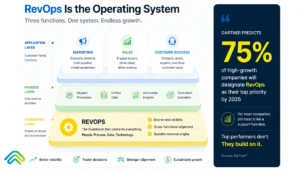

Every working RevOps strategy eventually faces the same uncomfortable truth. Most B2B revenue operations strategies don’t fail because the framework was wrong. They fail because the framework never made it out of the wiki.
In 2025, SpurIQ fixed a Series C SaaS company that missed its Q2 ARR target by 18%. They had world-class RevOps dashboards, clean CRM data, and documented playbooks in Notion. The problem wasn’t strategy. The problem was that reps weren’t consistently following through on signals, and nobody noticed until the quarter was already lost.
This is the execution gap that kills revenue operations strategies. Most B2B companies in 2026 don’t suffer from a lack of frameworks, they suffer from “slideware strategy” that lives in wikis and decks but never makes it into daily workflows.
A strategic framework is essential for aligning teams such as marketing, sales, and finance, driving cohesive growth, and streamlining processes. Organizations often face communication breakdowns between departments, which can impede growth and lead to missed opportunities. A dedicated revops team is crucial for streamlining revenue-related processes, improving workflows, and ensuring compliance across functions. Business leaders play a key role in facilitating strategic execution, accountability, and cross-functional management within revenue operations. By Q1’s end, even the most sophisticated plans have decayed into good intentions.
The distinction matters: system-embedded strategy means playbooks wired directly into tools and triggers. Revenue operations strategy must extend beyond alignment and metrics into an execution layer that turns every insight into a tracked action.
This guide walks through the four pillars that separate RevOps strategies that compound from RevOps strategies that stay theoretical. The first three pillars are well-trodden ground; alignment, data architecture, process discipline. The fourth, the execution layer, is where the winning teams have started spending their attention in the past eighteen months. It’s also where most teams are still leaking revenue without realising why.
What a Revenue Operations Strategy Actually Means
A revenue operations strategy is an operational blueprint for how revenue is generated, monitored, and improved across the entire customer lifecycle. It’s not just about org charts or team structure. It’s a set of decisions about data management, processes, governance, and execution spanning marketing, sales, customer success teams, and finance. The key components of a revenue operations strategy include data, metrics, and analytics, which are essential for accurate sales forecasting, reporting, and performance tracking.
The scope includes lead routing rules, ICP and qualification standards, lifecycle stages, handoff SLAs, compensation guardrails, and feedback loops from first touch to renewal. A revenue operations strategy connects teams, systems, and processes to ensure effective execution of go to market plans, allowing every function to work from the same structure and definitions. Integrating and sharing accurate customer data across marketing and sales tools is crucial for better decision-making and delivering seamless customer experiences.
This contrasts with traditional go to market strategy, which focuses on who you sell to, what you sell, and why it matters. Revenue operations strategy answers the “how”: how does the system actually run day to day, and what happens when it doesn’t? Establishing clear principles helps reinforce the decision making process and shapes the company’s culture and structure.
A well-structured revenue operations strategy provides a framework that defines how teams interact, what systems they use, and how information flows between groups. Successful revenue operations strategies can enhance collaboration across departments by aligning revenue teams around shared goals, breaking down silos, and improving the buyer experience. This alignment can be achieved through regular meetings and collaborative projects. Avoiding poor customer experiences is a critical goal, as managing the entire customer journey ensures a seamless experience and prevents revenue loss.
Here’s a concrete example: in 2024, a B2B infrastructure startup cut their quote-to-close cycle from 56 to 34 days by redesigning approval workflows and SLAs under a unified RevOps strategy. Revenue operations strategies can lead to predictable business growth by ensuring consistent inputs, shared systems, and repeatable actions. Governance and processes are supported by business rules, with automated checks helping maintain compliance standards and protect profit margins.
Also Read: Deal Risk Scoring: How AI Detects Stalled Deals Before Leadership Notices
The 4 Pillars of a Working RevOps Strategy
Most mature RevOps models converge on four practical pillars that connect strategy to outcomes. These pillars transform abstract alignment into measurable results. Today, a new framework—such as the CAT4 framework—replaces fragmented processes with centralized, real-time visibility and accountability, enabling better decision-making and operational excellence.
The four pillars are:
- Data & Systems Foundation – The unified, reliable data layer
- Process & Governance – Workflows, SLAs, and ownership definitions
- Insights & Planning – Metrics, forecasting, and feedback loops
- Execution Layer – System-driven triggers and automations
Pillars 1–3 dominated RevOps content and tooling from 2018–2024. But pillar 4, the Execution Layer, is where outperformance comes from in 2026. Companies can have clean CRMs but inconsistent follow-up. Detailed playbooks that reps don’t use. Great board metrics that don’t change field behavior. Implementing standardized processes and clear ownership within teams can significantly enhance collaboration and ensure all departments are aligned towards common goals. Marketing operations, in particular, transforms marketing from a cost center into a revenue driver by connecting every campaign directly to business outcomes, ensuring that marketing efforts contribute to growth.

Pillar 1 — Data Management and Systems Foundation
The data foundation establishes a single source of truth for all revenue operations. Without it, every downstream process breaks down into data silos and conflicting reports. Integrating customer data across marketing and sales tools is essential for providing real-time insights that drive better decision-making and personalized engagement.
What belongs in this pillar:
- Core systems: CRM (Salesforce or HubSpot), marketing automation (Marketo, HubSpot), customer success platform (Gainsight, Zendesk), product usage data (Segment), billing/ERP (Stripe, NetSuite)
- Data warehouse: Snowflake, BigQuery, or Redshift for aggregating events across systems
- Standardized schemas: Clear definitions for accounts, contacts, opportunities, lifecycle stages, MQL/SQL criteria, and pipeline sources with dates and owners mandated
- Marketing data: Managing and analyzing marketing data helps identify trends and informs strategic decisions to optimize marketing efforts.
In 2025, a PLG SaaS company unified Segment events, Stripe billing, and Salesforce into a single account 360 view. This enabled usage-based expansion plays that lifted NRR by 15–20%. Coordinating efforts across multiple departments ensures seamless data flow and campaign execution, supporting consistent processes and resource management.
The non-glamorous work matters most: deduplication (often reducing 15–25% duplicates), enrichment rules, field governance (RevOps approves new fields to prevent sprawl), and change management for new integrations. The adoption of new systems streamlines revenue operations and improves forecasting accuracy. Automating routine tasks and repetitive tasks in these processes improves workflow efficiency and frees up time for strategic activities.
Pillar 2 — Process and Governance
This pillar translates go to market intent into explicit workflows, SLAs, and ownership. Effective team collaboration requires a shift from report-out meetings to debate-in meetings centered on objective data, fostering transparency and accountability.
Core processes to define:
- Lead lifecycle and routing (geography-based, ICP-matched, response SLAs)
- Opportunity creation and stage definitions with exit criteria
- Deal desk and approvals workflows
- Onboarding and QBR cadence
- Renewal and expansion workflows
- Developing and optimizing marketing processes to ensure efficiency, automation, and standardization across the organization
Establishing clear Service Level Agreements between marketing, sales, and customer success helps define ownership and lead handoffs. Written RACI matrices should cover key revenue motions—who owns lead scoring, disqualification reasons, and stage progression.
Governance rhythms include weekly pipeline reviews, monthly go to market council meetings, and quarterly post-mortems that actually change rules in the stack. Automated checks against business rules help maintain compliance and protect profit margins, ensuring efficient and independent sales processes. Monitoring performance through regular reviews and using insights to refine processes is essential for continuous improvement.
A well-structured marketing operations process ensures resources are allocated effectively based on thorough audits of current processes and identified gaps, campaigns are executed on time, and performance metrics are accurately tracked. It is also crucial to measure performance to optimize campaigns and workflows.
Concrete result: tightening a 2-hour SLA on SDR-to-AE handoffs improved lead-to-opportunity conversion by 22% in one quarter. Aligning revenue teams around shared goals breaks down silos through regular meetings and collaborative projects.
Pillar 3 — Insights and Strategic Initiatives Planning
This pillar operationalizes metrics into adaptive planning cycles—not static dashboards that nobody references after the board meeting. Strategic planning plays a crucial role in developing long-term marketing strategies and aligning daily activities with overall business objectives. Predictive analytics in RevOps utilizes AI-driven models to improve revenue predictions by analyzing historical data and market trends, enabling teams to make strategic decisions based on integrated data and insights.
Analytics scope includes leveraging marketing data to identify trends and uncover growth opportunities:
| Metric | Target/Benchmark |
| Pipeline coverage | 3–4x quota |
| Stage conversion | 40% SQL-to-close |
| Win rate by segment | 28% enterprise, 45% SMB |
| Sales cycle | < 90 days |
| NRR/GRR | >110%/120% |
| CAC payback | < 12 months |
RevOps drives annual revenue target modeling, territory and quota design, and capacity planning using real historical conversion benchmarks. A well-built revenue operations strategy enhances forecasting accuracy by standardizing data inputs, defining qualification criteria, and tracking activity tied to expected outcomes. The use of marketing data for analysis and optimization is essential for informing these processes.
Specific feedback loops matter: lost-deal analysis feeds messaging tweaks (lifting win rates 5–8 points), NPS and product usage analysis fuels expansion plays. Mapping the entire customer journey helps identify gaps and bottlenecks in the sales process. Forecast accuracy itself becomes a RevOps KPI—mature teams target >85%.
Planning cycles must remain flexible to adapt to changing market conditions and market changes, ensuring strategic alignment and responsiveness to external factors. By 2026, teams rely on near real time visibility with hourly pipeline health checks to adjust plays weekly, not quarterly.
Pillar 4 — The Execution Layer: Turning Strategy into Daily Actions
A working RevOps strategy requires a dedicated execution layer that operationalizes decisions directly in tools and workflows. This is where most revenue operations strategies fail—not in planning, but in the daily discipline of acting on signals.
The execution layer means system-driven triggers, automations, and guided workflows ensuring the next best action is surfaced and executed. Automating routine tasks and repetitive workflows increases efficiency, improves team performance, and allows teams to focus on strategic initiatives rather than getting bogged down in busy work. This shift not only enhances sales performance but also leads to faster execution and more creative campaign development.
Common symptoms when this layer is missing:
- Forgotten inbound handraisers (40% drop-off without automation)
- Stalled opportunities with no contact for 30+ days (25% pipeline decay)
- Customer risk signals ignored until renewal
- Playbook adoption hovering under 30%
Components of a working execution layer include signal ingestion (intent, product usage, website behavior), playbook orchestration (what happens when signal X appears), task and outreach automation, and manager visibility into execution coverage and gaps. Optimizing customer engagement through these processes drives better relationships and revenue outcomes.
SpurIQ is the revenue execution platform purpose-built for this layer. We sit on top of your existing GTM stack—Salesforce, HubSpot, Outreach, Gong—and operationalize the strategies your RevOps function has already designed.
- Lead IQ executes signal-led outbound automatically: detects the signal, enriches the contact, drafts contextual outreach, routes through your sequencer. Coverage jumps from 40% manual to 90% automated.
- Deal IQ executes deal follow-through: surfaces stalling deals, drafts re-engagement, updates CRM, alerts managers when next steps slip.
The result is reliable execution visibility for leadership. You can see not only “pipeline created” but also “percentage of high-intent signals actioned within 24 hours” and “coverage of required follow-ups per stage.” Tracking sales performance and leveraging data driven decisions at this stage helps improve outcomes and ensures continuous optimization.
The technical architecture uses AI revenue action orchestration—a central engine pulling from CRM, CS, and product data for dynamic routing and content generation. Organizations report a 10–20% increase in sales productivity when implementing effective RevOps strategies with this execution discipline.
A 2025 case: a 200-rep B2B SaaS org improved forecast accuracy from 62% to 82% and increased win rate by 5 points after automating follow-through on multi-threading, next steps, and renewal risk signals via SpurIQ. These practices help improve performance across the revenue cycle.
Philosophically, the strategy should live in the work, not the wiki. When a new rule is agreed in a pipeline review, it’s encoded as a new automation in SpurIQ the same week. Marketing operations transforms marketing from a cost center into a revenue driver by connecting every campaign directly to business outcomes. Ensuring all teams move in the same direction is critical to avoid poor customer experiences and maximize revenue.
Also Read: From Signal to Action: The Missing Layer in Modern GTM Stacks
Tools and Platforms Map for Modern RevOps
The 2026 RevOps landscape is layered: data, systems of record, enablement/intelligence, and execution.
| Layer | Tools |
| Data & storage | Snowflake, BigQuery, Redshift, Segment CDPs |
| Systems of record | Salesforce, HubSpot, Zendesk, Gainsight |
| Engagement & enablement | Outreach, Salesloft, Gong, Highspot, Chili Piper |
| Intelligence | Looker, Tableau, Mode, forecasting platforms |
| Execution | SpurIQ |
SpurIQ sits in the execution layer, orchestrating actions across these tools rather than replacing CRM, enablement, or analytics platforms. Tool selection guidance: avoid redundant platforms, ensure open APIs, prioritize tools that can both read and write to CRM so RevOps can embed playbooks directly. AI investment is increasingly important, as integrating AI-powered tools enhances decision-making and streamlines go-to-market processes.
When integrating systems, focus on improving customer relations by providing a comprehensive view of customer data and interactions. Proper integration not only enhances collaboration but also reduces operational costs by approximately 30% through the elimination of redundant efforts across departments.
The most common missing category in 2024–2026 stacks is the dedicated execution layer connecting insights to automated, measurable actions. The revops team plays a critical role in selecting, integrating, and managing these tools to ensure seamless workflows and maximize revenue impact.
Also Read: Tool Sprawl Is Killing Your Sales Team: How to Consolidate Without Losing Power
How to Measure RevOps Strategy Success
RevOps ROI isn’t more dashboards, it’s improved revenue predictability, efficiency, and resilience. Companies with aligned revenue teams can experience revenue growth up to 19% higher than those without a RevOps function.
Core KPIs with concrete definitions:
- Forecast accuracy: Mature teams >85% vs. 60–70% for peers
- Pipeline velocity: Lead-to-close days (target 20–30% reduction)
- Win rate by segment: +5–10 points improvement
- NRR/GRR: >110%/120% targets
- CAC payback: < 12 months
- Sales cycle length: Target 25% reduction
Aligning teams around shared revenue goals and business goals is essential for driving growth and measuring success. Key metrics in RevOps include Net Revenue Retention, Customer Lifetime Value, Customer Acquisition Cost, and Annual Recurring Revenue. Distinguish between activity KPIs (emails sent, calls made) and execution quality KPIs (signal coverage >90%, SLA adherence 95%, next-step completion 85%).
Build a simple RevOps scorecard reviewed monthly: 5–7 metrics, green/yellow/red thresholds, clear owners. SpurIQ’s reporting serves as the source for execution metrics, enabling better decision making.
Also Read: Speed-to-Lead in 2026: Why Response Time Still Wins (And How AI Fixes It)
90-Day RevOps Maturity Roadmap
If you’re building or restructuring a RevOps function, here’s the sequence that works. Not the only sequence. The one that survives contact with reality.
Days 1–30: Assess and stabilize
- Run a stack and data audit (CRM health, lifecycle definitions, routing rules)
- Document current funnels and conversion rates (typically 25–35% baseline)
- Identify 3–5 high-impact breakdowns and assign temporary owners
To create a successful revenue operations strategy, organizations should identify inefficiencies in their revenue operations processes and conduct an audit of current workflows to understand where improvements are needed. Use the audit findings for allocating resources effectively, ensuring that efforts are focused on the most critical gaps to enhance overall performance.
Days 31–60: Redesign and align
- Redefine lifecycle stages, handoff SLAs, and stage exit criteria
- Stand up governance cadence: weekly pipeline meeting, monthly RevOps council
- Align on KPIs and create first RevOps scorecard covering pipeline, win rate, NRR, forecast accuracy
During this phase, focus on identifying growth opportunities through strategic planning and market research, ensuring that redesign and alignment efforts are guided by areas with the highest potential for expansion.
Days 61–90: Operationalize and execute
- Implement first automated plays in the execution layer (signal-led outbound, stalled-deal follow-ups, renewal risk alerts)
- Integrate SpurIQ with Salesforce/HubSpot and engagement tools to orchestrate plays end-to-end
Coordinate efforts across multiple departments to ensure successful implementation and seamless execution of new processes.
Implementing a revenue operations strategy involves changing how an organization thinks, collaborates, and makes decisions. Ninety days establishes foundations and proves impact (10–20% improvement in SLA adherence), but full RevOps maturity typically takes 12–18 months for sustainable growth.

The Bottom Line
Revenue operations strategy in 2026 isn’t about better frameworks. The frameworks already exist. There are entire industries built around teaching them, certifying them, and consulting on them. The strategy layer is solved.
What’s not solved is the execution layer. Every RevOps function eventually faces the same hard truth; alignment, data architecture, and process discipline matter, but without something that turns them into reliable behaviour at the moment of execution, they remain theoretical. The strategy lives in the wiki. The work happens (or doesn’t) on rep memory.
The teams winning in 2026 are the ones who closed the strategy-execution gap. They built the orchestration layer that makes the framework operational. Their forecasts hold because their data reflects reality. Their processes are followed because the system enforces them, not because reps remember. Their RevOps function delivers on its strategic mandate because the layer between strategy and outcome finally exists.
If you’re building or restructuring a RevOps function this year, this is the part to get right. The other three pillars are necessary. The execution layer is what makes them sufficient.
SpurIQ is the execution layer your RevOps strategy needs to actually deliver. See how it works.
Revenue Operations Strategy FAQs:
What is a revenue operations strategy?
A revenue operations strategy is the cross-functional blueprint for how sales, marketing, customer success, and finance coordinate to generate and retain revenue. It acts as a strategic framework that integrates all revenue-related functions, ensuring alignment across departments. It covers four pillars: data and systems, process and governance, insights and planning, and the execution layer. A complete strategy addresses all four to drive business growth.
How is RevOps different from sales operations?
Sales operations focuses on sales rep productivity, territory management, and deal support. RevOps spans the full lifecycle from first touch through renewal and expansion, including marketing operations and CS processes. It ensures all departments work toward the same goals.
What’s the difference between revenue intelligence and revenue execution?
Revenue intelligence surfaces what’s happening; call analysis, forecast risks, customer behavior signals. Revenue execution takes action on these insights automatically, routing tasks, drafting outreach, and enforcing SLAs. SpurIQ is the revenue execution platform connecting intelligence to action.
What’s a marketing operations framework?
It’s the subset of RevOps covering MQL definitions, campaign operations, lead lifecycle, attribution models, and MarTech governance. Marketing operations should align marketing strategy with the overarching business strategy and the overall revenue cycle, ensuring marketing campaigns map directly to pipeline and revenue streams.
What’s a business operations framework?
A higher-level operating model including RevOps alongside finance ops, people ops, and product ops. RevOps plugs into BizOps via shared planning cycles, budgeting, and board-level reporting to support organizational objectives.
How long does it take to build a working RevOps function?
Realistic timeline: 90 days to establish foundations and show early wins, 6–9 months to re-platform or unify data if needed, 12–18 months to reach full maturity. Many businesses underestimate the continuous improvement required for long term growth.
What’s the best RevOps tool stack?
No single best stack exists, but essential categories include CRM, marketing automation, CS platform, BI, and an execution layer. The most commonly missing category is execution, teams should look for platforms capable of AI-driven action orchestration to optimize workflows across the existing stack. Integrating these systems is crucial, and a dedicated RevOps team plays a key role in managing and streamlining these integrations for maximum efficiency.
How do you measure RevOps ROI?
ROI shows in improved forecast accuracy, faster pipeline velocity, higher NRR, and shorter CAC payback. Forrester research indicates mature RevOps orgs grow revenue 19% faster and see 15% higher profitability. An execution-focused strategy with platforms like SpurIQ enables these gains through informed, data driven decisions and resource allocation.