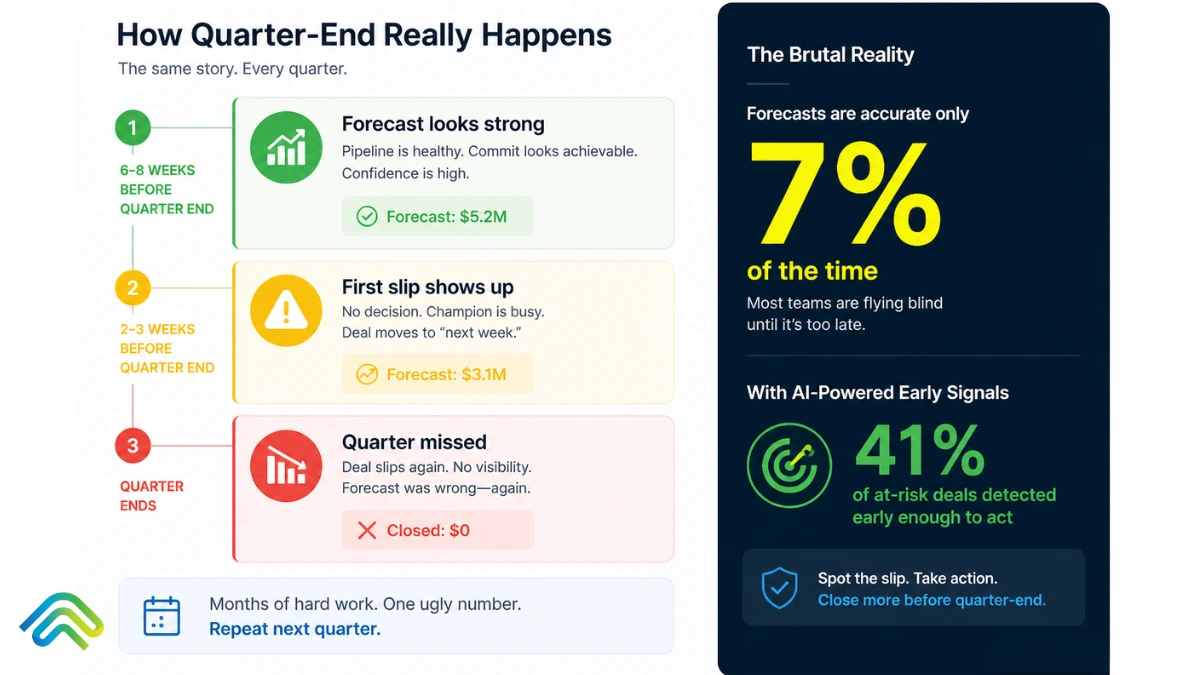
It’s the second Friday of the third month of the quarter. Your forecast says you’ll hit 102% of the plan. By the following Wednesday, three deals have slipped to next quarter. By Friday, that’s seven. The forecast was built on rep optimism, last week’s activity logs, and a CRM that updated when someone remembered to update it. Nobody saw the deal stall. Nobody could.
Your VP Sales says it’s a timing issue. The reps say the buyer went quiet. The CRO knows what really happened: the deals were dying for weeks. Nobody had the system to see it.
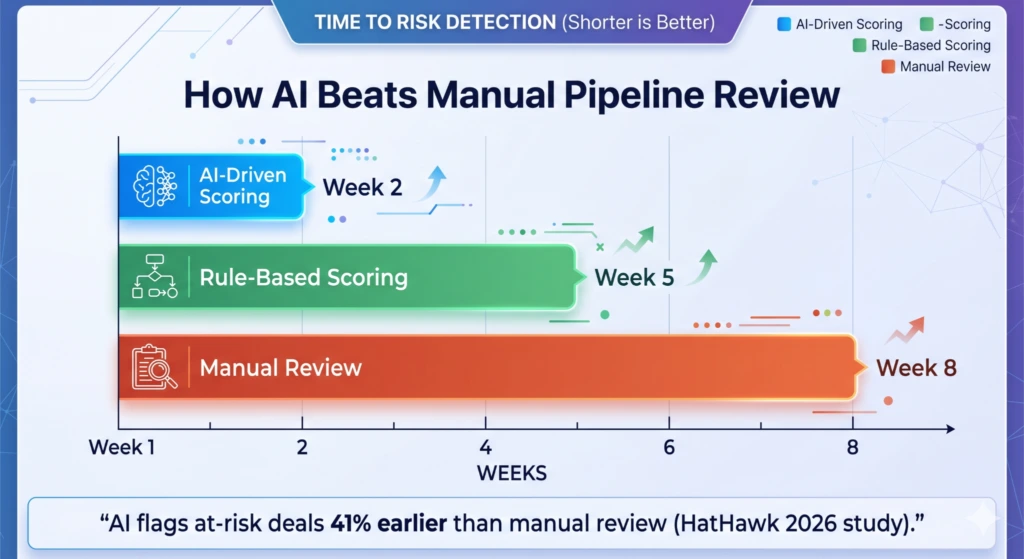
This quarter-end scramble is a universal pain point, and the data proves it. Only 7% of sales organizations achieve 90%+ forecast accuracy (Gartner Research). The median sits dangerously at 70–79%, and 69% of sales operations leaders say forecasting is becoming harder, not easier. Meanwhile, AI deal risk scoring – when properly implemented – flags at-risk deals 41% earlier than manual reviews and identifies up to 89% of deal failures before they happen.
In this guide, we will break down exactly how this works. We will cover what deal risk scoring actually is, the hidden signals AI tracks that humans consistently miss, the proven framework for implementing it, and what separates the platforms that simply score risk from the platforms that actually save deals.
What Is Deal Risk Scoring? (And Why Static Scoring Stopped Working)
Deal risk scoring is a data-driven, systematic method for evaluating the health of sales opportunities. It assigns a numerical score to each open deal based on weighted indicators of risk, moving forecasting away from subjective rep gut-feel to an objective, evidence-based assessment.
To understand where we are today, you have to look at the three generations of scoring approaches:
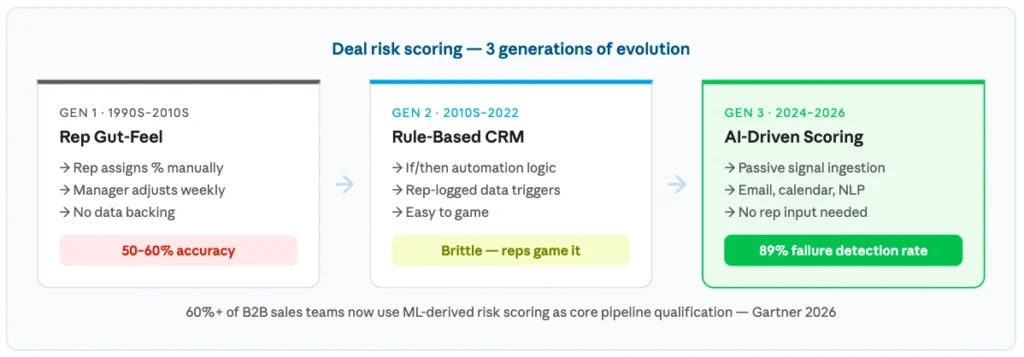
Generation 1: Rep Gut-Feel Forecasting (1990s–2010s)
For decades, forecasting relied on salespeople assigning probability percentages to deals (“I feel 70% confident this will close”). Managers would interrogate these numbers weekly in pipeline reviews, adjusting them up or down based on experience. The forecast accuracy rarely broke 50–60%. The core failure mode here is human nature: account executives are systematically, inevitably over-optimistic about their own deals. They have to be to survive in sales, but that optimism destroys pipeline predictability.
Generation 2: Rule-Based CRM Scoring (2010s–early 2020s)
As CRMs matured, RevOps teams tried to enforce logic. They built rule-based automation: If a deal has been in Stage 3 for 30 days, reduce probability by 10%. If there has been no logged activity in 14 days, flag the deal as yellow. While a step forward, this approach was brittle. It relied entirely on reps manually logging data. Reps quickly learned to “game” the system by sending a meaningless check-in email simply to reset the 14-day activity timer, creating a false sense of deal health.
Generation 3: AI-Driven Deal Risk Scoring (2024–2026)
Modern deal risk scoring doesn’t ask the rep for input; it passively ingests truth. AI models connect directly to the execution layer – email inboxes, calendar systems, Zoom recordings, and marketing engagement platforms. It analyzes the unstructured data (what the buyer is actually saying and doing) to assess risk objectively, in real time.
Why the shift matters now: By 2026, over 60% of B2B sales teams use ML-derived intent and risk scoring as a core component of pipeline qualification (Gartner Market Prediction for Revenue Intelligence Platforms). The shift from rep self-reporting to evidence-based scoring isn’t a future trend – it is the new baseline for any competitive revenue organization.
How AI Actually Detects Stalled Deals (The Six Mechanisms)
The reason AI vastly outperforms human managers in pipeline reviews isn’t magic; it is processing capacity. A sales manager can review the last three emails on a deal. An AI model can review the last three years of successful deal patterns and cross-reference them against every micro-interaction happening today.
Here are the six mechanisms AI uses to detect risk:
Mechanism 1: Engagement Velocity Tracking
AI doesn’t just look at whether an email was sent; it looks at the pace of the response. If a prospect historically replies to emails within 4 hours, and that response time slowly stretches to 12 hours, then 24 hours, then 48 hours – the AI flags the velocity decay weeks before the rep realizes they are being ghosted.
Mechanism 2: Multi-Threading Analysis
Enterprise deals require consensus. AI maps the communication graph to identify single-threaded vulnerabilities. If a $150K software deal only features back-and-forth communication with a mid-level manager, and the VP or IT Director hasn’t been cc’d or attended a meeting in three weeks, the AI spikes the risk score. It knows the historical win rate for deals with only one active stakeholder.
Mechanism 3: Stage Progression Pattern Matching
Every organization has an ideal deal velocity. AI analyzes your historical closed-won and closed-lost data to build a predictive timeline. If a deal sits in “Technical Validation” for 18 days, and the AI knows that 92% of deals that sit there for more than 14 days eventually fail, it immediately surfaces the risk.
Mechanism 4: Sentiment and Urgency Tracking
Using Natural Language Processing (NLP), AI reads the emotional and linguistic shifts in buyer communication. It detects when collaborative language (“how do we implement this?”) shifts to defensive or evasive language (“we are still reviewing internally”). It also tracks urgency decay – noticing when a buyer stops using time-bound words and starts using passive deferrals.
Mechanism 5: Close Date Reliability Scoring
Sales reps are notorious for pushing close dates to the last day of the month or quarter. AI evaluates the probability of that close date based on the remaining steps required. If the close date is in 10 days, but the AI sees that security review hasn’t started and legal hasn’t received a contract, it marks the close date as mathematically impossible and adjusts the forecast.
Mechanism 6: Buyer Process Monitoring
AI watches the buyer’s internal mechanics. Did they bring in procurement at the expected milestone? Have they shared the technical documentation internally? By monitoring document views and internal forward tracking, AI knows if the buyer is actually working on the deal when the rep isn’t in the room.
The 12 Signals AI Watches (And Humans Miss)
Humans suffer from confirmation bias; they look for signs that a deal is going to close. AI looks for deviations from the successful baseline. Here are the 12 specific signals that predictive models watch to catch deals before they fall apart.
| Signals | What AI Watches | Why Humans Miss It |
| Buyer-initiated contact | Days since prospect proactively reached out vs your team chasing | Reps see their own outreach as engagement |
| Email response velocity | Trend in reply time over rolling 2-week window | Manual review only sees the last reply, not the trend |
| Content engagement decay | Open rates, link clicks, document review time on shared assets | Hidden in marketing platforms, not surfaced in CRM |
| Stakeholder dropout | Decision-makers who attended early calls but missed recent ones | Reps don’t notice absence – only presence |
| Sudden formality shift | Communication tone moving from casual to corporate | Subtle linguistic patterns invisible to humans |
| Meeting cancellation rate | Frequency of buyer-initiated reschedules in last 30 days | Each cancellation looks reasonable in isolation |
| Multi-threading depth | Number of engaged stakeholders vs deal value norm | Single-thread risk only obvious in retrospect |
| Stage time vs historical | Days in current stage vs your closed-won baseline | No memory of historical patterns at scale |
| Champion engagement decline | Drop in champion’s response rate or meeting attendance | Champions are often invisible to the rep until they leave |
| Procurement involvement timing | Did legal/procurement engage at the expected stage? | Easy to assume buyer is just busy |
| Competitive language presence | Mentions of competitors in recent buyer communication | Reps overweight first-meeting competitive intel, ignore late-stage shifts |
| Buyer urgency language shift | “ASAP” → “soon” → “when we get to it” pattern in messaging | Urgency erodes gradually; humans calibrate slowly |
Also Read: From Signal to Action: The Missing Layer in Modern GTM Stacks
Why Detecting Risk Isn’t the Same as Stopping It
Here’s what most deal risk scoring content gets wrong: it treats detection as the destination. It is not. Detection is the starting line.
The Detection-to-Action Gap
Imagine the most sophisticated deal risk scoring system possible. It detects, in real time, that a $250K deal is at risk: the buyer’s VP of Engineering has gone silent for 11 days, sentiment in the latest email shifted from collaborative to neutral, and the procurement contact hasn’t been engaged despite the deal being three weeks from projected close.
The system surfaces this in a beautiful dashboard. A red flag appears. A risk score updates from 78 to 41. An alert fires.
Now what?
In most teams: nothing. The alert goes to a manager who already has 47 other red flags this quarter. The rep is currently focused on three other deals. The dashboard is reviewed in the next pipeline meeting – four days later. By the time someone takes action, the buyer has moved on.
Why This Happens
Detection platforms answer the question “which deals are at risk?”. They don’t answer “what do we do about it, and who does it, and when?”. The risk score is information. It only becomes valuable when it triggers an action that changes the outcome.
The data is sobering: even teams with sophisticated risk scoring still lose ~40% of flagged at-risk deals because the gap between flag and intervention is too long. The flag was right. The action came too late.
What Actually Saves Deals
The teams who beat their forecast in 2026 aren’t the ones with the best dashboards. They’re the ones who closed the gap between detection and intervention. A risk flag that triggers an automated draft email to the silent buyer, a calendar nudge to the rep, an escalation to the manager, and a CRM update – all in under 15 minutes – saves deals at 3x the rate of a flag that sits in a queue waiting for human action.
This is where revenue execution earns its place. SpurIQ detects deal risk across your existing stack, CRM activity, email engagement, calendar data, conversation intelligence – and turns the risk score into executed action automatically. When a deal flags red, SpurIQ doesn’t just notify the rep. It drafts the re-engagement email in the buyer’s context, schedules the follow-up, alerts the manager with full deal history, and updates CRM – all in one workflow. Detection and execution stop being separate problems. The signal becomes the action. You stop deal slippage, protect quarter-end revenue, and close more of what you’ve created through one revenue execution platform that delivers system-driven deal follow-through and risk detection with executed action.
How to Implement Deal Risk Scoring (The 5-Step Framework)
If you are a CRO or RevOps leader looking to transition from gut-feel forecasting to systemic risk detection, follow this five-step implementation framework to ensure your rollout actually impacts revenue.
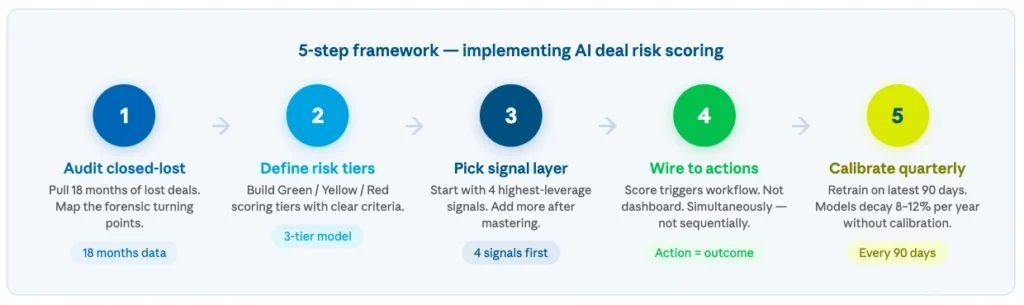
Step 1: Audit Your Closed-Lost Deals (Last 18 Months)
Before you can score risk, you need to know what risk looks like in your specific market. Pull the last 18 months of closed-lost data. Look for the turning points. Did deals die because champions left? Did they stall out during the security review? Map the exact forensic moments when successful momentum turned into a stalled deal.
Step 2: Define Your Risk Categories (Green / Yellow / Red)
Simplicity scales. Group your risk scores into actionable tiers.
- Green (Healthy): High engagement, multi-threaded, progressing faster than historical averages.
- Yellow (At-Risk): Velocity is slowing, single-threaded communication, sentiment shifting to neutral.
- Red (Critical): Ghosting, missed milestones, impossible close dates.
Step 3: Pick Your Signal Layer
Don’t try to track all 12 signals on day one. Complexity is the enemy of adoption. Start with the four highest-leverage indicators:
- Stage time vs historical: Catches 50% of stalls early.
- Multi-threading depth: Catches single-threading risk in late-stage deals.
- Buyer-initiated contact decay: Catches engagement loss before sentiment shifts.
- Email response velocity trend: Catches the slow fade most reps miss.
Add the remaining signals once you’ve operationalized the first four.
Step 4: Wire Risk Scores to Actions, Not Dashboards
This is where most implementations fail. A risk score that lives in a dashboard is informational. A risk score that triggers a workflow – draft a re-engagement email, schedule a manager review, escalate the deal, update CRM – is operational. Build the action layer at the same time you build the scoring layer. Don’t treat them as sequential projects.
Step 5: Calibrate Quarterly
Markets change. Buyer behavior changes. Your product evolves. A scoring model trained on Q4 2024 data is degraded by Q3 2026. Run a quarterly calibration: feed the AI the latest 90 days of won/lost outcomes, retrain the model, and check that the new risk scores correlate with actual outcomes. Teams that don’t do this see model accuracy decay 8–12% per year.
Also Read: Speed-to-Lead in 2026: Why Response Time Still Wins (And How AI Fixes It)
The Manager’s Risk Radar, What to Do When a Deal Goes Red?
Technology spots the problem, but leadership often has to execute the save. For Sales Managers and CROs, having a playbook for red-flagged deals is critical.
The 24-Hour Rule
When a deal goes red, action within 24 hours saves it 3x more often than action within a week. The rule is non-negotiable: red flag → 24 hours → intervention. If your team can’t move that fast, the scoring system is decoration.
The Diagnostic Triage
Three questions managers should answer before intervening:
- Why did the score drop? Was it a single signal (champion went quiet) or a pattern (multi-signal degradation over weeks)? Single signals get a tactical response. Patterns get a strategic re-engagement.
- What’s the buyer’s state? Are they evaluating a competitor, deprioritizing the project internally, or experiencing a buyer-side reorganization? The cause determines the response.
- Is the rep equipped to save it? If the deal needs a senior re-engagement (CRO→CRO call, peer reference, executive sponsor), don’t leave it to the rep. Step in.
The Three Most Common Save Plays
- The Champion Re-engagement: If the original champion went silent, find out why directly. Not via the rep – manager-to-champion. Often the silence is internal: the champion lost political support, got reassigned, or never had budget authority.
- The Stakeholder Expansion: If the AI flags a deal as dangerously single-threaded, the manager must instigate a wider conversation. Reach out laterally to other department heads or utilize executive-to-executive multi-threading to bypass a stalled mid-level contact.
- The Honest Reset: When velocity grinds to a halt and urgency shifts, the worst thing to do is send another “just checking in” email. Send a transparent, low-pressure message asking if their internal priorities have shifted. Giving the buyer permission to say “not right now” often breaks the silence and reveals the truth.
Also Read: Signal-Based Outbound vs Cold Outbound: The 2026 Shift Every Sales Team Needs
Deal Risk Scoring Tools – Category Overview for 2026
The market is crowded. Understanding the difference between a tool that listens to calls and a platform that executes revenue workflows is vital.
| Category | What It Does | Best For | Common Vendors |
| Conversation Intelligence | NLP on calls and emails to detect sentiment shifts and risk language | Teams with high call volume and recorded conversations | Gong, Chorus (now ZoomInfo), Otter |
| Revenue Intelligence Platforms | Forecast & deal scoring rolled up across team and pipeline | Mid-market & enterprise CROs needing forecast accuracy | Clari, Aviso, Boostup (now Terret) |
| Activity Capture & Relationship Mapping | Auto-captures activity, maps stakeholder graph, flags relationship gaps | Enterprise teams with complex multi-threaded deals | People.ai, Altify |
| CRM-Native AI Scoring | Built-in deal scoring inside Salesforce / HubSpot | Teams already standardized on CRM, lower complexity | Salesforce Einstein, HubSpot Breeze |
| Revenue Execution Platforms | Detects risk and executes the next best action automatically – enrichment, drafting, escalation, CRM update – in one workflow | Teams where the gap between flag and action is the bottleneck | SpurIQ |
The Bottom Line
Deal risk scoring is the most under-implemented capability in B2B sales. The technology exists. The accuracy is there – 90% of deal failures are detectable weeks before they happen. The business case is unambiguous: 41% earlier risk detection, 95% forecast accuracy, fewer end-of-quarter surprises (Internal study by SpurIQ).
And yet only 7% of sales organizations achieve the forecast accuracy that deal risk scoring makes possible. Most are still running pipeline reviews on rep optimism and last-week’s activity logs. The deals are dying for weeks before anyone notices, and by the time the dashboard turns red, the buyer has already chosen someone else.
The gap isn’t intelligence. It’s execution. Detection is necessary but insufficient. Knowing a deal is at risk doesn’t save it. Acting on the risk – fast, contextually, automatically – saves it.
The teams winning Q4 2026 forecasts aren’t the ones with the most sophisticated dashboards. They’re the ones who closed the gap between flag and action. The risk score is only valuable when it triggers something that changes the outcome.
SpurIQ closes the gap between deal risk and deal action. See how it works and book a demo at spuriq.ai.
Frequently Asked Questions (FAQs):
What is deal risk scoring?
Deal risk scoring is an objective, data-driven method for evaluating pipeline health. It uses historical data and real-time behavioral signals to assign a numerical health score to sales opportunities, moving forecasting away from rep intuition and toward predictable, evidence-based metrics.
How does AI detect stalled deals?
AI detects stalled deals by monitoring unstructured data – email velocity, multi-threading depth, sentiment shifts, and meeting cancellations – across your tech stack. It cross-references current buyer behavior against historical closed-won patterns to identify deviations and flag risk weeks before a human would notice.
What signals indicate a deal is stalling?
Key signals include a decay in buyer-initiated contact, slowing email response velocity, sudden shifts to formal or corporate language, unengaged stakeholders, meeting cancellations, and a reduction in urgency phrasing (e.g., shifting from “ASAP” to “eventually”).
How accurate is AI deal risk scoring?
When properly calibrated and integrated with full activity capture, AI deal risk scoring can identify up to 89% of deal failures before they happen and flags at-risk opportunities 41% earlier than manual pipeline reviews. (Internal study by SpurIQ).
What are the best AI deal risk scoring tools?
The best tools depend on your needs. Gong leads in conversation intelligence, Clari excels at forecast roll-ups, Salesforce Einstein offers CRM-native scoring, and SpurIQ leads in revenue execution by turning risk detection directly into automated follow-up actions.
How do you implement deal risk scoring?
Implementation requires five steps: auditing the last 18 months of closed-lost deals, defining clear risk categories, selecting a manageable layer of high-leverage signals, wiring risk scores to automated workflows rather than static dashboards, and calibrating the model quarterly.
What’s the difference between deal risk scoring and lead scoring?
Lead scoring evaluates the likelihood of a new prospect becoming a qualified opportunity based on demographic and early engagement data. Deal risk scoring evaluates active, mid-to-late stage pipeline opportunities based on ongoing buyer communication, stakeholder engagement, and deal momentum.