Let’s be honest about the promise we were sold over the last ten years. For a decade, Chief Revenue Officers and VPs of Marketing have operated under a comforting, yet entirely flawed, premise: if we can just see the opportunity, we can capture it.
At SpurIQ, we bought into the idea of total visibility. We globally poured billions of dollars into data enrichment platforms, predictive scoring algorithms, and intent tools. We constructed cathedral-like dashboards designed to track every single click, whitepaper download, and whispered demo requests across the internet. Our RevOps teams are leaner, sharper, and more data-savvy than they’ve ever been.
And yet, you can walk into almost any boardroom during a quarterly business review and hear the exact same frustrating question: Why, despite having more data and visibility than ever before, is our pipeline still leaking revenue?
The reality on the sales floor is grim. We are absolutely drowning in signals, but we are starving for action. We’ve spent the last decade perfecting the science of signal detection. We know exactly who is looking at us. But we are still living in the dark ages of signal execution. This gap- this massive, silent void between knowing something is happening and actually doing something about it- is the single greatest bottleneck inside the modern B2B Go-to-Market engine today.
The GTM Stack Has a Signal Problem – And It’s Not What You Think
If you pull a typical GTM leader aside and ask them about their stack’s “signal problem,” they almost always point to the same two culprits. They’ll complain about data quality, or they’ll groan about signal fatigue. They’ll tell you they desperately need better ZoomInfo enrichment to improve accuracy, or they need tighter orchestration rules to quiet the noise.
They fundamentally believe their problem is informational.
They are wrong. The information is fine. It’s the execution that’s broken.
The False Premise of the “Complete” Stack
Most revenue organizations build their technology stacks in a very linear, predictable way. They start by buying a system of record- usually Salesforce or HubSpot. Then, they add a system of engagement, like Outreach or Salesloft, so reps can send emails. Finally, they sprinkle data sources on top: a little Clearbit here, some 6sense intent data there. As Deloitte has extensively documented in their enterprise technology research, buying the technology without rewiring the operational workflow is a recipe for stalled growth. The prevailing myth in our industry is that once you achieve visibility across these different layers, the stack is “done.”
The prevailing myth in our industry is that once you achieve visibility across these different layers, the stack is “done.” The assumption is that if a buying signal successfully makes its way to a sales rep’s desktop, the technology has fulfilled its purpose.
This premise isn’t just naive; it’s practically operational negligence. It assumes that the moment a human being sees an opportunity flash on their screen, they will flawlessly, consistently, and immediately execute the absolute best next step. Anyone who has ever managed a sales team knows this is a fantasy.
“The modern GTM stack is complete up to signal detection and broken immediately after.” – CTO SpurIQ
Introducing the Gap: Signal Detection ≠ Signal Action
Think about what a signal actually is. It’s just a data point. It’s a tiny indication of potential. It is not a closed-won deal. Your current stack is phenomenally good at telling you when a prospect from a tier-one target account visits your pricing page, downloads a case study, or gets flagged by an intent tool as “in–market.”
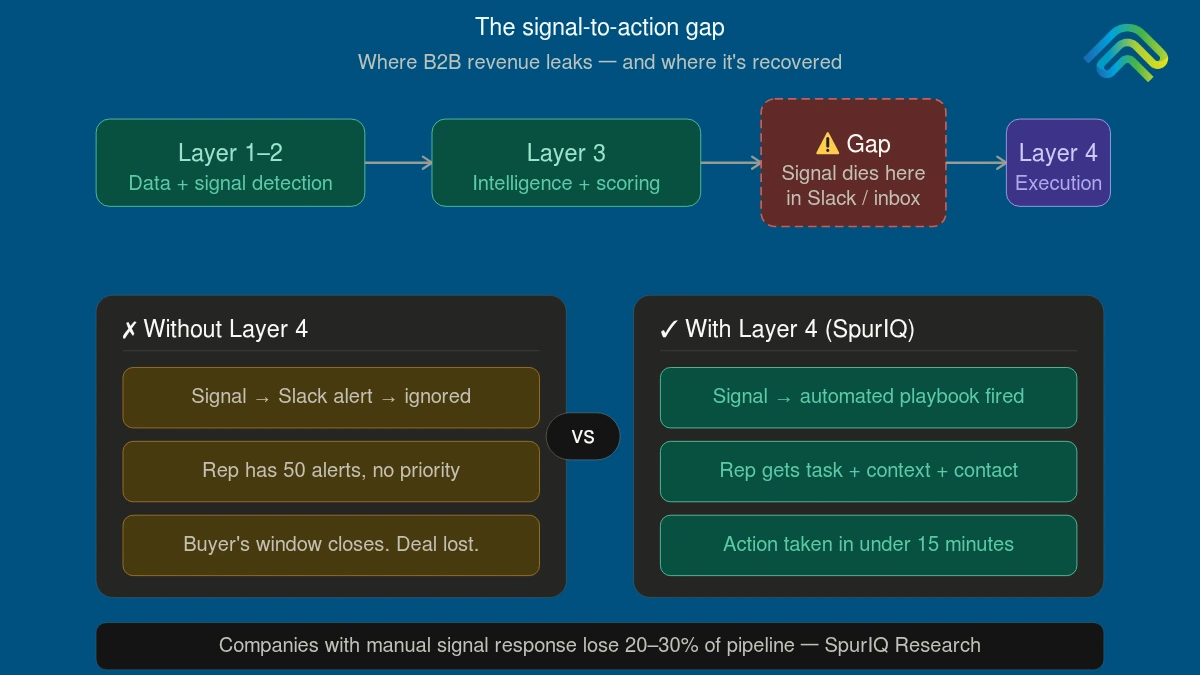
But what happens next? In 90% of B2B organizations, that precious, high-intent signal is delivered as a Slack alert, an email notification, or just another line item on a sprawling Tableau dashboard.
From that moment on, the signal is left entirely to the mercy of human memory. It relies on a rep prioritizing it over their coffee, figuring out the right workflow, manually typing up an email, and remembering to hit send before the prospect’s attention shifts elsewhere.
This is the exact failure point. The tech stack stops the moment the signal arrives, but the actual monetary value is only unlocked when the signal is acted upon. Signal detection is necessary, sure. But signal action is what pays the bills. As McKinsey & Company notes on the future of B2B sales the organizations capturing the most market share are those that can react to customer insights with unprecedented speed. Signal detection is necessary, sure. But signal action is what pays the bills.
What ‘Signal to Action’ Actually Means?
If we want to fix this, we have to stop treating signal response like a random event and start treating it like a rigid operational process. In plain terms, the Signal-to-Action continuum is the specific path a data point travels from the moment your systems detect it, to the exact moment a meaningful business action is executed in response.
This journey always breaks down into three critical stages:
- Signal Detected: The moment the raw data enters your ecosystem. For example, a “G2 Buyer Intent” alert arrives indicating someone is looking at your software category.
- Signal Interpreted: Context is wrapped around the raw data. Who is this account? What pipeline stage are they in? Who is the likely buyer? (e.g., Ah, this is a Fortune 500 account we lost a deal with last year, and they are back in a ‘considering’ stage).
- Action Taken: A specific, trackable, and measurable execution happens. (e.g., An SDR immediately drops the primary contact into a highly personalized “competitor takeout” email sequence).
Where Most Stacks Break Down?
Stage 3 is where the wheels fall off. It’s where 90% of the friction lives and where your revenue leaks out. You likely have incredible, expensive tools for Stage 1 (Intent providers) and Stage 2 (Scoring models). But the bridge connecting Stage 2 to Stage 3? It’s just a manual, rickety rope bridge.
Your stack detects the fire. Your scoring model tells you how big the fire is. And then you hand a plastic bucket to a busy sales rep and just sort of hope they remember the way to the well.
Why the Modern GTM Stack is Built for Visibility, Not Execution?
How did we get here? The current design of the GTM stack is historically biased toward reporting, analysis, and looking backward. We have optimized everything for the view of the funnel, and completely neglected the flow through the funnel.
1. Dashboards Report What Happened – They Don’t Prevent It
The hard truth that many management consultants are hesitant to tell their clients is that dashboards are diagnostic tools, not corrective systems. A thermometer can tell you that you have a fever; it cannot synthesize the penicillin. If your organization is relying on a dashboard to “fix” revenue, you are essentially watching a GPS highlight that you are fifty miles off-route and expecting the screen to turn the steering wheel. A dashboard will elegantly show you that your team only responded to 15% of high-intent signals last quarter. Great. But it did absolutely nothing to help you respond to the 85% you missed at the exact moment they mattered. Dashboards are autopsies. They aren’t preventive medicine.
2. CRM = System of Record, Not System of Action
Your CRM was designed to do one thing really well: store data accurately so your CFO can run reports. It is fundamentally retrospective. Yes, Salesforce has workflow capabilities, but let’s be real- they are clunky, they break easily when handling complex, multi-system signals, and they are rarely optimized for the split-second action required in a modern, signal-driven sales environment. CRMs are built to manage deals. They were never built to manage high-velocity signals.
3. Intent Tools Surface Signals But Own No Workflow
Tools like Bombora or 6sense are brilliant at identifying in-market accounts. They are the ultimate detectives- providing the “what” and the “where.” But they aren’t built to execute the “how.” When you get a “spike” in intent for cloud migration, it’s delivered to you as an insight. It is not delivered as a fully baked, context-aware workflow assigned to a specific account executive.
4. The Human Memory Problem: Reps Can’t Act on 40+ Signals a Day
Put yourself in the shoes of an average SDR. On any given Tuesday, they are bombarded by a chaotic mix of signals: 12 new website visits, 15 LinkedIn post engagements, 4 intent spikes from target accounts, and 18 email opens.
That’s roughly 50 potential signal interactions a day. The human brain literally cannot prioritize these in real-time while also trying to maintain a standard cadence of cold calls and prospecting emails. Expecting a human being to manually process, interpret, and flawlessly action even 20% of these signals is an organizational failure on the part of leadership. It is not a rep failure.
The Layers of a Complete GTM Stack (and What’s Missing)
If we want to build a truly functional, high-velocity GTM engine, we have to move past this visibility-centric obsession and embrace an execution-centric architecture. At the highest levels of consulting, we have formalized this transition into what we call The 4-Layer GTM Stack for the Signal-to-Action Era.
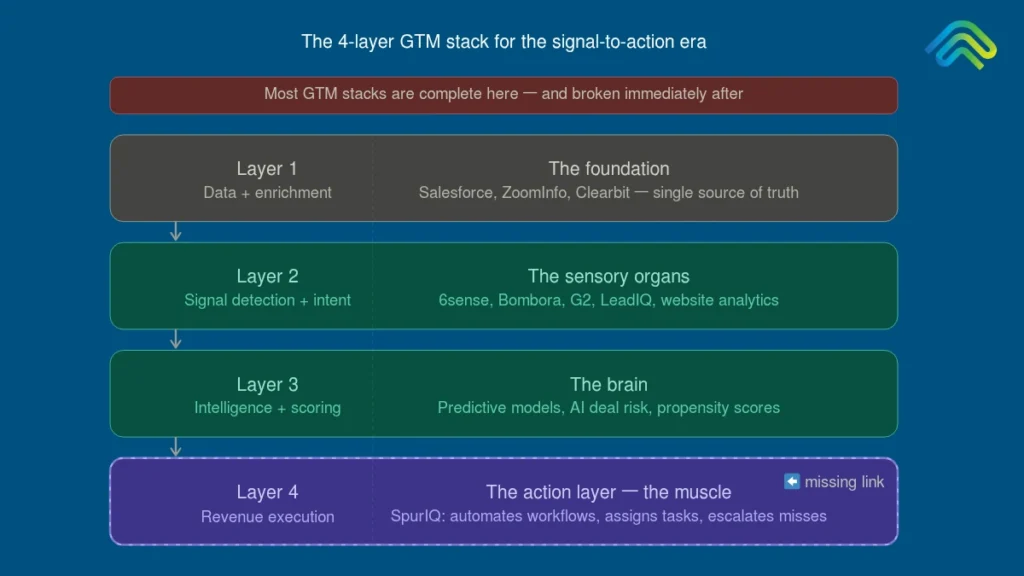
- Layer 1: Data & Enrichment (The Foundation)
- Function: Gather, clean, and enrich your account and contact data.
- Systems: Salesforce, ZoomInfo, Clearbit.
- Purpose: Establish a single source of truth about who exactly you are targeting.
- Layer 2: Signal Detection & Intent (The Sensory Organs)
- Function: Identify behavioral activity and shifts in market context.
- Systems: 6sense, G2, Bombora, LeadIQ, website analytics.
- Purpose: Figure out when is the right time to engage.
- Layer 3: Intelligence & Scoring (The Brain)
- Function: Synthesize those signals, combine them with your data, and determine the account’s propensity to buy.
- Systems: Predictive models, custom scoring, AI deal risk indicators.
- Purpose: Determine why a specific signal matters and rank its priority.
“Consulting leaders now define GTM success by the presence of a ‘4-Layer GTM Stack,’ the final layer of which is Revenue Execution.” – SpurIQ CEO
- Layer 4 (The Missing Link): Revenue Execution – The Action Layer (The Muscle) This is the massive gap in your current setup. This is the connective tissue you are missing.
- Function: Automate the operational workflow triggered by Layer 3 to ensure consistent, immediate, and highly contextualized action.
- Systems: Revenue Execution Platforms (like SpurIQ).
- Purpose: Close the loop entirely. Move from knowing when to engage, to automating how to engage, guaranteeing that the work actually gets done.
What the Action Layer Looks Like in Practice?
When you actually implement an Action Layer, the entire culture of your GTM motion changes. You move away from annoying ‘Slack alerts’ and passive ‘notifications’ and move toward automated playbooks and hard, systemic accountability.
Here is how it fundamentally changes your day-to-day:
- Signals Trigger Automated Workflows: When your intelligence layer determines a signal is a priority ‘A,’ it doesn’t just put a gold star next to it. Layer 4 grabs that account and automatically drops it into your pre-built “Competitor Displacement” playbook.
- Accountability is Assigned, Not Assumed: The system stops “notifying” the rep. Notifications get swiped away. Instead, it assigns a specific, mandatory task (e.g., “Add John Doe to Sequence X“) directly into their Outreach or CRM task queue.
- Follow-through is Tracked, Not Hoped For: Layer 4 acts as a digital manager. It watches the task. If the AE hasn’t actioned a massive intent signal within 4 hours, the system automatically escalates it to the VP of Sales, or instantly reassigns the lead to a hungrier rep.
Real Example: The Pricing Page Loop
Let’s trace a very standard, high-value signal through a traditional stack versus a 4-Layer stack. Imagine a VP of IT from a Fortune 500 target account is looking at your pricing page right now.
- L1 (Data): Your system knows “Company X” is in your ICP.
- L2 (Signal): LeadIQ catches the VP of IT on the pricing page.
- L3 (Intelligence): Your scoring model sees this is an enterprise account with high intent, flags it as “Urgent,” and scores it an A+.
In a normal company, this is where the process dies in a Slack channel.
- L4 (Action): But with a Revenue Execution layer, the engine fires immediately.
- System Action: Instantly pings the LeadIQ API to enrich the contact’s missing phone number.
- Rep Action: Automatically creates a high-priority, blocking task in the Enterprise AE’s Outreach instance: “Pricing page visit: Company X. Execute personalized email. Reference their existing legacy solution and attach our enterprise pricing one-pager.”
- The Result: The rep opens their laptop, sees the task, has the context, has the contact info, and has the email template ready to go. Total time from the buyer looking at the website to the rep taking meaningful action? Under 15 minutes.
Revenue Execution: The Category that Closes the Loop
What we are talking about here with Layer 4 isn’t just a neat little feature update for your CRM. It is an entirely emergent category of GTM technology.
What is Revenue Execution?
Revenue Execution (Rex) is the operational discipline and technology category that automates, monitors, and optimizes the specific workflows triggered by high-intent business signals to ensure consistent, context-aware, and immediate action, thereby maximizing conversion rates and revenue velocity.
It helps to differentiate it from what you already know:
- RevOps (The Strategy): This is your structure. It’s the rules of engagement, the data architecture, and the policy (e.g., deciding how we score leads).
- RevTech (The Systems): The literal software tools sitting in your stack.
- Revenue Execution (The Action): The technology layer that takes your RevOps strategy and forces it into reality by automating the physical actions across your RevTech stack.
Let me be incredibly clear: SpurIQ is not an intent tool. It is not a CRM. And God knows it is not another dashboarding platform. SpurIQ is the Revenue Execution layer. It is the autonomous steering wheel for your revenue engine, bridging the gap between your intelligence (Layer 3) and your engagement tools (Salesloft, Outreach, CRM).
How to Close Your Signal-to-Action Gap?
You can’t buy your way out of this with more data. Closing this gap requires a permanent, structural shift in how you think about revenue operations. Here is your roadmap to move from passive visibility to aggressive execution.
Step 1: Audit the Gap (Map Where Signals Die)
You need to conduct a ruthless, honest “Signal Flow” audit next week.
- Pick your top 5 highest-converting signals (e.g., a “G2 Pricing Page Visit” or a “Contact Us Request”).
- Get in a room and whiteboard the exact journey of that signal from the millisecond it is detected to the moment a rep physically does something about it.
- Find the black holes. Which system is holding the data? Where does a human have to copy-paste something? How many hours pass between detection and action?
“B2B companies with a manual signal response process lose 20–30% of their potential pipeline value in the Signal-to-Action Gap.” – SpurIQ Research Team
Step 2: Assign Ownership at the Signal Level – Not the Deal Level
Right now, your reps own deals. But if you walk onto the floor and ask, “Who owns this intent spike?” everyone will look at each other. You need to build a Signal Ownership Matrix.
- Who owns the “Pricing Page Visit” signal for a Tier A account? (The AE, and the SLA is 30 minutes).
- Who owns a “generic intent spike” for a Tier C account? (The SDR, and the SLA is 12 hours). Stop letting signals float in the ether. Tie them to a name and a stopwatch.
Step 3: Automate Action Triggers Tied to Specific Signal Types
The final step is to burn the manual bridge and replace it with a Revenue Execution platform. The World Economic Forum’s macro-analysis on the future of work highlights that competitive advantage over the next decade lies in automating routine decision-making so humans can focus on complex relationship-building. Here is how you do it:
- Integrate L2/L3: Plug your intent providers directly into your action layer (SpurIQ).
- Define the Playbooks: Build highly specific, automated reactions for your best signals. (e.g., If they look at our competitor on G2, automatically drop them into the “Competitor Takeout” sequence).
- Automate the Assignment: Let the system push the task, the context, and the deadline directly into the rep’s face in their native tool. Remove the guesswork.
Key Takeaways for Leaders:
- Stop buying visibility; start buying execution. Lack of information isn’t killing your quarter. The systematic failure to act on that information is.
- The 4th Layer is mandatory. A tech stack without an execution layer isn’t a revenue engine; it’s just an incredibly expensive monitoring system.
- Human prioritization fails at scale. You cannot ask a 24-year-old SDR to perfectly parse and action 50 complex buying signals a day without automated help. It’s unfair and inefficient.
- Signal ownership > Deal ownership. The real value of a deal is unlocked the moment they show intent. Shift your accountability to the top of the funnel.
- Revenue Execution is the new operational edge. This is the battlefield where the best B2B companies will steal market share over the next five years.
Final Words
We spent the entirety of the 2010s building out the infrastructure of visibility. We succeeded. We can now see every agonizing detail of our market, our prospect accounts, and our pipelines. But we have to admit that this hyper-visibility accidentally created a massive systemic inefficiency: we built eyes, but we forgot to build hands. We lost the ability to act with equivalent velocity.
The Signal-to-Action Gap is not a minor operational hiccup you can fix by yelling at your team to “check Slack more often.” It is a category-level missing layer. Fixing it requires a new mindset and a new technology: Revenue Execution.
Your intent data is screaming. Your buying signals are firing on all cylinders. And your reps are drowning in the noise. SpurIQ is the missing layer designed to finally close the loop.
[SEE HOW SPURIQ FILLS THE MISSING LAYER]
FAQs:
Q. What is the signal-to-action gap in B2B GTM?
The signal-to-action gap in B2B Go-to-Market (GTM) refers to the systemic failure and time delay that occur between identifying a high-value prospect interaction (signal) and the actual execution of a context-aware sales or marketing activity. This gap is the core cause of revenue leakage in modern stacks, as they are optimized for signal detection rather than signal execution.
Q. Why don’t intent tools fix revenue execution?
Intent tools (like G2 or 6sense) identify opportunities but are not designed to execute the response. They deliver intent signals as notifications or data points, leaving the prioritization, workflow creation, and follow-through to manual human processes. Intent tools are sensory organs, not the active muscles required for revenue execution.
Q. What is the revenue execution layer in a GTM stack?
The Revenue Execution layer (often automated by platforms like SpurIQ) is the “muscle” of the GTM stack that connects intelligence/scoring insights to the native engagement platforms of sales reps. It automates the operational workflows triggered by high-intent signals, ensuring context-aware playbooks are deployed consistently and with hard accountability, closing the loop between insight and action.
Q. What is a Revenue Execution Platform (REP) and how is it different from a CRM?
A CRM stores deal data retrospectively. A Revenue Execution Platform like SpurIQ automates the operational workflows triggered by live intent signals, pushing contextualized tasks directly into a rep’s queue before the buying window closes.
Q. How long does the average B2B company take to respond to a high-intent signal?
Most B2B organizations take 24–72 hours to manually respond to intent signals like pricing page visits. Research suggests that response within the first 5 minutes increases conversion likelihood by over 80%.
Q. What is signal fatigue in sales and how do you fix it?
Signal fatigue occurs when reps receive more alerts than they can humanly process, often 40–60 signals daily, leading to selective ignoring. The fix is a Layer 4 execution engine that prioritizes, routes, and assigns signals automatically rather than broadcasting them as notifications.
Q. What’s the ROI of closing the Signal-to-Action Gap?
SpurIQ’s research indicates B2B companies with manual signal response lose 20–30% of pipeline value. Closing this gap with automation can directly recover that revenue without increasing headcount or ad spend.
Q. How do intent tools like 6sense or Bombora fit into a complete GTM stack?
They function as Layer 2, sensory organs that detect when a prospect is in-market. Without a Layer 4 execution engine, their signals expire unused inside Slack channels and dashboards.
Q. What is a Signal Ownership Matrix and why does your sales team need one?
A Signal Ownership Matrix maps every signal type to a specific role, SLA, and escalation path. Without it, high-intent signals have no owner and expire. With it, a Tier A pricing page visit automatically triggers the AE with a 30-minute SLA.
Q. Can workflow automation in Salesforce replace a Revenue Execution Platform?
CRM workflow builders like Salesforce Flow handle simple, single-system triggers. They break under multi-system, high-velocity signals requiring cross-platform context assembly. Revenue Execution Platforms like SpurIQ, Revenue.io are purpose-built for this complexity.
Q. What is “signal-to-action velocity” and how do you measure it?
Signal-to-action velocity measures the average time between a qualifying signal being detected and a meaningful sales action being taken. It’s the single most predictive metric of pipeline conversion efficiency in modern B2B GTM.