
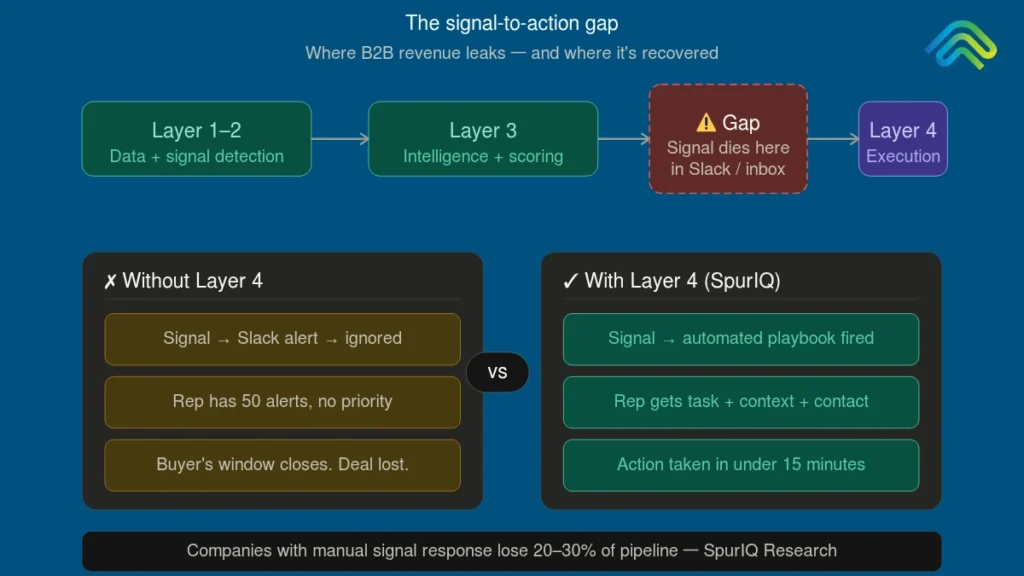
From Signal to Action: The Missing Layer in Modern GTM Stacks
Let’s be honest about the promise we were sold over the last ten years. For a decade, Chief Revenue Officers and VPs of Marketing have operated under a comforting, yet entirely flawed, premise: if we can just see the opportunity, we can capture it. At SpurIQ, we bought into the idea of total visibility. We globally poured billions of dollars into data enrichment platforms, predictive scoring algorithms, and intent tools. We constructed cathedral-like dashboards designed to track every single click, whitepaper download, and whispered demo requests across the internet. Our RevOps teams are leaner, sharper, and more data-savvy than they’ve ever been. And yet, you can walk into almost any boardroom during a quarterly business review and hear the exact same frustrating question: Why, despite having more data and visibility than ever before, is our pipeline still leaking revenue? The reality on the sales floor is grim. We are absolutely drowning in signals, but we are starving for action. We’ve spent the last decade perfecting the science of signal detection. We know exactly who is looking at us. But we are still living in the dark ages of signal execution. This gap- this massive, silent void between knowing something is happening and actually doing something about it- is the single greatest bottleneck inside the modern B2B Go-to-Market engine today. The GTM Stack Has a Signal Problem – And It’s Not What You Think If you pull a typical GTM leader aside and ask them about their stack’s “signal problem,” they almost always point to the same two culprits. They’ll complain about data quality, or they’ll groan about signal fatigue. They’ll tell you they desperately need better ZoomInfo enrichment to improve accuracy, or they need tighter orchestration rules to quiet the noise. They fundamentally believe their problem is informational. They are wrong. The information is fine. It’s the execution that’s broken. The False Premise of the “Complete” Stack Most revenue organizations build their technology stacks in a very linear, predictable way. They start by buying a system of record- usually Salesforce or HubSpot. Then, they add a system of engagement, like Outreach or Salesloft, so reps can send emails. Finally, they sprinkle data sources on top: a little Clearbit here, some 6sense intent data there. As Deloitte has extensively documented in their enterprise technology research, buying the technology without rewiring the operational workflow is a recipe for stalled growth. The prevailing myth in our industry is that once you achieve visibility across these different layers, the stack is “done.” The prevailing myth in our industry is that once you achieve visibility across these different layers, the stack is “done.” The assumption is that if a buying signal successfully makes its way to a sales rep’s desktop, the technology has fulfilled its purpose. This premise isn’t just naive; it’s practically operational negligence. It assumes that the moment a human being sees an opportunity flash on their screen, they will flawlessly, consistently, and immediately execute the absolute best next step. Anyone who has ever managed a sales team knows this is a fantasy. “The modern GTM stack is complete up to signal detection and broken immediately after.” – CTO SpurIQ Introducing the Gap: Signal Detection ≠ Signal Action Think about what a signal actually is. It’s just a data point. It’s a tiny indication of potential. It is not a closed-won deal. Your current stack is phenomenally good at telling you when a prospect from a tier-one target account visits your pricing page, downloads a case study, or gets flagged by an intent tool as “in–market.” But what happens next? In 90% of B2B organizations, that precious, high-intent signal is delivered as a Slack alert, an email notification, or just another line item on a sprawling Tableau dashboard. From that moment on, the signal is left entirely to the mercy of human memory. It relies on a rep prioritizing it over their coffee, figuring out the right workflow, manually typing up an email, and remembering to hit send before the prospect’s attention shifts elsewhere. This is the exact failure point. The tech stack stops the moment the signal arrives, but the actual monetary value is only unlocked when the signal is acted upon. Signal detection is necessary, sure. But signal action is what pays the bills. As McKinsey & Company notes on the future of B2B sales the organizations capturing the most market share are those that can react to customer insights with unprecedented speed. Signal detection is necessary, sure. But signal action is what pays the bills. What ‘Signal to Action’ Actually Means? If we want to fix this, we have to stop treating signal response like a random event and start treating it like a rigid operational process. In plain terms, the Signal-to-Action continuum is the specific path a data point travels from the moment your systems detect it, to the exact moment a meaningful business action is executed in response. This journey always breaks down into three critical stages: Where Most Stacks Break Down? Stage 3 is where the wheels fall off. It’s where 90% of the friction lives and where your revenue leaks out. You likely have incredible, expensive tools for Stage 1 (Intent providers) and Stage 2 (Scoring models). But the bridge connecting Stage 2 to Stage 3? It’s just a manual, rickety rope bridge. Your stack detects the fire. Your scoring model tells you how big the fire is. And then you hand a plastic bucket to a busy sales rep and just sort of hope they remember the way to the well. Why the Modern GTM Stack is Built for Visibility, Not Execution? How did we get here? The current design of the GTM stack is historically biased toward reporting, analysis, and looking backward. We have optimized everything for the view of the funnel, and completely neglected the flow through the funnel. 1. Dashboards Report What Happened – They Don’t Prevent It The hard truth that many management consultants are hesitant to tell their clients