A Series B founder hears the phrase “revenue operations” three times in a single week. Once, a board member asked why the forecast keeps missing. Once on a podcast where a CRO credits RevOps for a successful IPO. And once from a recruiter pitching a VP RevOps hire as the solution to every GTM problem.
Each person used the same two words. Each meant something slightly different. The founder walks away more confused than before, wondering whether RevOps is a real function, a philosophy, or simply the latest B2B buzzword.
Here is the answer: revenue operations is a real, measurable function, and the data on its impact is unambiguous. Companies with mature RevOps grow revenue 19% faster. Organisations that achieve cross-functional alignment see 36% higher revenue growth and 28% higher profitability, as per Forrester. And public companies with strong RevOps programmes outperform peers by 71% in stock performance over five years.
This guide answers four questions in order: what RevOps is, why it emerged when it did, how it actually works, and whether your team needs it. It is the foundational reference. If you want the implementation framework, the full strategy guide is at /revenue-operations-strategies.
What is Revenue Operations?
Revenue operations (RevOps) is a B2B business function that aligns sales, marketing, and customer success teams around shared revenue accountability, with shared data, shared metrics, and shared execution standards.
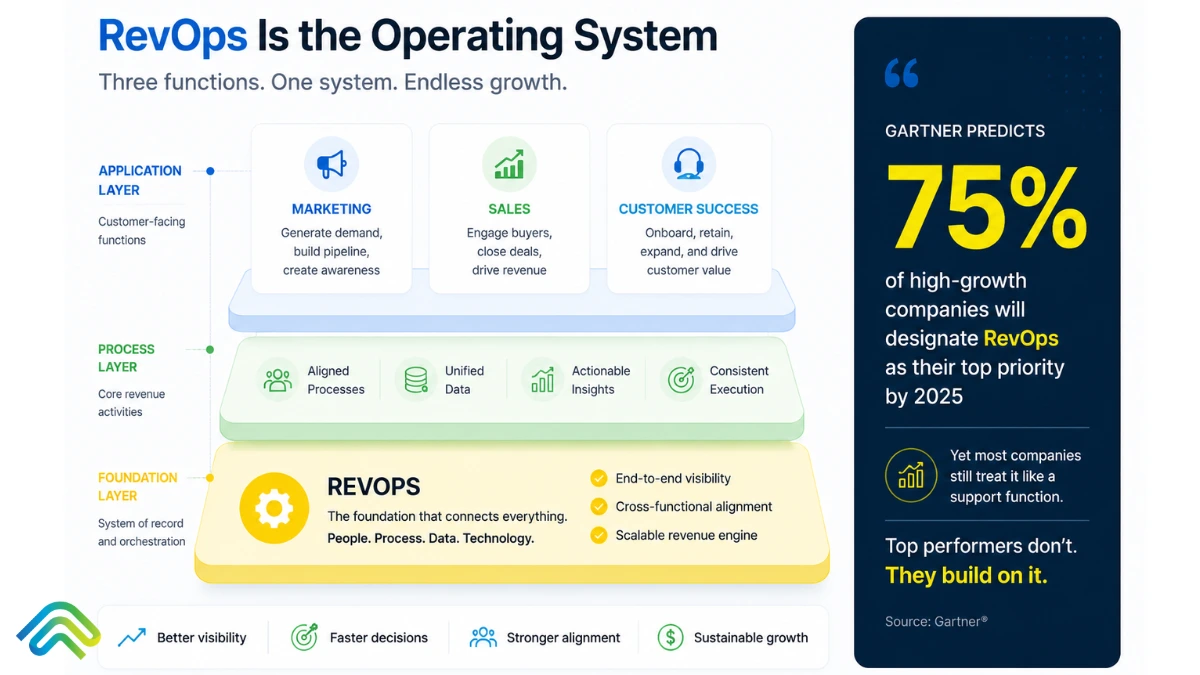
This revenue operations definition holds across several companies, GTM motion, and industry: RevOps is the operating system underneath the revenue function, not a tool, a title, or a department rename.
Where sales, marketing, and customer success have historically operated as three separate teams with three separate targets, three separate dashboards, and three separate definitions of success, RevOps consolidates them into one coherent system. The goal is simple: to drive revenue growth by eliminating the friction that siloed teams create across the entire customer journey.
What RevOps Does
- Builds shared definitions: what counts as a qualified lead, what marks a successful handoff, and when a customer is at risk of expansion.
- Maintains shared data: one source of truth in the CRM, integrated across all revenue-generating platforms.
- Sets shared metrics: NRR, CAC payback, pipeline velocity, and full-funnel conversion rates owned by one function.
- Enforces shared processes: handoff SLAs, qualification frameworks, lifecycle stage governance.
- Reports shared accountability: one revenue forecast that reflects the full system, not three competing versions.
What RevOps is NOT
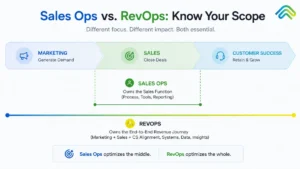
- It is not just sales operations with a fancier name. Sales ops focuses on sales team productivity. RevOps spans all three revenue functions. See the full comparison at revenue Operations vs sales Operations.
- It is not revenue intelligence, which is a tool category, not a business function.
- It is not finance. FP&A handles income statement modelling. RevOps handles pipeline-driven revenue modelling.
- It is not a software product you can buy and deploy in an afternoon.
Common synonyms: Revenue operations strategy, RevOps function, revenue operations team. “Ops revenue” is sometimes used as shorthand but is technically inverted and best avoided in professional contexts.
Why RevOps Emerged: A Brief History
RevOps didn’t appear overnight. It evolved in direct response to how B2B selling broke, scaled, and demanded more. Here is how the function evolved, year by year, from a fragmented back-office role to a boardroom priority.
- Pre-2015:
Sales ops, marketing ops, and customer success ops existed as separate functions. Each owned its own metrics, tooling, and pipeline version. Forecasts didn’t reconcile across functions. Handoffs broke routinely, and nobody owned the gaps.
- 2015 to 2019:
SaaS companies began consolidating these three ops revenue functions into a single team to solve the handoff problem. The label “revenue operations” became dominant around 2017 to 2019. Salesforce, HubSpot, and Outreach all formalised RevOps roles during this period.
- 2020 to 2022:
RevOps mainstreamed during the SaaS boom. The function exploded in headcount as companies scaled fast and needed cross-functional discipline to manage growth without chaos. Average RevOps team sizes roughly doubled.
- 2023 to 2024:
Capital efficiency stopped being optional. Median CAC payback stretched to 20 to 23 months (Benchmarkit 2025), more than double the previous benchmark. RevOps became the function responsible for delivering the efficiency that investors were now demanding. With a sharper focus on customer acquisition cost, net revenue retention, and annual recurring revenue as the primary indicators of health.
- 2025 to 2026:
AI-driven execution emerged as the missing layer. The strategy frameworks were largely solved. The execution gap, the distance between a RevOps plan and reliable rep behaviour, became visible. The teams that closed it pulled away from the rest. By 2026, 75% of B2B SaaS leaders name RevOps as a top-3 strategic priority (Gartner 2025).
The Scope of Revenue Operations
Understanding what RevOps owns versus what adjacent functions own is where most organisations get confused. Blurring these boundaries leads to duplicated effort, unclear accountability, and a RevOps leader who ends up as a catch-all inbox for GTM problems nobody else wants to own.
What RevOps Owns
- Cross-functional alignment:
Shared ICP, shared lifecycle definitions, and shared metrics across sales, marketing, and CS. RevOps is the function that forces three teams to agree on what “qualified” means, what “closed” means, and what “at risk” means, before those terms appear in a board deck.
- Data architecture:
A single source of truth in the CRM, integrated with marketing automation platforms, sales engagement, CS platforms, billing/ERP, and product usage data. RevOps does not just own the CRM; it owns the logic that connects everything to it.
- Process and governance:
Lifecycle stages, qualification frameworks, handoff SLAs, deal desk management, RACI matrices, and governance rituals. These are the behaviour standards that make the rest of the function operational rather than theoretical.
- Insights and planning:
Forecasting, attribution, capacity planning, territory design, compensation plan input, and board-level revenue reporting. RevOps translates pipeline data into the language leadership uses to make decisions.
- Tech stack architecture:
CRM administration, GTM tool selection, integration design, and data warehouse decisions. RevOps owns the system, not just the tools inside it.
What RevOps Does NOT Own
- Selling itself: Reps still close deals. RevOps builds the system; sales executes inside it.
- Marketing strategy or creative: RevOps owns marketing operations, the workflow under campaigns, not the campaigns themselves.
- CS delivery: CS managers own customer relationships. RevOps owns the system that enables them.
- Financial planning: FP&A owns income statement modelling. RevOps owns pipeline-driven revenue modelling. These are related but distinct.
- Product strategy: Product teams own feature roadmaps. RevOps owns how revenue feedback loops back to product, not what the product does next.
The Four Pillars of Revenue Operations
Every mature RevOps function is built on four pillars. Each one is described here at a conceptual level. The revenue operations framework below is the conceptual foundation. Let’s have a look:
- Pillar 1: Alignment
Shared definitions, metrics, and accountability across sales, marketing, and CS. The work of getting three functions to operate as one coherent revenue system. Without this pillar, every other investment in data, process, and tooling collapses into siloed efforts that never reconcile.
- Pillar 2: Data and Systems Foundation
A single source of truth, integrated tooling, and working attribution across the full funnel. This is the plumbing under everything else. The scale of the problem is often underestimated: 45% of B2B contacts are never logged in CRM today (Salesforce 2025). Customer data quality is the foundation of everything that follows. Fixing this is most of the foundational work.
- Pillar 3: Process and Governance
Documented playbooks, qualification frameworks, lifecycle stage definitions, and governance rituals. The behaviour standards that make consistency possible across reps, quarters, and GTM motions. Without this pillar, alignment becomes aspiration rather than operation.
- Pillar 4: Execution Layer
The system that turns the first three pillars into reliable behaviour at the precise moment execution is required. This is the most underbuilt pillar in most RevOps functions, and the one where most revenue leaks. A strategy that does not reach the rep at the right moment does not deliver outcomes.
Each pillar has a full implementation framework behind it. For the deep strategy guide on putting all four into practice, see “Mastering Revenue Operations Strategies: From Team Alignment to Seamless Execution“
Who is on a RevOps Team?
The RevOps function spans a range of roles from analyst to C-suite, and the right hiring sequence matters as much as the right roles. A revenue operations manager typically anchors the day-to-day function, while a Chief Revenue Officer sets the strategic direction at the executive level.
Here is how the function is typically structured:
| Role | What They Do | Typical Stage to Hire |
| VP Revenue Operations / CRO | Owns the entire RevOps function. Aligns sales, marketing, and CS. Usually reports to the CEO or COO. | Series B+ (or earlier if founder is full-time GTM) |
| Director of Revenue Operations | Day-to-day ops leader. Implements strategy, manages the team, and owns process design. | Series B |
| Revenue Operations Analyst | Data analysis, reporting, forecasting. Provides insights to support decisions. | Series A–B |
| RevOps Systems Manager | Tech stack ownership. CRM admin. Integration architecture. Tool selection. | Series A–B |
| Sales Operations Manager | Sales-specific support. Pipeline mechanics, comp plan execution, sales tool admin. | Seed–Series A |
| Marketing Operations Manager | Marketing-side ops. Campaign workflows, attribution, MarTech ownership. | Series A |
| Customer Success Operations Manager | Renewal workflows, expansion plays, churn forecasting. | Series B+ |
How a RevOps Team Grows
- First hire (Series A):
Usually a Sales Operations Manager. This person identifies the most painful pipeline gaps, establishes basic CRM hygiene, and lays the foundation for everything else.
- Second wave (Series B):
Add a Director of Revenue Operations alongside Marketing Ops and a Systems Manager. The function becomes genuinely cross-functional, not just sales-facing.
- Mature team (Series C):
A VP RevOps or CRO leads a team of 5 to 12 specialists covering analytics, systems, sales ops, marketing ops, and CS ops. The function runs like an internal consulting firm for the revenue organisation, with dedicated ownership of the sales pipeline, revenue pipeline, and customer lifecycle metrics.
Why RevOps Matters: The Business Case
The intuitive argument for RevOps is that aligned teams perform better. The data makes that argument concrete and measurable.
The Growth Case
- Companies with aligned RevOps grow revenue 19% faster (Forrester).
- Aligned organisations achieve 36% higher revenue growth and 28% higher profitability (Boston Consulting Group, BCG).
- High-performing RevOps teams drive 1.6x higher EBITDA margin than their peers (BCG).
The Efficiency Case
- A strong revenue operations strategy can reduce go-to-market expenses by approximately 30% by breaking down silos and eliminating duplicated work. It directly contributes to the overall sustainable growth.
- Companies report 10 to 20% increases in sales productivity following RevOps maturity (BCG).
The Customer Experience Case
- Streamlining sales-to-CS handoffs can improve customer satisfaction scores by 15-20%.
- A cohesive customer experience across the lifecycle drives higher retention and meaningful NRR improvement.
The Forecasting Case
- Mature RevOps teams achieve 90%+ accuracy when forecasting revenue. The 2026 median is 70-79% (Gartner). The gap between those two numbers represents millions in misallocated capital for any revenue operations company at scale.
The Capital Case
- Public companies with strong RevOps see 71% higher stock performance over a five-year horizon (Forrester).
- RevOps maturity is now a key factor in fundraising and M&A evaluations.
The RevOps Tech Stack
The RevOps function does not operate in isolation. It runs on a stack of interconnected platforms. Understanding the architecture and where the gaps typically appear is essential for anyone building or auditing a GTM stack. For a deeper look at what happens when the stack grows too complex, see “Tool Sprawl Is Killing Your Sales Team: How to Consolidate Without Losing Power“
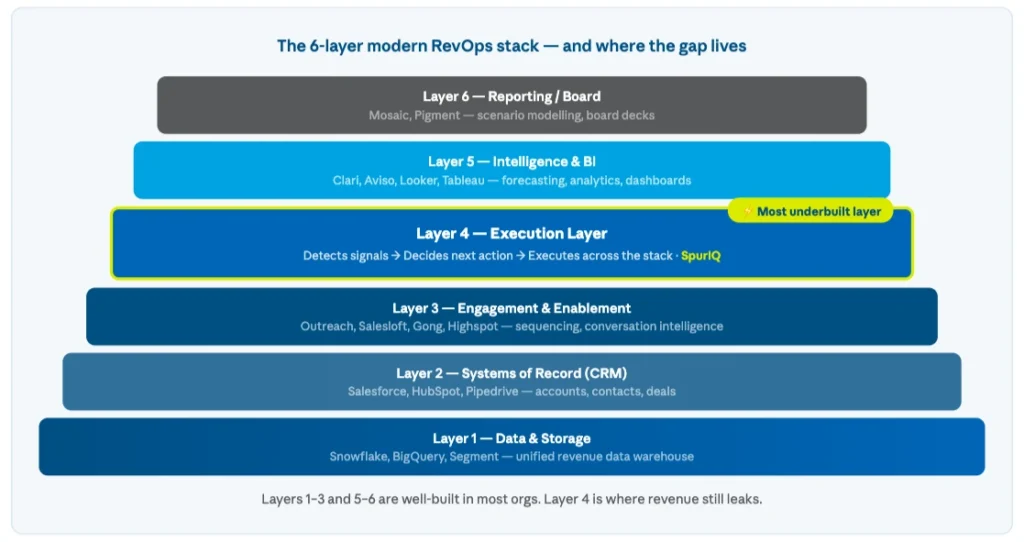
The Six Layers of a Modern RevOps Stack
| Layer | What It Does | Common Vendors |
| Data & Storage | Warehouses for unified revenue data and event aggregation | Snowflake, BigQuery, Segment |
| Systems of Record (CRM) | Source of truth for accounts, contacts, deals, customers | Salesforce, HubSpot, Pipedrive |
| Engagement & Enablement | Outbound sequencing, conversation intelligence, and enablement | Outreach, Salesloft, Gong, Highspot |
| Intelligence & BI | Forecasting, pipeline analytics, dashboards, attribution | Clari, Aviso, Looker, Tableau |
| Execution Layer | Detects signals, decides next action, executes across the stack | SpurIQ |
| Reporting / Board | Board-level revenue reporting, scenario modelling | Mosaic, Pigment |
Where Most RevOps Stacks Have a Gap
After eight to ten years of stack-building, most B2B companies in 2026 have invested heavily across every layer of the GTM stack. The foundations are largely in place:
- Mature data warehouses centralising revenue signals
- CRMs capturing accounts, contacts, and deal activity
- Engagement platforms sequencing outbound and logging conversations
- Intelligence layers surfacing forecasts, pipeline health, and attribution
The gap that remains, and the one most teams are still patching with rep discipline rather than tooling, is the execution layer between intelligence and action.
The breakdown looks like this in practice: a signal fires, the intelligence platform detects it, the CRM captures it, the dashboard surfaces it, and the rep is supposed to act on it. Most of the time, they do not. Not because they do not care, but because the action sits at the bottom of a queue with 50 other competing priorities, with no system enforcing the order of events.
The distance between signal and action is where revenue quietly leaks.
For a detailed breakdown of how this gap forms and what it costs, see “From Signal to Action: The Missing Layer in Modern GTM Stacks“
For a closer look at how unactioned signals translate into deal risk, see “Deal Risk Scoring: How AI Detects Stalled Deals Before Leadership Notices“
SpurIQ is the revenue execution platform purpose-built for this layer. Sitting on top of your existing GTM stack, Salesforce, HubSpot, Outreach, and Gong, it operationalises the strategies your RevOps function has already designed. Here’s how it works in practice:
- Lead IQ executes signal-led outbound automatically: detects the signal, enriches the contact, drafts contextual outreach, and routes it through your sequencer.
- Deal IQ executes deal follow-through: surfaces stalling deals, drafts re-engagement, updates CRM, and alerts managers before deals go cold.
The result is reliable execution visibility for leadership and a forecast that finally reflects reality, not just rep optimism. The strategy lives where it should: in the work, not the wiki.
Should Your Team Build a RevOps Function?
The reader has now spent significant time understanding what RevOps is. The practical question is whether it is the right investment for your organisation right now.
You Need RevOps If…
- Your sales, marketing, and CS teams operate in silos with conflicting metrics and no shared source of truth.
- Your forecast accuracy is below 75%, and you cannot explain why.
- Your MQL-to-SQL conversion is broken, and marketing and sales are blaming each other.
- Your NRR is below 100%, or you cannot reliably measure it.
- Your CAC payback is creeping past 18 months.
- Your investors are asking detailed questions about unit economics, attribution, or capital efficiency.
- You are running multiple GTM motions (PLG plus sales-led, multi-product) and your tooling cannot track them coherently.
You are Probably Not Ready for Full RevOps If…
- You have fewer than 5 sales reps.
- Your ARR is below $2M.
- Your sales motion is short-cycle, transactional, and single-product.
- You do not yet have a defined ICP or a repeatable sales motion.
The Practical Path
Most companies start with Sales Operations at Series A and evolve to a full RevOps function at Series B or C. Do not skip the foundational step. A RevOps function built on top of an unstable sales motion will paper over problems rather than solve them. The sequence matters as much as the destination.
How to Start Building RevOps
RevOps does not get built in a day, but it does get built in a sequence. Here is where to start.
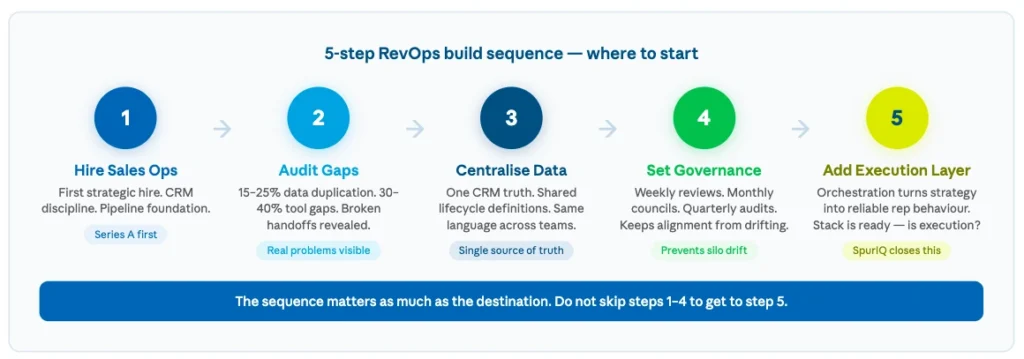
Step 1: Hire a Sales Operations Manager first
This person will identify the most painful gaps, establish CRM discipline, and lay the foundation for the broader RevOps function. Many companies also choose to bring in a revenue operations strategist at this stage to set the cross-functional direction before the full team is in place.
Step 2: Audit your data and process gaps
Most teams find 15 to 25% data duplication, 30 to 40% tool adoption gaps, and broken handoffs at every funnel stage. Analysing data at this stage reveals where the sales process breaks down and where lead management is falling through the cracks. The audit is where the real problems become visible.
Step 3: Centralise data
Establish a single source of truth in the CRM. Standardise lifecycle definitions, qualification criteria, and metrics so every function speaks the same language.
Step 4: Set governance rituals
Weekly pipeline reviews. Monthly RevOps councils. Quarterly process audits. Governance is not overhead. It is the mechanism that keeps alignment from drifting back into silos.
Step 5: Add the execution layer
Once the foundations are stable, add the orchestration layer that turns strategy into reliable behaviour. Automate routine tasks where possible so your team can focus on strategic initiatives rather than manual follow-through. The stack is ready. The question is whether execution is consistent enough to match it.
Bottom Line
Revenue operations is the function that turns three siloed teams, sales, marketing, and customer success, into one revenue system with shared accountability.
In 2026, it is a top-3 strategic priority for 75% of B2B SaaS leaders (Gartner 2025), and the data on its impact is unambiguous: 19% faster revenue growth, 28% higher profitability, 71% higher stock performance over five years.
But the function is only as effective as the system it produces. Strategy without execution does not deliver outcomes. The teams that win in 2026 are the ones who built the execution layer that operationalises every RevOps decision at the moment it needs to happen, not the moment someone remembers to act on it.
SpurIQ is the execution layer your RevOps function needs to actually deliver. See how it works.
Frequently Asked Questions (FAQs):
What is revenue operations in simple terms?
RevOps is the function that aligns sales, marketing, and customer success around shared revenue accountability, with shared data, shared metrics, and shared execution standards. It is the operating system underneath the revenue function. In addition, it covers everything from sales enablement and lead management to customer lifecycle tracking and revenue cycle optimisation.
What does a revenue operations team do?
A RevOps team owns five areas: cross-functional alignment, data architecture, process and governance, insights and planning, and tech stack architecture. They build the system that sales, marketing, and CS execute inside.
Is revenue operations the same as sales operations? No. Sales operations focus on sales team productivity. Revenue operations spans sales, marketing, and customer success. Sales ops is a subset of revenue ops in both scope and accountability. See the full comparison at Revenue Operations vs Sales Operations.
Is revenue operations the same as sales operations?
No, revenue operations and sales operations are not the same.
Sales operations focus specifically on improving sales team performance and productivity. Revenue operations, on the other hand, has a broader scope that includes sales, marketing, and customer success functions.
The key difference is scope:
Sales Ops: Sales-focused execution and productivity
RevOps: End-to-end revenue alignment and system management
In most organisations, sales operations functions as a subset within the broader RevOps structure.
What are the four pillars of revenue operations?
The four pillars of revenue operations form the foundation of a scalable and efficient GTM strategy.
These pillars include:
Alignment across teams and goals
Data and systems foundation
Process and governance
Execution layer
The first three pillars create operational stability, while the execution layer ensures strategies are successfully implemented across the organisation.
Who reports to whom in a RevOps team?
The VP Revenue Operations or CRO sits at the top, typically reporting to the CEO or COO. Beneath them: a Director of RevOps, plus specialists for sales ops, marketing ops, CS ops, analytics, and systems.
What metrics does RevOps own?
Pipeline velocity, forecast accuracy, NRR, CAC payback, full-funnel conversion rates, and CRM hygiene. These are revenue-system metrics, not function-specific metrics. They reflect the health of the entire GTM system. Average revenue generated per customer, customer lifetime value, and recurring revenue trends are also key components of how a mature RevOps function measures performance.
How long does it take to build RevOps?
Building a strong RevOps function is a long-term operational initiative rather than a quick implementation project.
Typical timelines include:
90 days for foundational setup
12–18 months for full operational maturity
Many companies successfully implement initial systems quickly but underestimate the time required to optimise processes, team alignment, and execution consistency at scale.
What tools should a RevOps function use?
A modern RevOps function typically relies on a layered technology ecosystem to manage data, workflows, forecasting, and execution.
The core RevOps tech stack usually includes:
Data warehouse
CRM platform
Sales engagement tools
Business intelligence and analytics platforms
Execution and orchestration layer
Executive and board-level reporting systems
One of the most commonly missing components is the execution layer, which connects strategy with day-to-day operational action.
How is revenue operations measured?
Through revenue outcomes (NRR, ARR growth, forecast accuracy) and efficiency metrics (CAC payback, pipeline velocity, sales cycle length). The benchmark is straightforward: mature RevOps grows revenue 19% faster (Forrester).