
What is Revenue Operations? The Complete 2026 Guide for B2B Teams
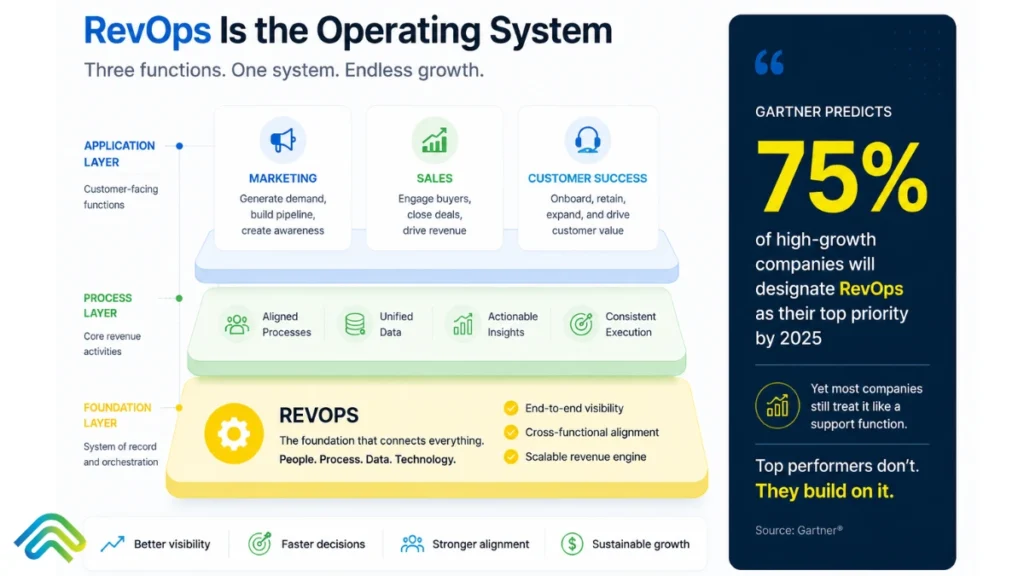
A Series B founder hears the phrase “revenue operations” three times in a single week. Once, a board member asked why the forecast keeps missing. Once on a podcast where a CRO credits RevOps for a successful IPO. And once from a recruiter pitching a VP RevOps hire as the solution to every GTM problem. Each person used the same two words. Each meant something slightly different. The founder walks away more confused than before, wondering whether RevOps is a real function, a philosophy, or simply the latest B2B buzzword. Here is the answer: revenue operations is a real, measurable function, and the data on its impact is unambiguous. Companies with mature RevOps grow revenue 19% faster. Organisations that achieve cross-functional alignment see 36% higher revenue growth and 28% higher profitability, as per Forrester. And public companies with strong RevOps programmes outperform peers by 71% in stock performance over five years. This guide answers four questions in order: what RevOps is, why it emerged when it did, how it actually works, and whether your team needs it. It is the foundational reference. If you want the implementation framework, the full strategy guide is at /revenue-operations-strategies. What is Revenue Operations? Revenue operations (RevOps) is a B2B business function that aligns sales, marketing, and customer success teams around shared revenue accountability, with shared data, shared metrics, and shared execution standards. This revenue operations definition holds across several companies, GTM motion, and industry: RevOps is the operating system underneath the revenue function, not a tool, a title, or a department rename. Where sales, marketing, and customer success have historically operated as three separate teams with three separate targets, three separate dashboards, and three separate definitions of success, RevOps consolidates them into one coherent system. The goal is simple: to drive revenue growth by eliminating the friction that siloed teams create across the entire customer journey. What RevOps Does What RevOps is NOT Common synonyms: Revenue operations strategy, RevOps function, revenue operations team. “Ops revenue” is sometimes used as shorthand but is technically inverted and best avoided in professional contexts. Why RevOps Emerged: A Brief History RevOps didn’t appear overnight. It evolved in direct response to how B2B selling broke, scaled, and demanded more. Here is how the function evolved, year by year, from a fragmented back-office role to a boardroom priority. Sales ops, marketing ops, and customer success ops existed as separate functions. Each owned its own metrics, tooling, and pipeline version. Forecasts didn’t reconcile across functions. Handoffs broke routinely, and nobody owned the gaps. SaaS companies began consolidating these three ops revenue functions into a single team to solve the handoff problem. The label “revenue operations” became dominant around 2017 to 2019. Salesforce, HubSpot, and Outreach all formalised RevOps roles during this period. RevOps mainstreamed during the SaaS boom. The function exploded in headcount as companies scaled fast and needed cross-functional discipline to manage growth without chaos. Average RevOps team sizes roughly doubled. Capital efficiency stopped being optional. Median CAC payback stretched to 20 to 23 months (Benchmarkit 2025), more than double the previous benchmark. RevOps became the function responsible for delivering the efficiency that investors were now demanding. With a sharper focus on customer acquisition cost, net revenue retention, and annual recurring revenue as the primary indicators of health. AI-driven execution emerged as the missing layer. The strategy frameworks were largely solved. The execution gap, the distance between a RevOps plan and reliable rep behaviour, became visible. The teams that closed it pulled away from the rest. By 2026, 75% of B2B SaaS leaders name RevOps as a top-3 strategic priority (Gartner 2025). The Scope of Revenue Operations Understanding what RevOps owns versus what adjacent functions own is where most organisations get confused. Blurring these boundaries leads to duplicated effort, unclear accountability, and a RevOps leader who ends up as a catch-all inbox for GTM problems nobody else wants to own. What RevOps Owns Shared ICP, shared lifecycle definitions, and shared metrics across sales, marketing, and CS. RevOps is the function that forces three teams to agree on what “qualified” means, what “closed” means, and what “at risk” means, before those terms appear in a board deck. A single source of truth in the CRM, integrated with marketing automation platforms, sales engagement, CS platforms, billing/ERP, and product usage data. RevOps does not just own the CRM; it owns the logic that connects everything to it. Lifecycle stages, qualification frameworks, handoff SLAs, deal desk management, RACI matrices, and governance rituals. These are the behaviour standards that make the rest of the function operational rather than theoretical. Forecasting, attribution, capacity planning, territory design, compensation plan input, and board-level revenue reporting. RevOps translates pipeline data into the language leadership uses to make decisions. CRM administration, GTM tool selection, integration design, and data warehouse decisions. RevOps owns the system, not just the tools inside it. What RevOps Does NOT Own The Four Pillars of Revenue Operations Every mature RevOps function is built on four pillars. Each one is described here at a conceptual level. The revenue operations framework below is the conceptual foundation. Let’s have a look: Shared definitions, metrics, and accountability across sales, marketing, and CS. The work of getting three functions to operate as one coherent revenue system. Without this pillar, every other investment in data, process, and tooling collapses into siloed efforts that never reconcile. A single source of truth, integrated tooling, and working attribution across the full funnel. This is the plumbing under everything else. The scale of the problem is often underestimated: 45% of B2B contacts are never logged in CRM today (Salesforce 2025). Customer data quality is the foundation of everything that follows. Fixing this is most of the foundational work. Documented playbooks, qualification frameworks, lifecycle stage definitions, and governance rituals. The behaviour standards that make consistency possible across reps, quarters, and GTM motions. Without this pillar, alignment becomes aspiration rather than operation. The system that turns the first three pillars into reliable behaviour at the precise moment