If you’re a Series B founder sitting at your desk, reviewing two resumes your recruiter just forwarded, you might be asking yourself the critical question of revenue ops vs sales ops. The first profile is a “Sales Operations Manager” and the second one a “Revenue Operations Lead.” Both candidates boast about improving CRM hygiene, tightening forecast accuracy, and optimizing the tech stacks that support your business operations. You have a critical decision: which function does the business actually need to scale sustainable growth and drive predictable revenue growth?
Since 2022, search volume for “revops vs sales ops” has tripled, reflecting widespread confusion across B2B SaaS companies striving to align their sales functions and customer success processes. As businesses scale past early startup stages, the cracks in their go-to-market motions start to show, and leadership reflexively looks to operations professionals to fix them.
However, most resources answer this query as a simple glossary definition. The real question isn’t just what these terms mean – it is which function your specific business needs, when to hire for it, and how to evolve your operational structure to maximize annual recurring revenue and improve customer retention.
This guide breaks down exactly what you need to know. We will cover:
- What each function actually does in practice.
- Where they overlap and where their scopes diverge.
- A pragmatic decision framework for choosing one, the other, or both.
- How to evolve a traditional sales ops team into RevOps without breaking the processes that currently work.
So, without wasting time, let’s dive into the blog!
What Is Sales Operations?
Sales operations, often simply referred to as sales ops, is the functional backbone designed to improve the productivity, efficiency, and effectiveness of the sales team specifically. While it originated in the 1970s with Xerox’s pioneering efforts, it matured into a standard sales department pillar by the early 2000s as CRMs became the “system of record.”
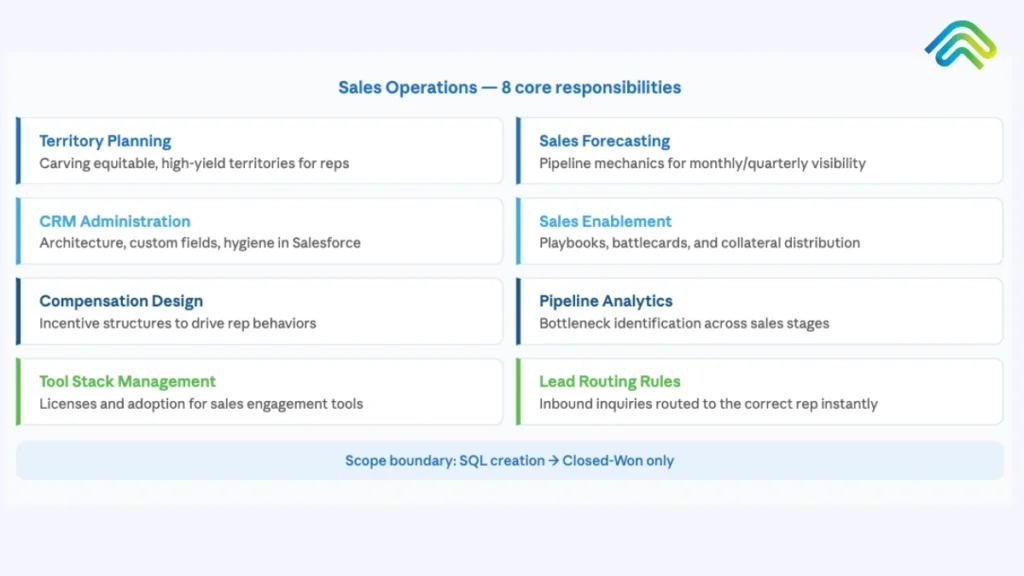
The sales operations team focuses on the “how” of selling. They are the mechanics of the overall sales engine, ensuring that sales representatives aren’t bogged down by friction. Their key functions and core responsibilities include:
- Territory planning sales and quota distribution to ensure fair market coverage.
- Sales forecasting along with well defined sales strategies and pipeline analytics to provide sales leadership with predictable numbers.
- Customer Relationship Management (CRM) administration, usually acting as the primary gatekeeper for data hygiene.
- Creating sales enablement materials and managing the sales funnel.
- Designing commission and compensation plans that align with business growth goals.
- Lead generation routing rules and sales data management.
Typically, sales ops professionals report to a VP of Sales or a Chief Revenue Officer (CRO). In the traditional model, this function sits firmly inside the sales org. When sales operations initiatives are successful, you’ll see a direct impact on sales performance: sales reps spend less time on administrative tasks, sales productivity climbs, and sales metrics like forecast accuracy finally stabilize. The sales team begins to operate as a productive engine, rather than a collection of individual heroes.
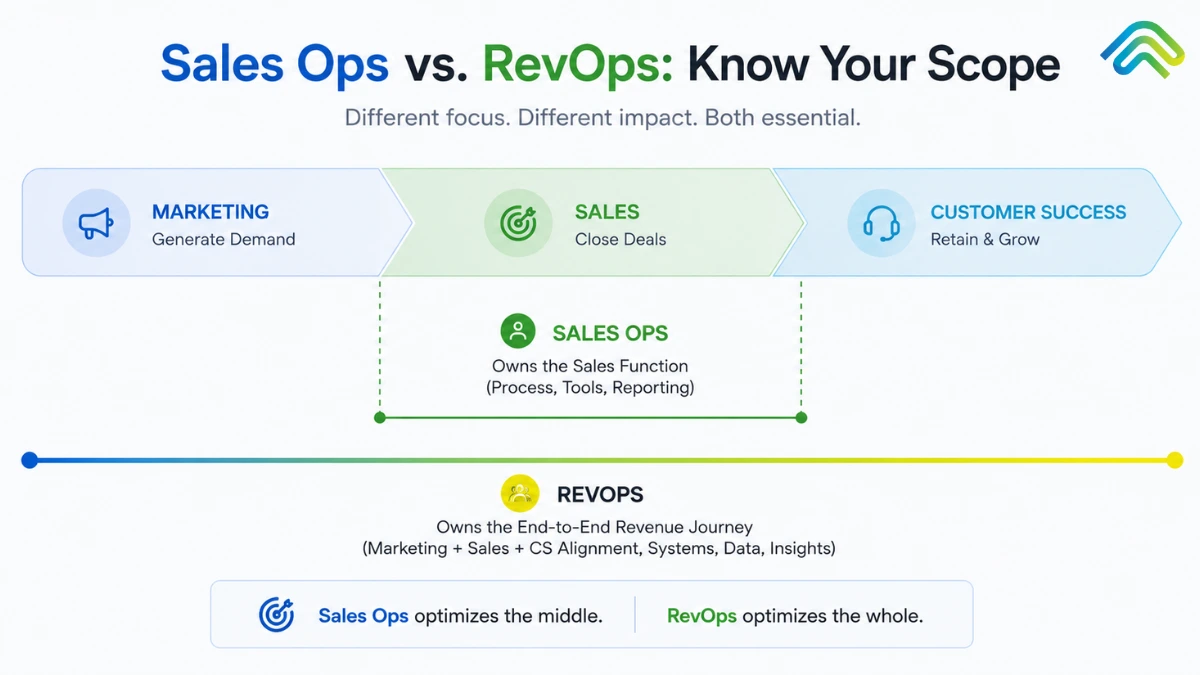
However, there is a historic limit: sales ops focuses almost exclusively on the sales funnel from the moment a lead is qualified until the deal is won. It doesn’t own the customer journey before the SQL handoff, nor does it manage existing customers after the closing deals phase. In this siloed model, marketing and customer success run their own ops in parallel, and the handoffs between them are frequently where revenue leaks occur.
What Is Revenue Operations?
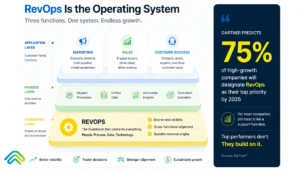
Revenue operations, or RevOps, is the strategic function that aligns sales, marketing, and customer success around shared revenue accountability. While sales ops is primarily about the sales reps, a revenue operations team is obsessed with the entire customer journey.
Revenue operations vs sales isn’t just a rebranding. This function emerged between 2017 and 2019 and became mainstreamed during the 2020–2022 SaaS boom when companies realized that “growth at all costs” was no longer a viable strategy. A revenue operations strategy focuses on the full revenue generation lifecycle.
Rather than looking at a single department, RevOps looks at the entire buyer journey. Core responsibilities include:
- Full-Funnel Data Architecture: Ensuring data flows seamlessly from the first marketing touchpoint through renewal.
- ICP Definition: Establishing a shared Ideal Customer Profile that both marketing and sales agree upon and target.
- MQL→SQL→Customer Lifecycle Management: Governing the rules of engagement and SLAs at every critical handoff point.
- Multi-Touch Attribution: Tracking key metrics which specific campaigns, content, and touchpoints actually drive revenue.
- NRR/Expansion Strategy: Building the operational framework for cross-selling and upselling existing accounts.
- GTM Tech Stack Design: Architecting a cohesive technology ecosystem that serves all revenue-generating teams, eliminating redundant tools.
- Alignment Governance: Running the cadences and meetings that keep sales, marketing, and CS moving in the same direction.
Who reports into RevOps? Usually, a Chief Revenue Officer or a COO/CEO. RevOps spans the organization rather than sitting inside any one department. The goal of successful revenue operations is to ensure that revenue teams operate as one cohesive system.
Why did RevOps emerge so rapidly? The SaaS economics that made strategic alignment optional in the 2010s broke. Capital efficiency stopped being a suggestion and became a requirement. With customer lifetime value (CLV) becoming the primary metric of company health, businesses realized they couldn’t afford a disjointed customer experience. According to Benchmarkit (2025), median CAC payback has stretched to 20–23 months. Companies that couldn’t make their marketing teams, sales teams, and customer success departments operate as one fell behind. Forrester reveals that companies with mature RevOps functions grow revenue 19% faster and achieve 15% higher profitability than their peers.
Key Differences Between RevOps and Sales Ops
The main difference is scope. Sales operations is a specialized tool; Revenue operations is the entire toolbox. While sales ops focuses on the sales cycle length and rep behavior, RevOps looks at market trends and customer success metrics to see how the top of the funnel impacts the bottom.
| Dimension | Sales Operations | Revenue Operations |
| Operational Scope | Exclusively sales-focused. Supports SDRs, Account Executives, and Sales Leadership. | Cross-functional. Encompasses Marketing, Sales, and Customer Success teams. |
| Core Problem Solved | Inefficient sales cycles, low rep productivity, and poor pipeline visibility. | Misaligned departmental silos, leaky handoffs, and unpredictable revenue growth. |
| Reports To | VP of Sales or Chief Revenue Officer (CRO). | Chief Revenue Officer (CRO), Chief Operating Officer (COO), or directly to the CEO. |
| Primary Metrics | Quota attainment, win rate, sales cycle length, pipeline coverage. | Net New ARR, Net Revenue Retention (NRR), CAC payback, Customer Lifetime Value (CLV). |
| Data Ownership | Sales pipeline data. Focuses on CRM opportunity stages and individual rep activity metrics. | Full-funnel unified data. Tracks the journey from anonymous website visitor to multi-year renewal. |
| Tooling Focus | CRM architecture, sales engagement (sequencing), and forecasting/pipeline dashboards. | Integrating the CRM, marketing automation, CS platforms, and centralized BI/analytics. |
| Process Scope | Active sales motion only. From opportunity creation to the Closed-Won handshake. | End-to-end lifecycle. From top-of-funnel lead generation through customer satisfaction retention and expansion. |
| Forecasting Approach | Sales-only forecast. Based on active opportunities, pipeline coverage, and historical rep win rates. | Revenue-wide forecast. Combines new sales pipeline, expected cross-sell/upsell expansion, and projected churn. |
| Attribution Model | Pipeline-stage or single-touch. Focuses on last-touch or “opportunity source” (e.g., cold call vs. inbound). | Multi-touch attribution. Sophisticated models (W-shaped, U-shaped) tracking all touches across the buyer journey. |
| Customer Success Ops | Strictly outside of scope. | A core pillar of the function, ensuring smooth onboarding and high product adoption. |
| Maturity Stage | Series A onwards. Usually the first strategic ops hire. | Typically Series B+. Added when cross-departmental friction impacts growth. |
| Common Job Titles | Sales Ops Manager, Sales Operations Analyst, VP of Sales Ops. | RevOps Lead, Director of Revenue Ops, VP of RevOps. |
A few key differences stand out in practice. In sales operations, success is measured by how well sales representatives are performing against their current quota. In revenue operations, success is measured by how effectively the company is driving revenue growth across the board – which includes minimizing churn and maximizing the customer lifetime.
While sales ops ensures the sales reps have what they need to close a deal today, RevOps ensures that the deals being closed today don’t become the churn headaches of tomorrow. RevOps looks at the entire revenue engine to identify where the friction lies – whether that’s a bad lead source from the marketing teams or a breakdown in the customer success operations handoff.
Also Read: Revenue Operations Strategies That Actually Work for B2B Growth in 2026
The Tooling Difference: Revenue ops vs sales ops
The tools each function relies on overlap heavily but are not identical. Sales Ops is heavily CRM-and-pipeline-tool centric. RevOps adds marketing automation, advanced attribution platforms, customer success tools, and the critical integration layer between all of them.
Here is how the modern tech stack breaks down by function:
| Technology Layer | Used By | Primary Use Case / Functionality | Common Vendors |
| CRM (System of Record) | Both | The central database for account information, opportunity tracking, and overarching pipeline management. | Salesforce, HubSpot, Pipedrive |
| Sales Engagement | Sales Ops primary | Automating outbound outreach, email sequencing, and dialer execution for high-volume prospecting. | Outreach, Salesloft, Apollo |
| Marketing Automation | RevOps primary | Nurturing top-of-funnel leads, scoring MQLs, and running targeted account-based marketing (ABM) campaigns. | Marketo, HubSpot Marketing Hub, Pardot |
| Customer Success | RevOps primary | Tracking product adoption, monitoring customer health scores, and flagging early churn risks. | Gainsight, Catalyst, ChurnZero |
| Sales Forecasting | Both | AI-driven pipeline analysis, deal risk scoring, and predictive revenue forecasting for board reporting. | Clari, Aviso, BoostUp |
| Conversation Intelligence | Both | Recording, transcribing, and analyzing sales calls to extract market insights and coach reps on messaging. | Gong, Chorus, Fathom |
| Data & Enrichment | Both | Sourcing B2B contact data, identifying buyer intent signals, and keeping CRM records accurate and up to date. | ZoomInfo, Clearbit, Bombora |
| Execution Layer / Action Orchestration | Both | Closing the strategy-execution gap by automating context-driven follow-ups and CRM updates based on buyer signals. | SpurIQ |
| Attribution & Routing | RevOps primary | Mapping complex buyer journeys, assigning revenue ROI to marketing channels, and routing leads instantly. | Bizible, Dreamdata, LeanData, HockeyStack |
| Reporting / BI | Both | Visualizing cross-functional data, building complex executive dashboards, and tracking global unit economics. | Looker, Tableau, Mosaic |
Revenue ops vs sales ops tooling also differs in the “integration layer.” Sales ops often focuses on ensuring the CRM talks to the sales dialer. RevOps focuses on ensuring the customer data flows seamlessly from the first website visit through the entire customer lifetime.
Crucially, both functions now require an “Execution Layer.” While traditional tools record what happened, modern revenue generating teams need tools that ensure the right action happens now. This is where SpurIQ sits, orchestrating the actions across the stack to ensure that no matter how your team is structured, the strategy is actually executed.
Metrics That Define Each Function
Metrics are where the revenue operations vs sales distinction becomes quantifiable. Sales ops focuses on efficiency within the silo, while RevOps focuses on the health of the entire business.
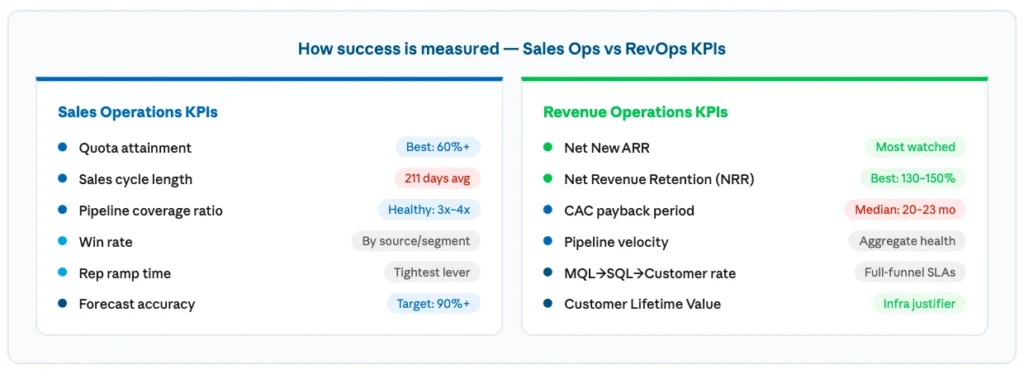
Sales Ops Core Metrics
Sales Ops is measured by the velocity and efficiency of the sales floor.
- Quota attainment: The percentage of sales reps hitting their assigned quota. Best-in-class organizations hit 60%+, though the median often hovers around 45–50%.
- Sales cycle length: The average number of days it takes a deal to move from SQL to closed-won. This metric is trending up across B2B – hitting a 211-day median for SaaS in 2026, according to SaaSHero data.
- Pipeline coverage ratio: The ratio of open pipeline value compared to the quota target. A healthy coverage ratio is generally considered to be 3x–4x.
- Win rate: The percentage of total opportunities that result in a closed-won deal. Sales Ops segments this rigorously by lead source, market segment, and individual rep.
- Rep ramp time: The time it takes from a new rep’s onboarding date to their first full quota attainment. Tightening this metric is one of Sales Ops’ highest-leverage operational outputs.
- Forecast accuracy: The variance between the actual closed revenue at the end of the period and the forecast projected at the beginning. This focuses strictly on the sales-only pipeline forecast.
RevOps Core Metrics
RevOps is measured by company-wide capital efficiency and total lifecycle revenue.
- Net New ARR: The new customer revenue closed within a specific period. This is the single most-watched RevOps metric for growth.
- Net Revenue Retention (NRR): The percentage of recurring revenue retained from existing customers, inclusive of expansion and churn. Best-in-class SaaS companies target 130–150%. If this dips below 100%, churn is outpacing expansion.
- CAC payback: The number of months required to recover the cost of acquiring a customer. The elite target is under 12 months, though the median sits at 20–23 months in 2026.
- Pipeline velocity: Calculated as (Leads × Win Rate × ACV) ÷ Sales Cycle. This serves as the ultimate aggregate health metric of the revenue engine.
- MQL → SQL → Customer conversion: The full-funnel conversion rate. Each stage handoff is a place where RevOps adds strict SLA discipline to prevent lead leakage.
- Customer Lifetime Value (CLV): The total gross margin or revenue expected from a customer over their entire relationship with the company. This is the metric that justifies the heavy infrastructure investment in RevOps.
When to Implement revenue operations vs sales operations?
Deciding between sales operations and revenue operations is usually a matter of organizational maturity rather than a binary “either/or.”
When to Implement Sales Operations
Most companies start with sales operations because the first signs of friction usually appear in the sales department.
- You have 5+ sales reps and your CRM is becoming a graveyard of dead data.
- Sales performance is inconsistent, and quota attainment is below 50%.
- Sales reps spend more than 30% of their time on administrative tasks instead of selling.
- You are raising prices or changing compensation plans – these require an owner.
- Typical Stage: Series A. Revenue: $2M–$10M ARR.
When to Implement Revenue Operations
As you grow, sales ops alone can’t solve cross-functional problems.
- Marketing and customer success are operating in silos with different data sets.
- Lead conversion is broken; marketing teams blame sales for not following up, while the sales team blames marketing for “low-quality” leads.
- NRR is dropping, and you can’t pinpoint if it’s a product issue, a sales mis-selling issue, or a customer success breakdown.
- Your CAC payback is creeping past 18–20 months.
- Typical Stage: Series B+. Revenue: $10M+ ARR.
The Pragmatic Truth: Most companies grow into RevOps by evolving their sales operations team. This isn’t a clean replacement. Instead, RevOps absorbs sales ops responsibilities while expanding the scope to cover marketing and CS. The Sales Ops Manager often becomes the first hire on the RevOps team.
How to Combine RevOps and Sales Ops for Maximum Impact
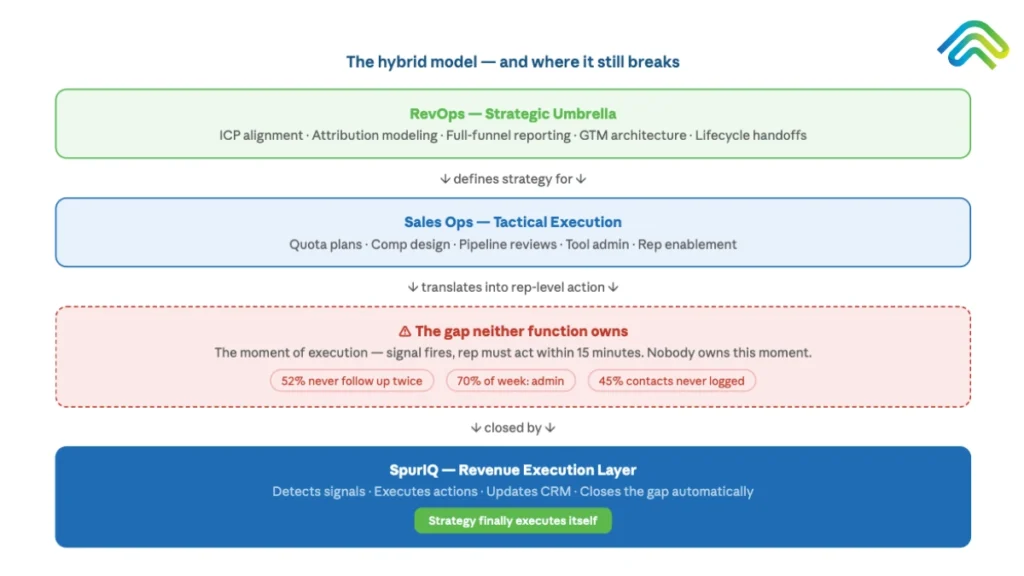
For an effective revenue strategy, the goal is to build a hybrid model where sales ops handles the tactical day-to-day and RevOps manages the strategic umbrella.
The Hybrid Model That Works
- Sales Ops as Tactical Owner: Owns the quota plans, sales practices, and sales tool stack management.
- RevOps as Strategic Umbrella: Owns the full-funnel data architecture, ICP definition, and GTM alignment.
- Shared Rituals: Both functions should participate in weekly pipeline reviews and quarterly OKR retrospectives.
The Common Failure Mode
Most companies build the structure correctly and still fail to deliver predictable revenue growth. Why? Because both functions are excellent at designing strategies, but neither function owns the moment of execution.
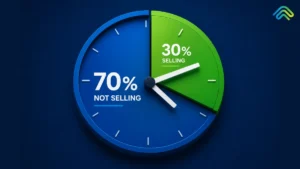
The data highlights this signal-to-action gap: You can have the most sophisticated revenue operations strategy in the world, but if a sales representative doesn’t follow up on a high-intent signal at 2 PM on a Tuesday, the strategy fails. Strategy lives in the wiki; the work happens on rep memory. Statistics show that 52% of reps never follow up twice, and 70% of their week is spent on administrative tasks. Adding more headcount to sales ops or RevOps doesn’t fix a lack of discipline.
The Missing Layer: Execution Orchestration
Whether your team is structured as sales ops only, RevOps only, or both, you face the same hard truth: strategies don’t execute themselves. This is the gap where revenue leaks occur.
SpurIQ is the revenue execution platform that closes this gap regardless of how your ops function is structured. We sit on top of your existing GTM stack – Salesforce, HubSpot, Outreach, Gong – and operationalize the strategies your sales ops or RevOps team has already designed.
- Lead IQ executes signal-led outbound automatically: it detects the signal, drafts the outreach, and routes it.
- Deal IQ executes deal follow-through: it surfaces stalling deals and updates the CRM automatically.
Sales ops gets the sales team’s efficiency it designed for. RevOps gets the cross-functional execution discipline it strategized. Both functions get a forecast that finally reflects reality because the data is being updated in real-time.
Bottom Line
Sales operations and revenue operations aren’t competitors. Sales ops is the tactical engine inside the sales department, while RevOps is the strategic spine across the entire revenue org.
Most companies grow into RevOps by evolving their sales ops team, expanding their focus from the moment of the “deal” to the entire customer journey. Whichever function your team is building, both face the same hard truth: a perfect strategy on a slide deck won’t drive revenue growth if it isn’t executed on the front lines.
Without an execution layer, every framework stays theoretical and every dashboard stays reactive.
SpurIQ is the revenue execution platform that operationalizes both Sales Ops and RevOps strategies. See how it works.
FAQs:
Is revenue operations the same as sales operations?
No. Sales operations focuses exclusively on the sales team – productivity, CRM administration, and sales forecasting. Revenue operations is broader, aligning sales, marketing, and customer success around shared data and shared revenue accountability.
What’s the difference between RevOps and Sales Ops?
Scope and reporting are the main differences. Sales ops covers sales only and typically reports to a VP of Sales. RevOps covers the entire customer journey and reports to a Chief Revenue Officer (CRO) or COO.
What are the 4 pillars of revenue operations?
The pillars are: (1) Alignment across teams, (2) Data Architecture for a single source of truth, (3) Process Discipline across the lifecycle, and (4) Execution Layer to turn strategy into action.
What does sales ops do?
The sales operations team is responsible for territory planning sales, sales forecasting, CRM management, sales enablement, and optimizing sales processes.
Is RevOps part of sales?
In a mature organization, no. RevOps is an independent function that sits above sales, marketing, and customer success to ensure alignment.
Does RevOps get commission?
Generally no. RevOps roles are salaried, often with bonuses tied to company-wide metrics like forecast accuracy, NRR, or CAC payback, rather than individual deal commissions.
What does OPS stand for in sales?
OPS stands for Operations. It refers to the team responsible for the process, tools, and data that support the revenue-generating functions.
What’s the difference between FP&A and Sales Ops?
FP&A is a finance function focused on budgeting and high-level financial planning. Sales ops is a revenue function focused on the sales funnel, rep activity, and sales performance.
What’s the best tool stack for Sales Ops or RevOps?
Both rely on a CRM, sales engagement platforms, and sales forecasting tools. RevOps adds marketing automation and customer success platforms. An execution layer like SpurIQ orchestrates action across the entire stack.