
Revenue Operations vs Sales Operations: Understanding the Key Differences and Choosing the Right Strategy
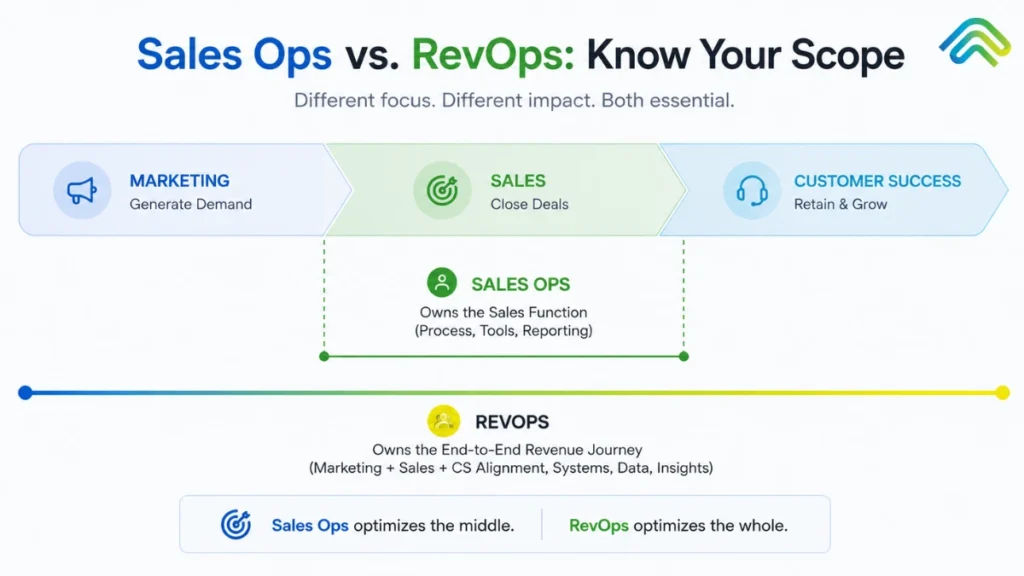
If you’re a Series B founder sitting at your desk, reviewing two resumes your recruiter just forwarded, you might be asking yourself the critical question of revenue ops vs sales ops. The first profile is a “Sales Operations Manager” and the second one a “Revenue Operations Lead.” Both candidates boast about improving CRM hygiene, tightening forecast accuracy, and optimizing the tech stacks that support your business operations. You have a critical decision: which function does the business actually need to scale sustainable growth and drive predictable revenue growth? Since 2022, search volume for “revops vs sales ops” has tripled, reflecting widespread confusion across B2B SaaS companies striving to align their sales functions and customer success processes. As businesses scale past early startup stages, the cracks in their go-to-market motions start to show, and leadership reflexively looks to operations professionals to fix them. However, most resources answer this query as a simple glossary definition. The real question isn’t just what these terms mean – it is which function your specific business needs, when to hire for it, and how to evolve your operational structure to maximize annual recurring revenue and improve customer retention. This guide breaks down exactly what you need to know. We will cover: So, without wasting time, let’s dive into the blog! What Is Sales Operations? Sales operations, often simply referred to as sales ops, is the functional backbone designed to improve the productivity, efficiency, and effectiveness of the sales team specifically. While it originated in the 1970s with Xerox’s pioneering efforts, it matured into a standard sales department pillar by the early 2000s as CRMs became the “system of record.” The sales operations team focuses on the “how” of selling. They are the mechanics of the overall sales engine, ensuring that sales representatives aren’t bogged down by friction. Their key functions and core responsibilities include: Typically, sales ops professionals report to a VP of Sales or a Chief Revenue Officer (CRO). In the traditional model, this function sits firmly inside the sales org. When sales operations initiatives are successful, you’ll see a direct impact on sales performance: sales reps spend less time on administrative tasks, sales productivity climbs, and sales metrics like forecast accuracy finally stabilize. The sales team begins to operate as a productive engine, rather than a collection of individual heroes. However, there is a historic limit: sales ops focuses almost exclusively on the sales funnel from the moment a lead is qualified until the deal is won. It doesn’t own the customer journey before the SQL handoff, nor does it manage existing customers after the closing deals phase. In this siloed model, marketing and customer success run their own ops in parallel, and the handoffs between them are frequently where revenue leaks occur. What Is Revenue Operations? Revenue operations, or RevOps, is the strategic function that aligns sales, marketing, and customer success around shared revenue accountability. While sales ops is primarily about the sales reps, a revenue operations team is obsessed with the entire customer journey. Revenue operations vs sales isn’t just a rebranding. This function emerged between 2017 and 2019 and became mainstreamed during the 2020–2022 SaaS boom when companies realized that “growth at all costs” was no longer a viable strategy. A revenue operations strategy focuses on the full revenue generation lifecycle. Rather than looking at a single department, RevOps looks at the entire buyer journey. Core responsibilities include: Who reports into RevOps? Usually, a Chief Revenue Officer or a COO/CEO. RevOps spans the organization rather than sitting inside any one department. The goal of successful revenue operations is to ensure that revenue teams operate as one cohesive system. Why did RevOps emerge so rapidly? The SaaS economics that made strategic alignment optional in the 2010s broke. Capital efficiency stopped being a suggestion and became a requirement. With customer lifetime value (CLV) becoming the primary metric of company health, businesses realized they couldn’t afford a disjointed customer experience. According to Benchmarkit (2025), median CAC payback has stretched to 20–23 months. Companies that couldn’t make their marketing teams, sales teams, and customer success departments operate as one fell behind. Forrester reveals that companies with mature RevOps functions grow revenue 19% faster and achieve 15% higher profitability than their peers. Key Differences Between RevOps and Sales Ops The main difference is scope. Sales operations is a specialized tool; Revenue operations is the entire toolbox. While sales ops focuses on the sales cycle length and rep behavior, RevOps looks at market trends and customer success metrics to see how the top of the funnel impacts the bottom. Dimension Sales Operations Revenue Operations Operational Scope Exclusively sales-focused. Supports SDRs, Account Executives, and Sales Leadership. Cross-functional. Encompasses Marketing, Sales, and Customer Success teams. Core Problem Solved Inefficient sales cycles, low rep productivity, and poor pipeline visibility. Misaligned departmental silos, leaky handoffs, and unpredictable revenue growth. Reports To VP of Sales or Chief Revenue Officer (CRO). Chief Revenue Officer (CRO), Chief Operating Officer (COO), or directly to the CEO. Primary Metrics Quota attainment, win rate, sales cycle length, pipeline coverage. Net New ARR, Net Revenue Retention (NRR), CAC payback, Customer Lifetime Value (CLV). Data Ownership Sales pipeline data. Focuses on CRM opportunity stages and individual rep activity metrics. Full-funnel unified data. Tracks the journey from anonymous website visitor to multi-year renewal. Tooling Focus CRM architecture, sales engagement (sequencing), and forecasting/pipeline dashboards. Integrating the CRM, marketing automation, CS platforms, and centralized BI/analytics. Process Scope Active sales motion only. From opportunity creation to the Closed-Won handshake. End-to-end lifecycle. From top-of-funnel lead generation through customer satisfaction retention and expansion. Forecasting Approach Sales-only forecast. Based on active opportunities, pipeline coverage, and historical rep win rates. Revenue-wide forecast. Combines new sales pipeline, expected cross-sell/upsell expansion, and projected churn. Attribution Model Pipeline-stage or single-touch. Focuses on last-touch or “opportunity source” (e.g., cold call vs. inbound). Multi-touch attribution. Sophisticated models (W-shaped, U-shaped) tracking all touches across the buyer journey. Customer Success Ops Strictly outside of scope. A core pillar of the function, ensuring smooth