The reality of B2B sales in 2026 is unyielding: AI for sales prospecting has shifted from a cutting-edge competitive advantage to the absolute baseline for revenue survival. According to the Salesforce State of Sales 2025 report, 81% of sales teams are actively using or experimenting with artificial intelligence tools in their prospecting workflows. The debate is no longer about whether to invite algorithms into your go-to-market (GTM) strategy – it is about how to deploy sales prospecting AI without driving your conversion metrics off a cliff.
Here lies the modern paradox. High-performing AI prospecting tools have made it 10x faster to scrape a list, enrich a contact record, map a target account, and spin up a highly personalized message. Yet, the Instantly Benchmark Report reveals that B2B cold email reply rates have plummeted to an all-time low of 3.43%.
We have entered the era of “more AI, fewer replies.” When scaling outreach becomes effortless via modern AI prospecting tools, the buyer’s inbox simply becomes a battlefield of automated noise.
This comprehensive playbook is built for Heads of Sales, RevOps leaders, SDR Managers, and founders who are ready to move past the superficial hype. You will discover exactly how modern AI for sales prospecting operates in 2026, mapping out the four operational stages where intelligence creates real leverage, analyzing the structural traps that stall mid-funnel pipeline, evaluating specialized software, and uncovering the missing execution layer that separates market leaders from the rest of the pack.
What Is AI for Sales Prospecting?
Enterprise AI for sales prospecting is the systematic application of artificial intelligence – specifically machine learning models, natural language processing (NLP), and large language models (LLMs) – to automate or significantly augment the operations of identifying high-fit prospects, gathering structured account intelligence, enriching contact data, and generating contextual outbound outreach at scale.
In practice, modern sales prospecting AI collapses activities that used to consume hours of manual SDR labor into a series of instantaneous background processes. Instead of a rep spending an entire afternoon cross-referencing LinkedIn profiles, corporate balance sheets, and tech-stack registries, a sales prospecting AI engine handles it instantly. This transitions outbound prospecting from a brute-force volume play to a game of surgical precision.
Instead of removing the human, deploying an optimized architecture for AI for sales prospecting is designed to strip away the repetitive administrative burden that routinely buries a senior rep’s strategic insight.
Why the Shift Happened
Three macroeconomic and technical factors converged to make this playbook essential:
- LLM Sophistication: Language models crossed the qualitative threshold where email text built by AI for sales prospecting platforms became functionally indistinguishable from deeply researched, human-written messages in blind testing.
- Commoditized Data Infrastructure: Waterfall data enrichment APIs became accessible at scale. This allows teams using AI prospecting tools to dynamically verify emails, phone numbers, and social handles across multiple databases simultaneously without destroying their software budget.
- The Proliferation of Downstream Buyer Signals: Modern infrastructure now allows organizations to systematically monitor complex buyer intent data, hiring trends, executive turnover, and tech-stack changes in real time, shifting teams away from static databases.
The Four Stages Where AI Delivers Real Lift
A highly functioning B2B prospecting engine relies on a clean, predictable workflow. Implementing tailored AI prospecting tools across these four core stages yields quantifiable efficiency gains, provided you understand where the technology excels and where its boundaries lie.
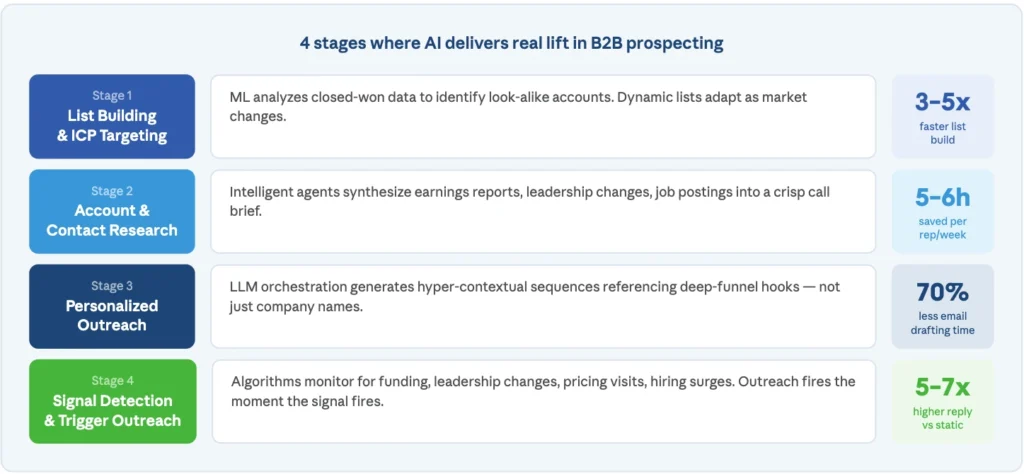
Stage 1: List Building & ICP Targeting
When assessing AI for sales prospecting, look first at target identification. Rather than relying on manual, static filters, machine learning algorithms analyze your historical closed-won data to identify look-alike accounts. These AI prospecting tools automatically score accounts based on firmographic fit, technographic alignment, and active intent, dynamically building lists that adapt as market conditions change.
- The Operational Lift: Outbound infrastructure achieves 3x to 5x faster list building. The operational time required to compile and verify a high-fit, 500-account target list drops from roughly 8 to 12 hours of manual sorting down to 90 minutes.
- Common Industry Tools: Apollo, ZoomInfo, 6sense, Clay.
Stage 2: Account & Contact Research
This stage uses intelligent agents built into premium AI prospecting tools to comb through unstructured web data – quarterly earnings reports, leadership shakeups, active job postings, technology adoptions, and public press releases. The underlying sales prospecting AI synthesizes these disparate data points into a crisp, 1-to-2 paragraph account brief for the rep.
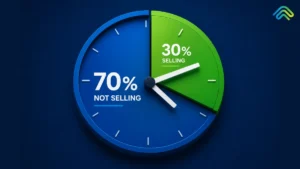
- The Operational Lift: Sales organizations regularly recover 5 to 6 hours per week per rep by eliminating manual research. Pre-call briefing and account prep that once demanded 20 to 30 minutes of deep-diving is reduced to a 5-minute review. This helps mitigate the systemic challenges associated with sales reps spending time not selling.
- Common Industry Tools: Clay, Apollo, Salesmotion, Common Room, or custom-prompted instances of ChatGPT and Claude.
Stage 3: Personalized Outreach Generation
Modern LLM orchestration engines analyze the gathered account intelligence alongside the prospect’s profile to generate hyper-contextual multi-channel sequences. These advanced AI prospecting tools automatically engineer specific variants to support continuous, algorithmic A/B testing.
- The Operational Lift: Email drafting time decreases by up to 70%. Personalization scales past surface-level variables like {{Company_Name}}, allowing teams using sales prospecting is to reference deep-funnel contextual hooks – such as specific bullet points from an executive’s recent industry panel presentation – automatically.
- Common Industry Tools: Lavender, Smartwriter, Apollo AI, Artisan, Instantly AI.
Stage 4: Signal Detection & Trigger-Based Outreach
Algorithms within sales prospecting AI software continuously monitor external digital environments for explicit buying signals, such as leadership changes, new rounds of funding, specific pricing page visits, or sudden surges in technical job openings. The system surfaces these triggers to initiate an outreach workflow the moment the signal is registered.
- The Operational Lift: Reply rates scale up to 5x to 7x higher than untargeted, static outbound campaigns. Transitioning to a signal-based outbound vs cold outbound framework boosts reply rates from the industry average of 3.43% to an optimized range of 15% to 25%.
- Common Industry Tools: Common Room, Champify, RB2B, Clay, Bombora.
The Trap Most Teams Fall Into
When sales organizations scale up their use of AI tools for prospecting, build extensive lists, and deploy automated personalizations, they often find that their aggregate pipeline metrics stall or drop. When this happens, revenue leaders frequently blame the software. However, the problem rarely lies within the tools themselves. Instead, it stems from four systemic operational traps.
Trap 1: Volume Inflation
Because implementing AI for sales prospecting makes it remarkably simple to launch personalized messages, organizations fall into the trap of multiplying their total output. Unfortunately, as every team scales their volume via automated AI prospecting tools, the market experiences severe inbox saturation. According to Sopro 2026 data, the average B2B decision-maker now receives more than 120 cold emails every single week. Pumping out a higher volume of messages into an already overcrowded ecosystem simply accelerates buyer fatigue and triggers spam filters.
Trap 2: Personalisation Theatre
Sophisticated B2B buyers have developed a keen eye for automated personalization patterns generated by basic sales prospecting AI platforms. An opening line like:
“Hi Sarah, I noticed your team at EnterpriseCorp just raised its Series B and is expanding the engineering team…”
may be accurate, but it reads instantly as a boilerplate template populated by an AI script. When personalization feels performative rather than genuinely consultative, prospective buyers tune out.
Trap 3: Stopping at the Email
The vast majority of automated outbound workflows terminate the moment the initial message is sent. They lack a mechanism to manage subsequent, contextual engagement. According to research by the RAIN Group, 52% of sales professionals fail to follow up a second time.
Initial AI Outreach Sent Successfully!

            │

            ▼

  ┌────────────────────────────────────────┐

  │  52% of Follow-Up Sequences Broken     │  ◄── The Leakage Point

  └────────────────────────────────────────┘

            │

            ▼

  Leaked Pipeline & Wasted Data Budget
While AI for sales prospecting software might help your team craft a strong first touch, a broken follow-up process prevents you from capturing the value of that initial contact. To see how to optimize these multi-touch touchpoints, teams must learn how to refine their sales call follow up email cadences across the entire pipeline journey.
Trap 4: Treating AI as a Volume Tool, Not an Intelligence Tool
The lowest-leverage way to use artificial intelligence is treating AI prospecting tools as a digital megaphone to blast more messages into the market. Conversely, the highest-leverage application of sales prospecting is using it as an intelligence filter to identify the exact 50 accounts your team should target this week, backed by the deep contextual data required to win them. Teams utilizing AI purely for volume run into diminishing returns; teams focusing on precision capture compounding revenue.
How the Top 14% Use AI Differently
The comprehensive Ebsta x Pavilion GTM Benchmarks report highlights a stark reality in modern B2B revenue generations: just 14% of elite sales reps generate 80% of total outbound revenue. When you examine how these top-tier performers leverage sales prospecting AI, distinct execution patterns quickly emerge.
Pattern 1: Signal-First Over List-First
Average sales teams operate out of static, monthly CSV lead sheets. Top-performing teams utilize dynamic, signal-driven lists that update daily using advanced AI for sales prospecting engines. AI infrastructure continuously monitors high-value target accounts, tracking structural changes, executive mobility, and intent spikes. It automatically flags the exact accounts requiring attention today, turning list management into an agile, real-time workflow.
Pattern 2: Context Briefs Over Strict Templates
Elite reps avoid letting automated AI prospecting tools completely dictate their customer-facing communication without oversight. Instead, they use AI to build comprehensive context summaries that compile an account’s pain points, vendor history, and strategic initiatives. The representative reviews this brief and personalizes the message manually, leveraging AI to handle the time-consuming research while retaining human control over the final note.
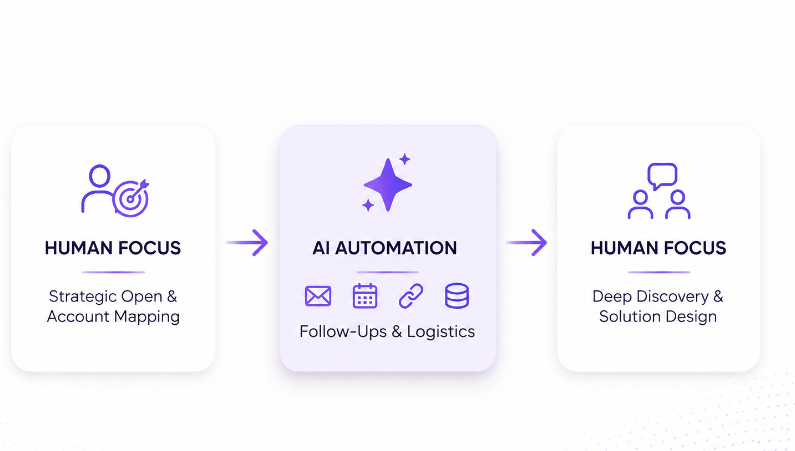
Pattern 3: Automating the Boring Middle
The human element provides the highest value at the bookends of the sales cycle: the creative, highly customized initial outreach and the deep, strategic discovery call. Top performers use sales prospecting AI to manage the repetitive tasks in the middle – such as sending multi-channel follow-ups, managing scheduling links, processing CRM logging, and reviving cold accounts. This keeps their focus square on active, high-intent conversations.
Pattern 4: Shifting the Analytical Metrics
While average teams monitor activity metrics like “total emails deployed” or “sequences initiated” by their AI prospecting tools, market leaders prioritize performance outcomes. They measure metrics such as “conversion rate on signal-triggered outreach,” “qualified opportunities created per account,” and “net revenue per AI-engaged contact.” Changing the underlying metrics directly drives smarter rep behavior.
Pattern 5: Closing the Loop
Top organizations don’t isolate AI for sales prospecting platforms within a top-of-funnel siloed bucket. They bridge their systems so that data flows continuously from the initial list build through research, automated execution, follow-up management, and CRM record tracking. This gives managers complete visibility over the entire cycle.
Best AI Prospecting Tools by Use Case
Navigating the 2026 sales tech landscape requires an objective look at where specific platforms sit within your go-to-market architecture. The table below categorizes the leading platforms by their primary core function.
| Tool Category | Core Functionality | Ideal Deployment Case | Common Industry Vendors |
| AI Email Writers | Drafts personalized multi-channel copy using basic account data inputs. | High-volume SDR setups seeking to accelerate template customization. | Lavender, Smartwriter, Apollo AI |
| AI SDR Platforms | Autonomous virtual agents designed to handle basic list research, outreach, and booking workflows. | Teams experimenting with fully automated inbound/outbound support layers. | Artisan, 11x, Regie, AI SDR by Reply.io (Read more: AI SDR Outbound Agent) |
| Account Intelligence | Crawls the web to aggregate unstructured data into comprehensive account profiles. | Mid-market and Enterprise account teams building out precise ABM motions. | Clay, Salesmotion, 6sense, Common Room |
| Signal Detection | Monitors real-time events across the web, including job changes, intent surges, and product usage. | High-velocity, signal-led outbound teams trying to optimize their timing. | Champify, Common Room, RB2B, Bombora |
| Data Enrichment | Aggregates and cross-references multiple data networks to verify B2B contact info. | Broad-market prospecting engines requiring reliable phone and email data. | Apollo, ZoomInfo, Clearbit, Prospeo |
| Revenue Execution Layer | Unifies the stack by orchestrating signal tracking, intent routing, and follow-up validation. | Operations seeking to connect separate apps into an automated, closed-loop revenue engine. | SpurIQ |
Structuring Your GTM Technology Stack
Building an effective outbound stack isn’t about buying every tool on the market. A reliable, scalable stack typically pairs one solid data enrichment vendor, an account intelligence tool, an outreach mechanism, and a central revenue execution layer to keep your core systems talking to each other.
Beyond AI Prospecting – The Execution Gap That Closes the Loop
Even if you buy the best AI prospecting tools available, traditional workflows often hit a wall right after the initial email is sent. This is where the execution gap appears: target lists remain unacted on, critical buyer signals go unaddressed, CRMs fall out of date, and crucial multi-touch follow-ups fall through the cracks.
The core issue is that conventional ai tools for prospecting focus on improving your outreach inputs. They help you generate better copy and source more data, but they don’t fix the broken processes that happen after your outreach goes out.
Traditional sales tools are optimized to scale the first touchpoint. A true revenue execution platform, by contrast, is built to manage the entire customer lifecycle. This means orchestrating the first touch, validating follow-ups, re-engaging stalled deals, updating records across your CRM, and providing sales leadership with clear visibility into execution performance.
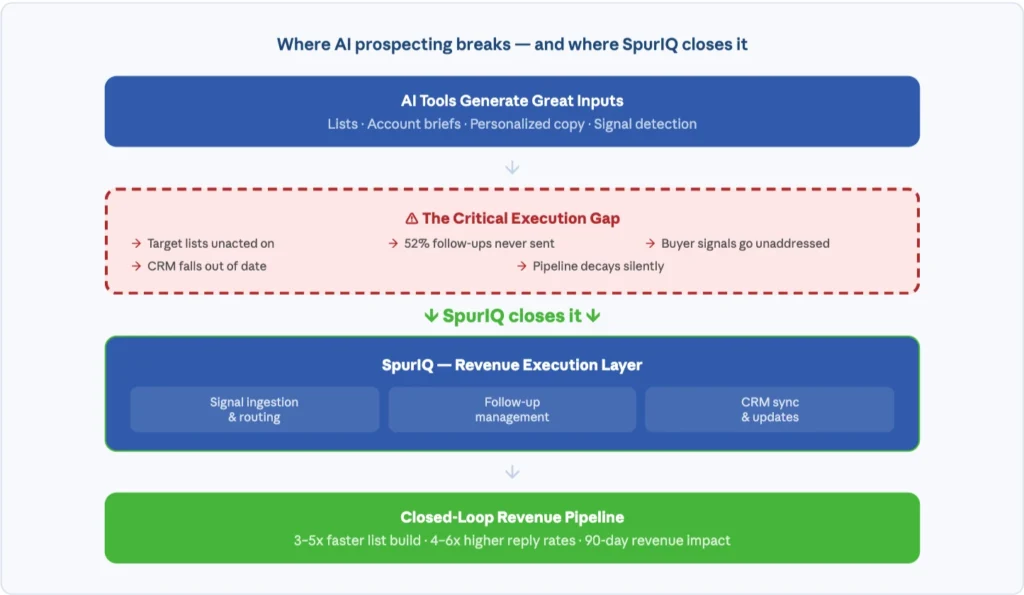
Defining Full-Loop Revenue Execution
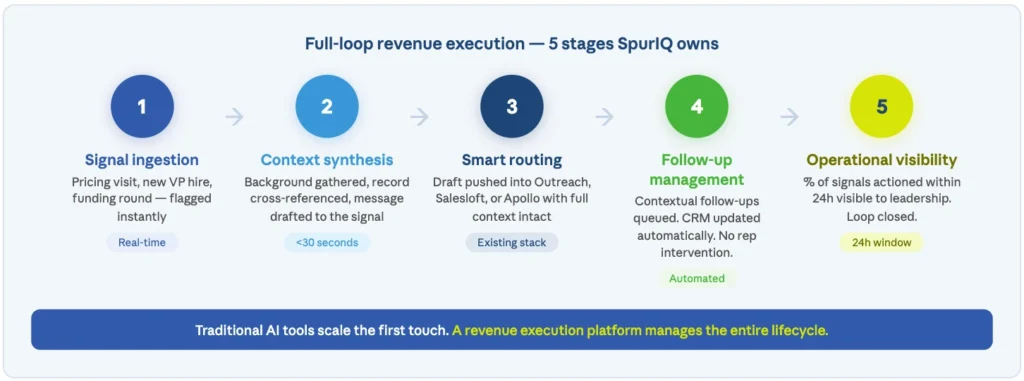
- Signal Ingestion: A sales prospecting AI model flags a critical buying signal – such as an enterprise lead visiting your product’s pricing page or an ideal contact stepping into a new VP role.
- Context Synthesis: Your systems instantly gather relevant background data, cross-reference the contact record, and draft a tailored message tied to that specific trigger.
- Smart Routing: The system pushes this personalized draft directly into your existing sales dialer or sequencer (such as Outreach, Salesloft, or Apollo) with all the necessary context intact.
- Active Follow-Up Management: The execution layer monitors prospective buyer interactions, queuing up contextual follow-ups over time and updating your CRM automatically to reflect recent activity.
- Operational Visibility: Command dashboards show revenue leaders exactly what percentage of high-intent market signals were successfully actioned within a 24-hour window, closing the gap between AI generation and actual sales execution.
This unified architecture is exactly why SpurIQ was developed. SpurIQ is a comprehensive revenue execution platform built to integrate seamlessly with your existing AI stack – including platforms like Apollo, Clay, Common Room, and Outreach – to close the operational gaps that derail typical workflows.
Within this platform, Leads Execution is purpose-built to handle signal-led prospecting execution. It tracks high-value buyer signals, pulls clean contact data, drafts context-aware outreach, routes records to your sequencers, monitors ongoing responses, and ensures follow-ups always trigger on schedule. This changes the game for your sales reps: instead of managing complex manual workflows across disparate AI prospecting tools, they step into a strategic decision-making role. While traditional AI tools focus on creating better prospecting inputs, SpurIQ ensures those inputs successfully convert into active, high-value sales pipeline.
How to Get Started With AI Prospecting
Transforming your outbound sales motion from manual workflows to an optimized, high-yield revenue engine is straightforward when handled in clear, manageable stages.
- Step 1: Audit Your Current Pipeline Workflows: Map out your sales operations across the four key prospecting stages: list building, research, outreach development, and signal tracking. Pinpoint the specific bottleneck currently slowing down your sales team.
- Step 2: Automate a Single High-Leverage Stage First: Avoid trying to overhaul your entire system over a weekend. Focus first on deploying signal-triggered outreach to maximize reply rates, or use AI for sales prospecting software to streamline account research and give your reps their time back.
- Step 3: Connect Your Tools Directly to Your CRM: Ensure every tool you introduce reads and writes directly to your core CRM database. Isolating data in standalone platforms creates visibility gaps and causes execution errors.
- Step 4: Shift Your Focus From Volume to Quality Metrics: Move away from tracking raw activity volume. Instead, evaluate your campaigns based on positive response rates, meeting conversion consistency, and total pipeline value generated by your sales prospecting AI.
- Step 5: Deploy an Execution Layer Before Scaling Up: Before increasing your outbound volume via third-party software, integrate a dedicated execution layer to manage your data flows, keep your CRM clean, and ensure your follow-ups run reliably.
The Strategic Payoff
When organizations deploy this structured sequence correctly, they typically unlock a 3x to 5x acceleration in list-building speed, cut down pre-call manual research times by 50% to 70%, and see reply rates climb 4x to 6x on signal-triggered campaigns within the first 90 days. For a deeper look at fixing these process disconnects across your enterprise, explore our guide on closing the signal-to-action gap in the B2B GTM stack.
The Bottom Line
Deploying AI for sales prospecting is no longer a luxury for forward-thinking sales teams – it is the baseline standard for modern enterprise outbound. With 81% of sales teams incorporating intelligence tools into their workflows, success comes down to how well you execute.
Generating lists, researching accounts, and drafting copy are all critical steps, but they fall short if your team struggles to convert those initial interactions into active pipeline. The companies winning the market are not just buying the newest AI prospecting tools; they are pairing smart AI inputs with a dedicated execution layer that closes loop holes across the sales cycle.
Maximize the return on your sales tech stack. SpurIQ provides the revenue execution platform your team needs to streamline operations, eliminate manual bottlenecks, and turn outbound prospecting into a predictable engine for revenue growth.
Frequently Asked Questions:
How does AI help in sales prospecting?
AI optimizes the outbound sales cycle across four core functions:
Compiling and sorting target accounts lists 3x to 5x faster via specialized AI prospecting tools.
Generating comprehensive prospect briefs in under a minute using automated models.
Drafting context-rich outreach tailored to specific accounts.
Tracking real-time buyer intent signals across the web so your team reaches out exactly when a prospect is ready to engage.
What are the best AI prospecting tools?
The right tools depend entirely on your specific go-to-market motion. For list generation and verification, Apollo and ZoomInfo lead the market. For account intelligence and research automation, Clay stands out. For optimizing email copy, Lavender and Smartwriter are excellent choices. For real-time signal tracking, look to Common Room and Champify. To connect these separate AI tools for prospecting into a unified outbound workflow, revenue execution platforms like SpurIQ tie the entire ecosystem together.
How do I use AI for sales prospecting?
Start by picking a single, high-leverage area to automate, such as signal-triggered outreach or account research. Choose platforms that sync directly with your CRM to avoid creating isolated data silos. Shift your tracking metrics toward positive reply rates and meetings booked rather than raw email volume, and add an execution layer to manage your workflows before scaling up your underlying sales prospecting AI. Most teams see measurable improvements within 30 to 60 days.
Can AI replace SDRs in sales prospecting?
No. In complex B2B sales cycles, AI is built to handle repetitive manual tasks – like data entry, research compilation, and draft writing – not to replace human insight. It cannot replicate strategic judgment, qualification skills, multi-threading, or navigating complex buying committees. Top teams use AI for sales prospecting to free up their SDRs’ time so they can focus on high-value human interactions.
Is AI prospecting better than cold outbound?
They are fundamentally different concepts. Cold outbound is a specific type of sales motion, while sales prospecting AI is the technology used to run it. Pairing AI tools with signal-based selling consistently outperforms traditional, volume-heavy cold outbound campaigns, driving response rates up to 15% to 25% compared to the standard cold outbound average of 3.43%.
What’s the best way to actually execute AI-generated prospecting at scale?
Because 52% of sales professionals miss following up a second time, simply generating outreach copy via AI prospecting tools is only half the battle. The solution is adding a dedicated revenue execution layer to manage the entire sales loop. This layer tracks active signals, routes personalized messages through your sales sequencers, handles follow-ups automatically, and keeps your CRM clean. Platforms like SpurIQ are purpose-built to manage this orchestration layer.