
Deal Risk Scoring: How AI Detects Stalled Deals Before Leadership Notices
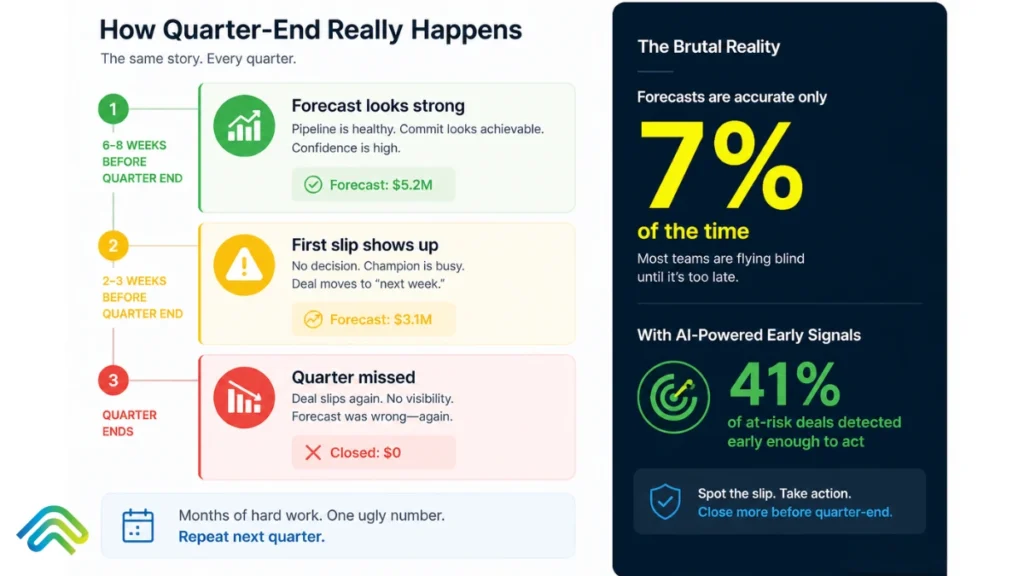
It’s the second Friday of the third month of the quarter. Your forecast says you’ll hit 102% of the plan. By the following Wednesday, three deals have slipped to next quarter. By Friday, that’s seven. The forecast was built on rep optimism, last week’s activity logs, and a CRM that updated when someone remembered to update it. Nobody saw the deal stall. Nobody could. Your VP Sales says it’s a timing issue. The reps say the buyer went quiet. The CRO knows what really happened: the deals were dying for weeks. Nobody had the system to see it. This quarter-end scramble is a universal pain point, and the data proves it. Only 7% of sales organizations achieve 90%+ forecast accuracy (Gartner Research). The median sits dangerously at 70–79%, and 69% of sales operations leaders say forecasting is becoming harder, not easier. Meanwhile, AI deal risk scoring – when properly implemented – flags at-risk deals 41% earlier than manual reviews and identifies up to 89% of deal failures before they happen. In this guide, we will break down exactly how this works. We will cover what deal risk scoring actually is, the hidden signals AI tracks that humans consistently miss, the proven framework for implementing it, and what separates the platforms that simply score risk from the platforms that actually save deals. What Is Deal Risk Scoring? (And Why Static Scoring Stopped Working) Deal risk scoring is a data-driven, systematic method for evaluating the health of sales opportunities. It assigns a numerical score to each open deal based on weighted indicators of risk, moving forecasting away from subjective rep gut-feel to an objective, evidence-based assessment. To understand where we are today, you have to look at the three generations of scoring approaches: Generation 1: Rep Gut-Feel Forecasting (1990s–2010s) For decades, forecasting relied on salespeople assigning probability percentages to deals (“I feel 70% confident this will close”). Managers would interrogate these numbers weekly in pipeline reviews, adjusting them up or down based on experience. The forecast accuracy rarely broke 50–60%. The core failure mode here is human nature: account executives are systematically, inevitably over-optimistic about their own deals. They have to be to survive in sales, but that optimism destroys pipeline predictability. Generation 2: Rule-Based CRM Scoring (2010s–early 2020s) As CRMs matured, RevOps teams tried to enforce logic. They built rule-based automation: If a deal has been in Stage 3 for 30 days, reduce probability by 10%. If there has been no logged activity in 14 days, flag the deal as yellow. While a step forward, this approach was brittle. It relied entirely on reps manually logging data. Reps quickly learned to “game” the system by sending a meaningless check-in email simply to reset the 14-day activity timer, creating a false sense of deal health. Generation 3: AI-Driven Deal Risk Scoring (2024–2026) Modern deal risk scoring doesn’t ask the rep for input; it passively ingests truth. AI models connect directly to the execution layer – email inboxes, calendar systems, Zoom recordings, and marketing engagement platforms. It analyzes the unstructured data (what the buyer is actually saying and doing) to assess risk objectively, in real time. Why the shift matters now: By 2026, over 60% of B2B sales teams use ML-derived intent and risk scoring as a core component of pipeline qualification (Gartner Market Prediction for Revenue Intelligence Platforms). The shift from rep self-reporting to evidence-based scoring isn’t a future trend – it is the new baseline for any competitive revenue organization. How AI Actually Detects Stalled Deals (The Six Mechanisms) The reason AI vastly outperforms human managers in pipeline reviews isn’t magic; it is processing capacity. A sales manager can review the last three emails on a deal. An AI model can review the last three years of successful deal patterns and cross-reference them against every micro-interaction happening today. Here are the six mechanisms AI uses to detect risk: Mechanism 1: Engagement Velocity Tracking AI doesn’t just look at whether an email was sent; it looks at the pace of the response. If a prospect historically replies to emails within 4 hours, and that response time slowly stretches to 12 hours, then 24 hours, then 48 hours – the AI flags the velocity decay weeks before the rep realizes they are being ghosted. Mechanism 2: Multi-Threading Analysis Enterprise deals require consensus. AI maps the communication graph to identify single-threaded vulnerabilities. If a $150K software deal only features back-and-forth communication with a mid-level manager, and the VP or IT Director hasn’t been cc’d or attended a meeting in three weeks, the AI spikes the risk score. It knows the historical win rate for deals with only one active stakeholder. Mechanism 3: Stage Progression Pattern Matching Every organization has an ideal deal velocity. AI analyzes your historical closed-won and closed-lost data to build a predictive timeline. If a deal sits in “Technical Validation” for 18 days, and the AI knows that 92% of deals that sit there for more than 14 days eventually fail, it immediately surfaces the risk. Mechanism 4: Sentiment and Urgency Tracking Using Natural Language Processing (NLP), AI reads the emotional and linguistic shifts in buyer communication. It detects when collaborative language (“how do we implement this?”) shifts to defensive or evasive language (“we are still reviewing internally”). It also tracks urgency decay – noticing when a buyer stops using time-bound words and starts using passive deferrals. Mechanism 5: Close Date Reliability Scoring Sales reps are notorious for pushing close dates to the last day of the month or quarter. AI evaluates the probability of that close date based on the remaining steps required. If the close date is in 10 days, but the AI sees that security review hasn’t started and legal hasn’t received a contract, it marks the close date as mathematically impossible and adjusts the forecast. Mechanism 6: Buyer Process Monitoring AI watches the buyer’s internal mechanics. Did they bring in procurement at the expected milestone? Have they shared the technical documentation internally? By monitoring document views