
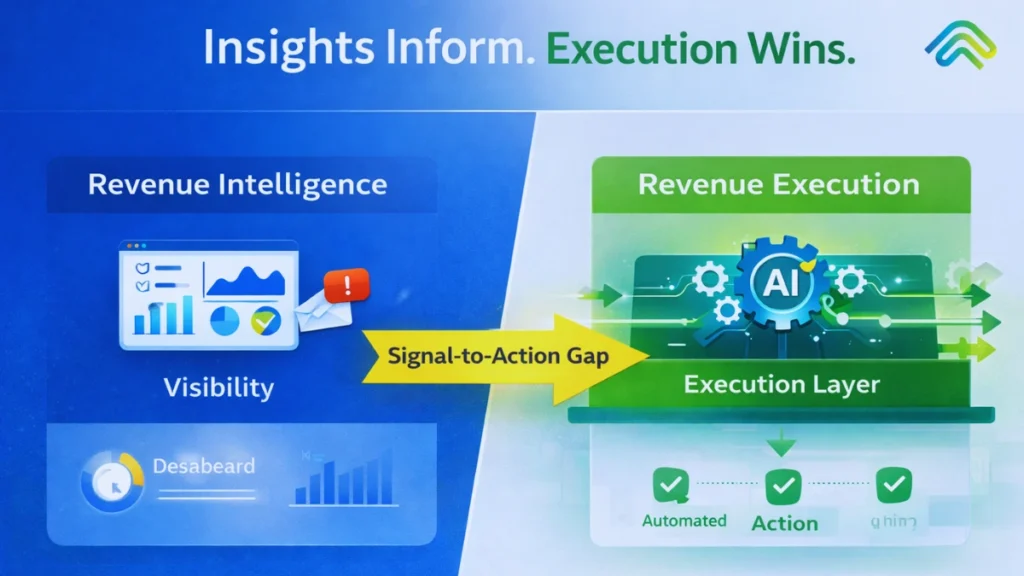
Revenue Intelligence vs Revenue Execution: Why Insights Don’t Close Deals
The Illusion of Visibility. Over the past five years, B2B companies have poured billions into revenue intelligence tools and revenue platforms. The promise was simple: better data leads to better revenue. As a result, dashboards improved. Forecasting accuracy improved. Executive visibility reached an all-time high. Yet, for all this visibility,revenue leakage remains a massive, systemic i`ssue. The root cause of this disconnect is a fundamental misunderstanding of what data actually does. Insight does not equal execution. And execution is what closes deals. When a buyer signals intent but the sales team fails to act immediately, revenue leaks. Industry analysis suggests that this post-signal inaction – the operational friction between knowing something and doing something about it costs B2B organizations between 20% and 30% of their potential revenue. The uncomfortable truth is that your revenue strategy likely isn’t broken. Your execution is. Welcome to the Signal-to-Action Gap. What Is Revenue Intelligence? Revenue Intelligence analyzes sales activities, pipeline data, buyer behavior, and forecasting metrics to provide predictive insights and performance visibility. It is designed to answer three critical questions: Typical Capabilities Include: Where It Lives: Revenue Intelligence is commonly integrated into CRM systems, Revenue Operations platform environments, and forecasting-centric platforms. For example, platforms like Clari and other “Run Revenue” systems do an exceptional job of optimizing forecasting visibility and providing executive oversight. But they all share one critical limitation: They stop at insight. What Is Revenue Execution? To solve the leakage problem, you must move beyond intelligence. Revenue Execution ensures that every revenue signal triggers the right action, at the right time, with strict accountability across the entire funnel. Instead of analyzing the past or predicting the future, Revenue Execution operates in the present. It answers: It operationalizes signals into automated, cross-functional action. If a deal stalls, it doesn’t just change a dashboard color to red; it triggers a workflow to fix it. The Core Distinction: Revenue Intelligence informs. Revenue Execution performs. Revenue Intelligence vs. Revenue Execution: The Core Distinction To understand why revenue leaks, you must understand the fundamental difference in how these two categories interact with your data. Revenue Intelligence is an observational layer. Revenue Execution is an operational layer. While Revenue Operations software optimizes process and reporting, Revenue Execution owns the physical outcome of that process. Consider how they compare across critical dimensions: Dimension Revenue Intelligence Revenue Execution Primary Goal Improve visibility: Understand the state of the pipeline and the accuracy of the forecast. Ensure action: Guarantee that the right steps are taken to advance or save the deal. Output Insights & forecasts: Dashboards, health scores, and predictive modeling. Triggered execution: Automated plays, mandatory tasks, and cross-functional escalations. Focus Predictive analytics: “Based on historical data, this deal has a 40% chance of closing.” Signal-to-action conversion: “This deal’s probability dropped; automatically alerting the VP to step in.” Dependency Human follow-up: Relies entirely on a rep remembering to check the dashboard and acting on it. Automated orchestration: Removes human memory from the equation, forcing the workflow. Value Moment Board reporting: Giving leadership confidence in the numbers at the end of the quarter. Revenue captured: Winning the micro-moments that prevent the deal from slipping mid-quarter. Why Insights Alone Fail to Close Deals? Having the best intelligence in the world is useless if the organization lacks the muscle memory to act on it. Insights fail to close deals due to four specific execution gaps: 1. Alert Saturation Sales leaders and reps are drowning in data. They receive deal risk scores, Slack alerts, and pipeline variance reports daily. When every notification is urgent, nothing is urgent. Without systemic enforcement of follow-up, reps simply tune the noise out. 2. Human-Dependent Execution Revenue platforms are great at flagging stalled deals. But then, they expect a busy, overwhelmed rep to manually prioritize a response. The reality is that human task prioritization breaks down under pressure. 3. Signal-to-Action Latency This is the time elapsed between a buyer engagement spike and the subsequent sales action. As documented in landmark research by Harvard Business Review, latency directly and severely reduces win probability. If you wait 24 hours to respond to a buying signal, the value of that signal approaches zero. This is the Signal-to-Action Gap. 4. Insight Without Accountability Revenue intelligence surfaces risk, but it rarely assigns ownership or enforces an intervention. If a deal slips silently and no manager is forced to intervene, the insight is worthless. The Revenue Execution Layer Missing in Modern Revenue Stacks Look at the modern B2B revenue stack: These are all excellent at surfacing intelligence. But nowhere in that stack is there a system that ensures escalation, automates play activation, closes mid-funnel dormancy, or triggers expansion actions. Insight leads to stalls. Execution leads to conversions. How Revenue (Action) Orchestration Bridges the Gap? To move from insight to execution, organizations require Revenue Orchestration. Revenue Action Orchestration converts distributed revenue signals into coordinated, cross-system action flows automatically. The Mechanism of Orchestration: This is what we call true execution ownership. Practical Example: The Deal Risk Scenario Let’s look at how the two systems handle the exact same problem: a stalling mid-funnel deal. Revenue Intelligence Platform Output: Revenue Execution Model Output: One system informs you that you are losing. The other system fights to win. Where Revenue Intelligence Still Matters? This is not to say Revenue Intelligence is obsolete. It is absolutely foundational. Revenue Intelligence is critical for: However, intelligence is upstream of performance. It sets the stage, but execution determines the realized revenue. The True Revenue Stack: Intelligence + Execution Mature B2B organizations are redesigning their tech architecture to reflect this reality: Without Layer 3, your massive tech investment remains entirely observational. Metrics That Reveal Execution Failure (Even When Intelligence Is Strong) Even if your intelligence is strong, your execution might be failing. You need to reframe your KPIs to spot the leakage: New Execution Metrics to Track: Why This Distinction Matters Now? As Gartner has extensively documented, B2B buying complexity is rising rapidly. Buying committees are larger, sales cycles are lengthening, and AI is exponentially