
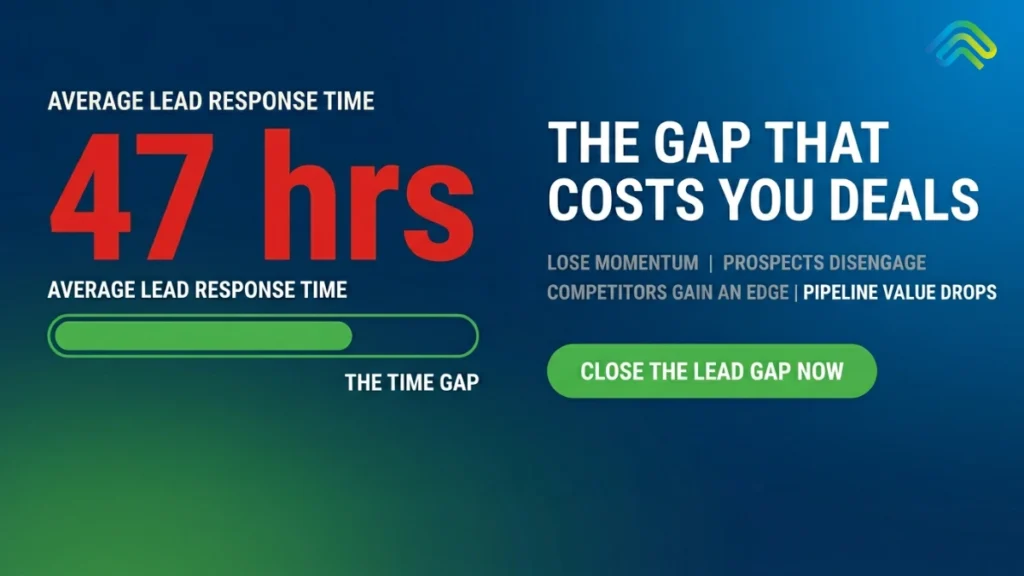
Speed-to-Lead in 2026: Why Response Time Still Wins (And How AI Fixes It)
Speed-to-lead in 2026 is still the simplest and most overlooked predictor of revenue performance. It’s Monday morning. You sit down with your coffee, log into your CRM, and see the damage: there are 47 demo requests from the weekend sitting untouched. The oldest one came in on Friday evening. It was a VP of Operations filling out your high-intent form while actively comparing three different vendors. That was 63 hours ago. By the time your SDR sends the first “Just following up” email, she’s already taken two meetings and signed a contract with a competitor. Everyone in B2B sales knows that speed-to-lead matters. It is not a new concept. The data proving that faster response times equal higher conversion rates has been consistent for more than 15 years. And yet, the reality on the ground is astonishing: the average B2B lead response time is still 47 hours, according to the Optifai 2026 Pipeline Study. Only 23% of companies manage to respond within 5 minutes, while a staggering 63% never respond to an inbound lead at all. In this guide, we are going to break down exactly what is happening. We will share the 2026 data that proves why response time still dictates who wins the deal. We will unpack the structural, systemic reasons most revenue teams fail at this despite knowing better. Finally, we will show you how AI-driven revenue execution finally fixes this gap – not by hiring a massive army of new SDRs, but by fundamentally owning the signal-to-action moment. What Is Speed-to-Lead? (And What It Really Measures) If you ask ten sales leaders, “What exactly does ‘speed to lead’ mean?”, you might get ten slightly different answers. Let’s define it in plain, operational language. Speed-to-lead is the exact measurement of time between a prospect submitting an lead form (such as a demo request, a contact form, a pricing enquiry, or a chat initiation) and the moment your sales team makes their first deliberate contact with that prospect by phone, email, or direct messaging. To build a system that works, it is crucial to distinguish speed-to-lead from other related metrics that often get incorrectly lumped together: Most importantly, you have to understand what speed-to-lead actually measures. It does not measure how fast an individual human can type an email. It measures execution discipline. If you achieve a 5-minute response time, it means your entire pipeline machinery – the form submission, the routing logic, the data enrichment, the rep notification, the rep availability, and the first dial – worked flawlessly end-to-end in under 300 seconds. A 47-hour response time means that pipeline broke somewhere along the way, or most likely multiple times. The 2026 Speed-to-Lead Statistics That Should Terrify You If you think your team is immune to the speed-to-lead problem, the industry benchmarks tell a different story. The data for 2026 is unambiguous. When we look at speed to lead statistics, they group naturally into three terrifying narratives: how teams actually perform, what that performance costs in revenue, and what modern buyers expect. The Performance Gap: What Teams Actually Deliver We have more sales technology than ever before, yet our baseline execution remains shockingly slow. The Revenue Impact: What Speed-to-Lead Is Actually Worth Every minute a lead sits in a queue, the probability of closing that deal plummets. How does speed to lead impact revenue generation? The Expectation Gap: What Buyers Now Demand The consumerization of B2B is complete. Buyers no longer tolerate the “we will get back to you in 1-2 business days” auto-responder. Why Most Teams Fail – And Why It’s Structural, Not Motivational When leaders see the data above, the initial reaction is usually to call a high-urgency sales meeting, yell at the SDR team, and demand they move faster. But this is the wrong approach. The failure is not motivational; it is entirely structural. Speed-to-lead can’t be fixed with a pep talk. To understand why deals decay in a B2B pipeline, we have to look at the five structural failure modes of modern sales environments. Failure Mode 1: Reps Don’t Have 5 Minutes The modern SDR is drowning in administrative tasks. Studies show that SDRs spend only 30% of their actual workday on active selling. The other 70% goes to manual CRM updates, internal meetings, account research, and inbox management. Even the most highly motivated rep cannot physically respond to an inbound demo request in 5 minutes if they are buried inside Salesforce, manually logging detailed notes from their previous discovery call. Speed-to-lead isn’t failing because your reps don’t care. It’s failing because the system they work inside is not built for speed. Failure Mode 2: Routing Logic Breaks When a lead arrives, a massive amount of invisible logic has to execute perfectly. The lead needs to be enriched with external data, scored for qualification, assigned to the correct geographic or vertical territory, and finally routed to a rep who is actually online and available. If even one step breaks – perhaps a routing rule relies on stale territory logic, or the assigned rep is out sick, or an enrichment API times out – the lead drops into a holding queue. Companies with a rigorously defined SLA respond within 15 minutes at nearly double the rate of those without (54.9% vs 29.5%, Blazeo 2026). But in most companies, these SLAs exist on a PDF, not in the actual routing infrastructure. Failure Mode 3: Data Quality Kills Speed Imagine achieving a 3-minute response time, only to dial a disconnected phone number and send an email that hard-bounces. A 5-minute response to a bad record is a 5-minute response to nobody. Currently, 20–35% of B2B contact records contain outdated or entirely incorrect information. Every time a rep rushes to follow up on a bad record, it burns their time and their motivation. Consequently, the next lead in the queue gets less energy and urgency than the last. Fast execution on terrible data is not a strategy. Failure Mode 4: After-Hours and Weekends As noted in