
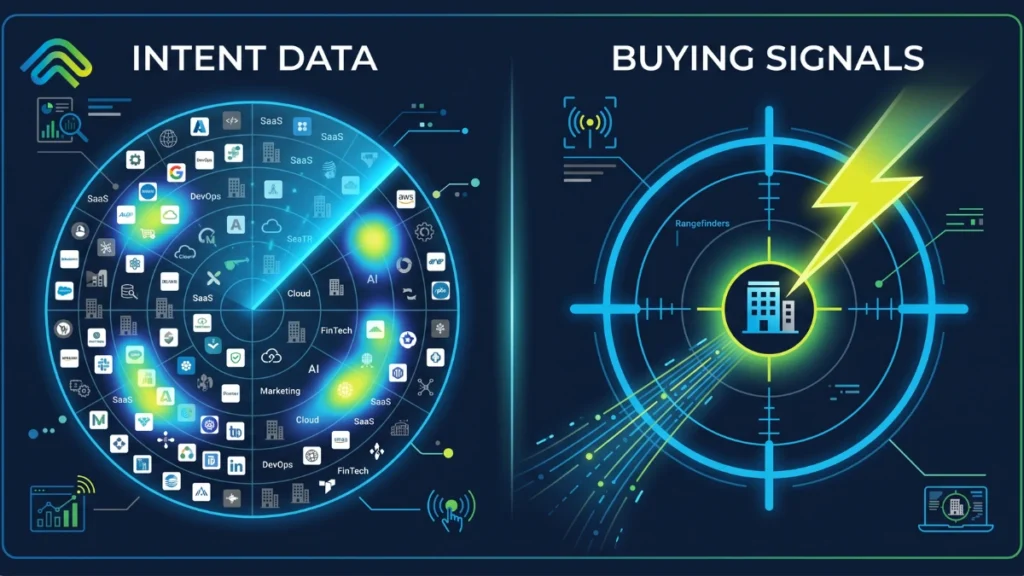
Buying Signals vs Intent Data: What Actually Triggers a Sale in 2026
Most sales leaders have everything in line: Bombora for intent; ZoomInfo for contact information; a CRM system full of behavioral data. And still, the pipeline is empty. If you look closely, most sales reps are cold-calling accounts that haven’t responded in 3 months. Simply, the timing of the outreach is just wrong! Even after having all essential and relevant data – what’s the result? Missed quarters. Longer sales cycles. Reps are burning out on effort that never converts. The problem is not a shortage of data. The problem is that most B2B sales teams treat buying signal and intent data as interchangeable. But, they are not. One tells you where to look. The other tells you when to move. Confuse between these two, and it is impacting your overall quarter sales. You are guessing in a well-dressed spreadsheet (in the era of Artificial Intelligence). While you can efficiently use buying signals and intent data together to increase your overall revenue. This guide draws a clean line between the two and shows how modern B2B revenue teams are using them together to build a faster, more predictable pipeline in 2026. What are Buying Signals in Sales? A buying signal is a real, measurable action or behavioral shift in a target account that indicates a prospect may be moving toward a purchase decision. To understand what makes these signals valuable, it helps to look at the level of certainty they provide. The key idea here is clarity. A buying signal is not a hunch or an account simply “looking active.” It is a concrete event that has already happened. For example, a decision-maker visiting your pricing page multiple times, a company announcing a new funding round, or a new VP of Sales joining and likely re-evaluating tools. These signals indicate that priorities are shifting and a buying window may have just opened. For a seller who is paying attention, this creates a clear and time-sensitive opportunity to act. What is B2B Intent Data in Sales? B2B intent data is behavioral information collected about companies based on their online research activity. It captures the digital trail a business leaves behind when employees research topics, compare vendors, read review content, or consume educational material related to your product category. There are two types worth knowing: 1. First-Party Intent Data First-party intent data is generated from your own digital properties. It is reliable because it reflects direct interaction with your brand. You own it, you can act on it immediately, and there is no middleman interpreting it for you. Common first-party signal sources include: 2. Third-Party Intent Data Third-party intent data is aggregated from external sources that track which companies are engaging with relevant topics across thousands of properties. When a cluster of employees at a target account starts consuming content around “sales automation” or “CRM integration,” that creates a third-party intent surge worth paying attention to. Some of the most significant third-party signal sources include: The Leading Intent Data Vendors When evaluating the best intent data providers, most B2B teams rely on a mix of trusted platforms. The honest limitation of intent data: It is probabilistic. It tells you someone at a company has been researching a topic. It does not tell you who, what their budget looks like, whether they hold any authority, or how close they are to a decision. That gap is exactly where buying signals become essential. What is the Difference Between Buying Signal and Intent Data? Intent data tells you who might be interested. On the other hand, buying signals tell you what just happened and why you should be on the phone right now. Intent data is probabilistic. It is built from patterns of content consumption across publisher networks, review sites, and third-party content hubs. It flags that something might be happening within an organization, but it does not confirm that a decision has been made, a budget has been approved, or that the person conducting the research has any buying authority. On the other hand, buying signals are deterministic. A new VP of Sales joining, a funding round closing, and a competitor’s contract lapsing. These are facts, not patterns. They tell you a window just opened, and that window closes fast. Research shows that vendors who reach out to a newly funded company within 48 hours see conversion rates four times higher than those who wait. There is also a critical identity gap most teams ignore. Intent data tells you the company, not the person. A topic surge at a 2,000-person enterprise confirms that someone inside is researching your category, but it stops there. You do not know if it is the CFO evaluating a budget shift or an intern writing a market report. Buying signals cut through that ambiguity. A named decision-maker visiting your pricing page three times this week is not a pattern. It is a person with a clear intent you can act on today. The table below draws the line: Factor Buying Signals Intent Data Nature Deterministic: something happened Probabilistic: something might be happening Buyer Stage Mid-to-late funnel Early funnel Actionability Act within hours Needs scoring and interpretation first Identity Contact or company-specific Account-level, often anonymous Risk if Used Alone Misses the early pipeline Creates noise; many accounts are not ready But here is what most comparison guides miss: neither intent data nor buying signals create revenue on their own. They create opportunity. What happens in the next 15 minutes decides whether that opportunity becomes a pipeline or leaks. So, you must be quick with your execution to actually move forward the revenue. Why Buying Signals Matter to Modern B2B GTM Teams Here is a hard truth most sales leaders already feel but rarely say out loud: by the time a prospect fills out your demo form, you are probably already too late. Gartner research confirms that B2B buyers spend only 17 percent of their total buying time in direct contact with potential vendors, meaning 80 percent of the journey happens entirely