
The Death of Legacy CRM: Why Salesforce and HubSpot Are Losing the Revenue Execution War
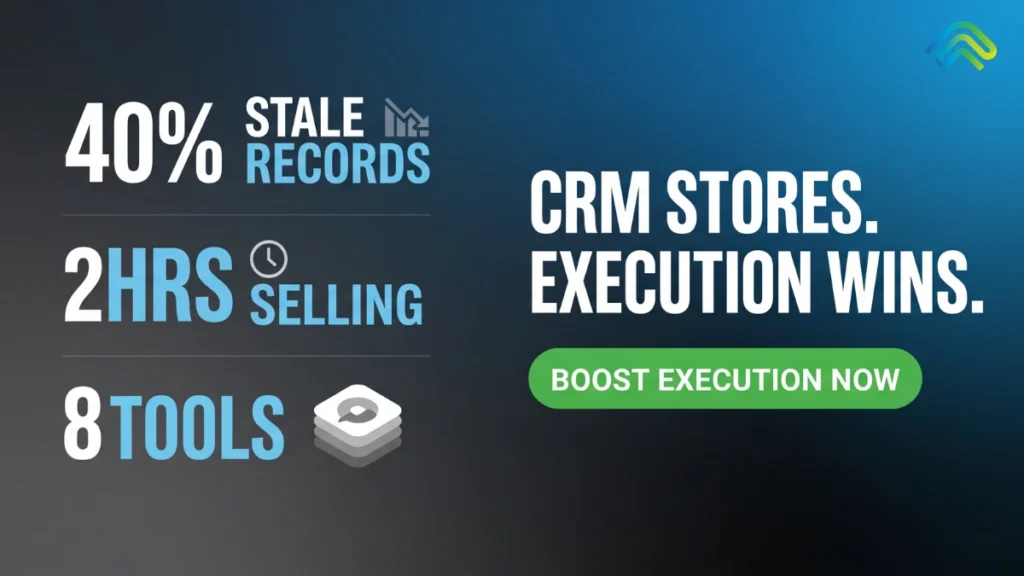
“In the next era of B2B, the winners won’t be the ones with the best database, but the ones with the best process for acting on that database.” ~ Aaron Ross (Author of Predictable Revenue) A trader once said, “You can have all the ships, the maps, and the cargo. If you never sail, the port stays empty.” Today, the same story is playing out inside every B2B revenue team. Revenue leaders are finally starting to admit a truth that has been whispered in boardrooms for years: their CRM is the most expensive address book in the company. B2B teams spend millions of dollars every year on Salesforce and HubSpot, yet an estimated 20 to 30% of potential revenue still leaks after the first buyer interaction. The tools are not broken. The problem is that they were never built for what matters most: execution. CRM systems were designed to record relationships, log calls, and track deals. In 2026, deals are not lost because of missing data. They are lost because no one acted on the data that was already there. People had notes, timelines, and contact history. They just never turned that information into timely, coordinated actions. This signals a massive shift in the market. CRM is not necessarily dying; it has evolved. The real power in the tech stack is moving to the Execution Layer that sits above the database. Legacy CRMs are losing the war because they are trying to solve an execution problem with a storage solution. How Salesforce and HubSpot Became the Center of Every Sales Org (And Why That Era Is Over) Twenty years ago, customer data lived in a hundred places: spreadsheets, email threads, sticky notes, and hazy memory. Then Salesforce came along and said, ‘’Put it all in one place.’’ Slowly but surely, it became the default system that every serious sales organization was expected to run on. The promise was to give every rep a single source of truth, and your team would finally see the whole pipeline, not just a fragmented view. HubSpot followed a similar path but with a different mission. While Salesforce leaned into the enterprise, HubSpot focused on SMBs and marketers. It offered a free CRM as a gateway to its marketing‑first stack, then built workflows that let growing teams track leads, touch points, and revenue in one interface. Within a few years, what started as a marketing tool quietly became a core CRM for thousands of companies. At first, this was a clear win. Centralized data helped leaders see pipelines, forecast revenue, and measure performance in ways that simply weren’t possible before. But somewhere along the way, the magic faded. What was built as a system of action turned into a system of record: a place reps updated because leadership demanded it, not because it helped them close. The very thing meant to drive revenue became the chore no one wanted to do. One revenue‑focused discussion put it clearly: “The CRM is not broken; your process is. You built a system to track leads, but you never built a system to follow up on them.” In that gap, the problems of CRM deepen: incomplete entries, missing context, and forecasts that feel like hopeful guesses rather than grounded predictions. That’s the quiet reality of the Salesforce‑and‑HubSpot era. They succeeded in becoming the center of the sales org, and in doing so, they also became the center of friction. What started as a solution to the common CRM problems of the early 2000s, over time, has become a legacy CRM that is no longer enough for the execution-first world of 2026. That’s how the era where CRM was the undisputed center is ending! The power is shifting now. 5 Core Reasons Why Businesses Are Leaving Legacy CRMs in 2026 In the early days of enterprise software, management thinker Peter Drucker said, “You can’t manage what you can’t measure.” For decades, CRM systems have given teams the ability to measure. However, the 2026 update is that you can’t execute what you don’t automate. That’s because businesses are realizing that knowing where every lead sits is no longer enough. Visibility isn’t the real challenge; it’s turning that visibility into coordinated and timely action. Legacy CRM systems were built to answer the question “What happened?” But B2B revenue teams are asking a new question: “What should happen next, and who is responsible for it?” Simply put, legacy CRM systems are not dying because they are broken. They are being replaced because they were built for a world that no longer exists. As B2B selling becomes more complex, distributed, and signal-driven, the old playbook starts to crack. Here are five reasons teams are quietly moving away from Salesforce and HubSpot as their revenue core: Failure 1: Data Graveyards, Not Decision Engines Legacy CRMs are fantastic at collecting data. They log calls, store notes, track stages, and centralize customer history. But they rarely turn that data into decisions. In practice, this looks like a rep opening a spreadsheet every morning and sorting leads by hand because the CRM doesn’t surface what really matters. Here’s how that gap usually shows up: Case Studies in the AI‑CRM space show that modern systems that surface intent signals can cut rep analysis time by 50–60% compared to traditional CRM‑only workflows. As a Revenue Ops podcast host once put it, ‘You’re not paying for data. You’re paying for the ability to act on it. If your CRM doesn’t tell you what to do next, it’s a data graveyard, not a decision engine.’ This is one of the biggest problems with CRM: rich data, weak action. Failure 2: Manual Hygiene Dependency The quality of your CRM data rests almost entirely on your reps tying the right fields at the right time. That’s a tough bet. CRM deployment landscapes suggest that 40-60% of CRM records are incomplete or stale at any given time. Meaning that, half of your pipeline, give or take, is built on guesswork, not facts. And, forecasts based