Tool Sprawl is Killing Your Sales Team: How to Fix It
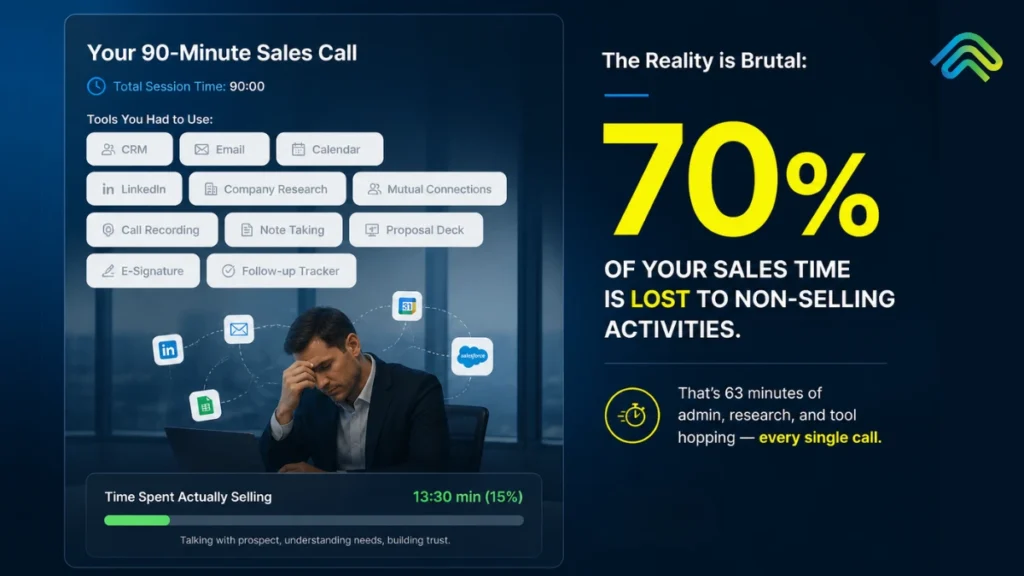
Your SDR has 11 tabs open: Salesforce, Outreach, LinkedIn Sales Navigator, ZoomInfo, Gong, Slack, Notion, Calendly, Salesloft, Apollo, and Chili Piper. They have been at their desk for 90 minutes. Total time spent actually selling: 14 minutes. This is not an edge case. It is the average workday for B2B sales reps in 2026. Salesforce’s State of Sales 2026 report found that reps spend only 30% of their week actually selling, with the rest consumed by admin work, data entry, and navigating platforms that were bought to speed things up. The average B2B sales team now uses 5 to 8 disconnected tools, while some enterprise teams run 12 or more. Reps lose 2 or more hours every day just to context switching. Half of all sellers say they feel overwhelmed by the number of platforms required to do their job. And according to Gartner research, 30-50% of subscription costs are wasted on tools nobody actively uses. At SpurIQ, this post covers the following things: why tool sprawl got this bad, what it is actually costing your team, how to consolidate without breaking deals or losing capability, and the consolidation framework that works in 2026. What is Tool Sprawl? Tool sprawl is the excessive accumulation of disconnected software tools that create more friction than value, slowing down workflows instead of improving productivity. It is a system failure, not a headcount problem. It occurs when a sales tech stack grows without architectural intent, resulting in redundant data flows, broken handoffs, and integration debt that compounds with every new addition. When the cost of maintaining tool interoperability exceeds the value each tool contributes, the stack stops being an enabler and becomes operational overhead. Furthermore, it is also worth separating tool sprawl from healthy stack growth. A team running five well-integrated tools with clean handoffs will outperform a team on three tools that cannot talk to each other. The number is not the issue. The architecture is. In 2020, the average B2B sales team ran on three or four tools. By 2026, that number has climbed to five to eight active tools for most teams, with enterprise orgs regularly peaking at twelve or more. The math compounds fast. Why did it happen? Every new pain point triggered a new vendor purchase. Outbound lagging? Add an intent data tool. Call quality low? Add a conversation intelligence platform. Pipeline visibility off? Add a forecasting layer. Nobody owned the stack as a whole, and slowly, one purchase at a time, teams built themselves into the mess they are now trying to get out of. According to Salesforce’s State of Sales report, 84% of sales teams without a consolidated platform are already planning to address their tech stack in the coming year, and 42% of reps say they feel overwhelmed by the number of tools required to do their job. That is not a technology problem. That is an architecture problem hiding inside a technology budget. The 5 Hidden Costs of Tool Sprawl Most RevOps leaders can feel these costs. Few have added them up. Here is what tool sprawl is actually taking from your team. Cost 1: Lost Selling Time As per SpurIQ research, reps spend roughly 70% of their day on non-selling tasks, leaving less than 30% for actual selling. That translates to about two hours of selling per day, with admin alone consuming roughly one of those hours. A mid-market AE can burn 45 minutes every morning just reconstructing yesterday across Gong, Outreach, Salesforce, and Apollo before typing a single word to a prospect. Cost 2: Data Silos Customer data sits fragmented across five to eight disconnected systems with no real-time sync. The CRM does not see what Outreach sees. “Outreach” does not see what “Gong” heard. The manager sees nothing in real time. According to Gartner, 49% of CSOs say their definition of a qualified lead differs greatly from marketing’s. That is not a strategy problem. That is a data problem. Cost 3: Subscription Bloat 30% to 50% percent of tool spend is wasted on unused or duplicate-function tools. The average sales team is quietly carrying 2 to 3 ghost subscriptions, paying for tools no one actively uses. Those subscriptions accumulate silently, auto-renewing every quarter with no one watching the utilisation data. One $4M ARR company found four overlapping enrichment tools running simultaneously, three of them at below 20% usage. According to Gartner, organisations that actively audit and optimise licenses cut software costs by 30% on average within the first year. Cost 4: Adoption Decay Reps avoid tools they do not need to use, and the pattern is consistent: adoption rates for non-CRM tools routinely fall to 30 to 50% within six months of rollout. The rep stops logging in. The invoice does not stop arriving. According to Salesforce’s 40 Sales Statistics 2026, 42% of reps already report feeling overwhelmed by too many tools, which means the new platform you rolled out last quarter is likely already on its way to becoming shelfware. Cost 5: Burnout and Quota Risk According to our survey, 50% of sellers feel overwhelmed by tool count, and that overwhelm has a direct cost: overloaded reps are 45% less likely to hit quota. Why Most Consolidation Advice Fails Most guides about tool sprawl tell you to rip out your stack and replace it with something cleaner. Buy the all-in-one. Standardise on one platform and shut everything else down. Problem solved. Except for one thing – it does not work. Here is why: Failure Mode 1: The All-in-One Trap Big platforms promise to do everything. And they do. Just not particularly well. For examples; HubSpot is a great marketing tool and a decent CRM. It is not a best-in-class sequencer. Salesforce is the system of record for most enterprise teams. It is not where your reps want to live their day. When you consolidate onto an all-in-one, you trade tool sprawl for capability gaps. Your team goes from too many mediocre handoffs to one platform that does most things adequately