In the modern C-suite, the quarterly board meeting has developed a predictable, if painful, cadence. The Chief Revenue Officer (CRO) presents a robust pipeline; the CMO highlights a surge in high-intent signals; and the CEO expresses cautious optimism. Yet, six weeks later, the post-mortem tells a different story. The targets were missed – not by a fraction, but by a canyon.
The data suggests we are living through a “Missed Target Epidemic.” According to executive research from Forbes, Forrester and Gong:
- 55% of mid-market companies miss quarterly revenue forecasts by more than 10%.
- 73% of B2B organizations failed to meet their total growth expectations last year.
- 80% of companies missed their forecast at least once in the last 24 months.
When these misses happen, the traditional reflex is to blame the “macro”, point to a “weak top-of-funnel,” or overhaul the sales compensation plan. But the reality is far more clinical. Companies aren’t missing revenue because of bad strategy or inferior products.
They are missing revenue because of hidden execution gaps.
Deals rarely die because of a sudden lack of interest. They slip because execution falters after the signal is received. This is the Revenue Execution Gap and it is the silent killer of the modern enterprise.
What is the Revenue Execution Gap?
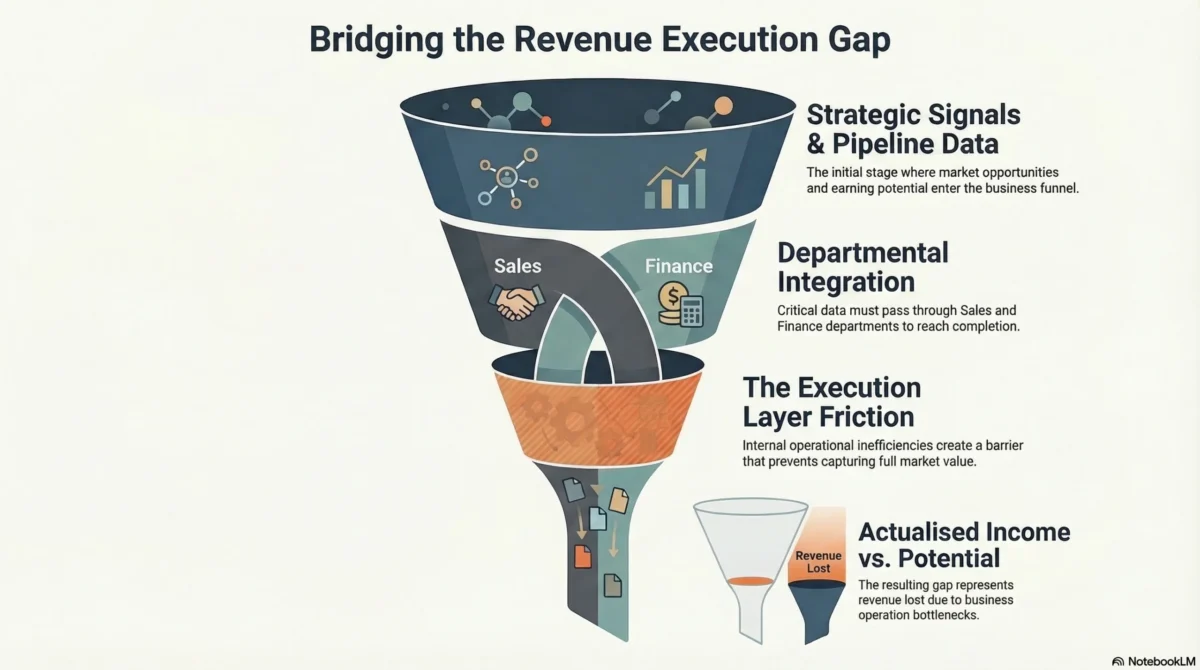
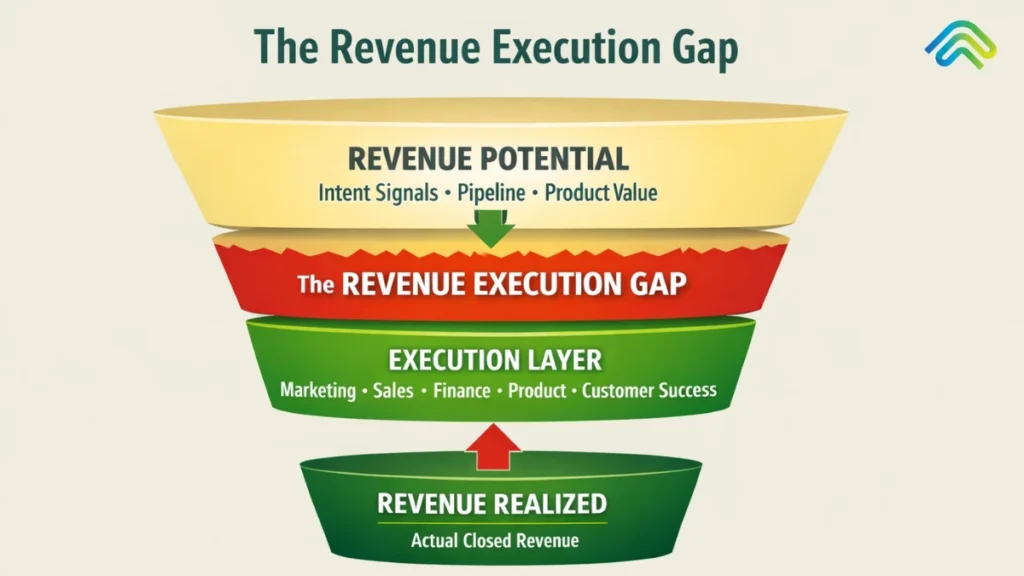
To solve the crisis, we must first define it with precision. The Revenue Execution Gap is the delta between Revenue Potential – the signals, intent and pipeline momentum generated by your GTM engine – and Revenue Realized.
It is the organizational friction that prevents a high-intent signal from becoming a closed-won contract. To understand what it is, we must differentiate it from the “usual suspects” of business failure. The Revenue Execution Gap is:
- Not a demand gen problem: The signals and leads are often present.
- Not a forecasting math problem: The spreadsheet isn’t broken; the reality it describes is.
- Not a CRO hiring problem: Changing the leader doesn’t fix a broken machine.
- Not a headcount issue: Throwing more bodies at a leaky bucket only increases the volume of the leak.
It is, fundamentally, a signal-to-action failure across the cross-functional funnel.
Where Deals Actually Start Slipping: A Stage-by-Stage Autopsy ?
The gap is not a single hole; it is a series of micro-fractures across the revenue lifecycle. To fix it, we have to perform a clinical autopsy on where momentum actually dies.
1. Top-of-Funnel: The Signal Ignored
The gap begins long before a deal is “created” in the CRM. In the age of “Dark Social” and 6-sense intent data, signals are everywhere, but execution is nowhere.
- Symptoms: Intent spikes (e.g., a key account visiting a pricing page six times) occur without prioritized follow-up.
- Execution Failure: Marketing-qualified leads (MQLs) are tossed over a “wall” where they sit in digital purgatory. Finance isn’t involved in early pricing discussions and product innovations – the very things customers want to buy – aren’t yet operationalized into the sales motion.
- The Research Insight: As noted in Forbes, many businesses fail to monetize their commercial assets – such as innovation, relationship equity and codified knowledge – simply because the “signal” of interest never triggers a “play” of action.
- Revenue Impact: Opportunity never exists. The gap starts at zero.
2. Mid-Funnel: The Momentum Black Hole
This is where the majority of slippage hides. Modern Go-To-Market (GTM) motions have over 40 operational growth drivers, yet most leaders only measure 10.
- Symptoms: Stalled deals without automatic escalation. Prospects go dark and the “Next Steps” field in the CRM remains unchanged for 14 days.
- Execution Failure: Weak handoffs between Product, Sales and the Deal Desk. There is no enforced “multi-threading” (engaging 6.8+ stakeholders required for a modern B2B deal).
- The Blind Spot: Pipeline health is not equal to execution health . A $10M pipeline is a vanity metric if the execution layer is too brittle to move it to the next stage.
- The Forecast Fallacy: CROs rely on “Sales Intuition” or “Commit” tags, but without execution enforcement, these are just guesses.
3. Late-Stage: The Finance & Deal Desk Blind Spot
Research indicates that 3–5% of total revenue leakage stems from weak coordination between Finance, Product, Sales and Contracting.
- Symptoms: Margin misalignment discovered in the 11th hour. Contract redlines that stall for three weeks in a legal queue.
- Execution Failure: Pricing exceptions are granted without accountability. Finance isn’t integrated into the workflow until the deal is “ready to sign,” by which time the buyer’s urgency has cooled.
- Revenue Outcome: Deals slip to the next quarter. Cash flow is delayed. Margin erosion occurs as sales reps “give away the farm” just to close the deal before the clock strikes midnight on the 31st.
4. Post-Sale: The Expansion Paradox
Perhaps the most egregious execution gap exists after the initial win. 73% of B2B revenue comes from existing customers, yet only 23% of companies effectively enable expansion.
- Symptoms: Usage signals (a 40% spike in platform seats) are captured by the product but never operationalized by Sales or Customer Success (CS).
- Execution Failure: Renewal risks aren’t auto-escalated. The system fails to monetize the customer’s success, turning potential Lifetime Value (LTV) into churn or stagnation.
- The Leak: Revenue leakage shifts from “Win-Loss” to “LTV Erosion.”
The Root Cause: The Go-To-Market Complexity Explosion
Why is the Execution Gap widening now? Because the GTM environment has hit a “Complexity Wall.”
The modern revenue engine is:
- Technology-enabled: We have 10+ tools in the stack (CRM, Gong, Outreach, 6-sense, etc.).
- Data-intensive: We are drowning in signals but starving for wisdom.
- Cross-functional: A single deal now requires a “squad” (Sales, CS, Finance, Legal, Product).
This creates a Decision-Heavy environment. Every day, your team is making thousands of micro-decisions. Yet, our measurement systems remain backward-looking. We look at what happened last month to guess what will happen next month, while the execution gaps of today go unaddressed.
Why Traditional Revenue Management Misses the Gap?
The market has attempted to solve this with software, but we’ve been buying tools that provide Visibility without providing Velocity.
1. Revenue Intelligence (e.g., Gong, Clari)
These tools are excellent at forecasting and deal scoring. They use AI to tell you a deal is “at risk.”
- The Limitation: They surface problems; they do not enforce actions. Knowing a deal is “red” doesn’t fix the deal if the rep doesn’t know exactly what the next cross-functional move is.
2. Revenue Operations (RevOps) Software
RevOps aligns systems, cleans data and standardizes processes. It creates a beautiful “map” of the journey.
- The Limitation: A map is not a car. You can have a perfect process on paper, but if the humans (or automated systems) don’t follow it, the execution gap remains.
3. Revenue Operations Platforms
These provide a unified view across CRM, Marketing and Finance.
- The Critical Line: Insight informs leadership; Execution drives outcomes. Most platforms stop at the “Insight” phase. They tell the CEO why they missed their number three weeks after they missed it.
The Three Executive Blind Spots
If you are a CEO, CFO, or CRO, you likely have three major blind spots regarding your revenue engine:
Blind Spot 1: Are Our Targets Even Measuring Execution?
Traditional KPIs are “Outcome Metrics”: Revenue, Win Rate, Retention, Pipeline Coverage.
What’s Missing: “Input Metrics” or “Execution Drivers.”
- Signal-to-Action Latency (How long does it take to react to a pricing page visit?)
- % of signals without follow-up.
- Cross-functional handoff delays (How long does a contract sit in Legal?)
- Slipped Revenue Ratio.
If you don’t measure execution, you can’t fix it.
Blind Spot 2: Are We Pulling the Right Growth Levers?
When targets are missed, the standard “Playbook” is:
- Hire/Fire the CRO.
- Add more SDR headcount.
- Change the commission structure.
- Buy more “AI” software.
The Reality: Research shows over 60% of growth factors are cross-functional and process-driven. Revenue is not a number to chase; it’s a system to build.
Blind Spot 3: Who Owns Execution Across the Funnel?
Sales owns the pipeline. Marketing owns demand. Customer Success owns retention. Finance owns cash.
But who owns revenue realization? In most companies, the answer is “no one.” It falls into the gaps between the silos.
The Signal-to-Action Gap: The Pulse of Execution
This brings us to the core of the SpurIQ philosophy. To close the Revenue Execution Gap, we must solve the Signal-to-Action Gap.
Definition: The Signal-to-Action Gap is the latency and inconsistency between a revenue signal and the action required to convert it.
- The Signal: An existing customer reaches 90% seat capacity.
- The Action: An automated expansion play, a Finance-approved quote and a CS outreach.
- The Gap: If that signal sits in a database for 10 days before someone notices, the gap has swallowed the opportunity.
Without orchestration, signals just become dashboards. And dashboards don’t close deals.
Revenue Execution vs. Revenue Performance
It is a common mistake to conflate these two terms.
- Revenue Performance is what you report to the Board. It is the result of the game.
- Revenue Execution is the operational muscle that creates those outcomes. It is the drills, the plays and the discipline of the team.
Performance is a lagging indicator. Execution is the only leading indicator that actually matters.
What Closing the Revenue Execution Gap Actually Requires?
To move from a “Forecast-driven” culture to an “Execution-driven” culture, an organization requires four pillars:
1. Signal Consolidation
You cannot execute on what you cannot see. You must unify signals across CRM, Marketing, Finance and Product into a single, real-time “Stream of Truth.”
2. Orchestrated Action Triggers
In the old world, a signal created an “Alert” (an email or a Slack ping). In the new world, a signal must trigger a Play. Not a notification, but a cross-functional workflow that moves the deal forward automatically.
3. Cross-Functional Enforcement
Execution cannot be optional. If a deal is stalled, the system must enforce multi-threading or trigger a Finance-led pricing review. The alignment between Sales, Finance and CS must be embedded in the workflow, not discussed in a weekly sync.
4. Closed-Loop Accountability
You must track the execution itself:
- Was the action taken?
- Was it timely?
- Did it change the outcome?
How Revenue (Action) Orchestration Solves the Crisis?
This is where the category of AI Revenue Action Orchestration comes into play. It is the evolution of the GTM stack.
Revenue Orchestration converts signal detection into coordinated, automated action flows across systems and functions. It is the “Execution Owner” that sits on top of your CRM and RevOps tools.
The SpurIQ Mechanism:
Signal > Prioritization > Automated Play > Ownership > Outcome Tracking.
SpurIQ’s role is to eliminate the latency that kills deals. It doesn’t just show you that revenue is slipping; it prevents it from slipping by:
- Lead IQ: Preventing top-of-funnel decay by ensuring every high-intent signal is met with an immediate, orchestrated response.
- Deal IQ: Stabilizing mid-funnel execution by automating the “drilling” of deals – ensuring Finance, Legal and Product are aligned before the “Commit” date.
It is not another dashboard. It is the Executioner.
Case Pattern: The Anatomy of a Slipped Deal
Let’s look at how a $500k deal slips without Revenue Orchestration:
- Week 1: A key stakeholder at a Target Account downloads a technical whitepaper and visits the pricing page. (Signal detected but not prioritized).
- Week 2: The rep finally reaches out, but the stakeholder is now in another evaluation. (Latency gap).
- Week 4: A deal is created, but only one contact is engaged. (Multi-threading gap).
- Week 7: The deal reaches the “Contract” stage. Legal and Finance discover a pricing misalignment that wasn’t addressed in Week 3. (Cross-functional gap).
- Week 9: The quarter ends. The deal slips to Q3. The CEO explains it as “economic headwinds.”
The Reality: Forecast accuracy wasn’t the issue. Execution ownership was.
The New Mandate for CEOs, CROs and CFOs
The competitive advantage in 2026 and beyond is no longer Visibility. Everyone has data. Everyone has a CRM. Everyone has AI-powered forecasting.
The new competitive advantage is Execution Discipline at Scale.
As a leader, you must ask:
- Are we measuring execution drivers, or just outcomes?
- Where exactly – in minutes and hours – do our deals start slipping?
- Are our signals automatically operationalized, or are they waiting for human intervention?
- Who owns cross-functional action enforcement?
How to Diagnose Your Revenue Execution Gap?
Before you hire ten more reps or buy another lead list, perform an Execution Audit:
- Audit Signal-to-Action Latency: How long does it take for a “Hand-raiser” to get a meaningful, cross-functional response?
- Map Cross-Functional Handoffs: Where does Sales stop and Finance begin? Is there a “black hole” in between?
- Identify Manual Dependency Points: How many steps in your “Perfect Process” require a human to remember to do something?
- Track Slipped Revenue Ratio: What percentage of deals in your “Commit” forecast actually close in the quarter they were promised?
Conclusion: Revenue Is a System, Not a Forecast
We have spent the last decade obsessed with “Revenue Performance” – with the numbers on the screen and the charts in the slide deck. But performance is just the shadow cast by execution.
We have crossed the threshold from experimentation into structural transformation. According to the Harvard Business Review, the enterprise debate over AI’s viability has decisively concluded. The board is no longer asking if this technology works. As Gartner consistently warns, the singular, urgent question driving strategy today is: “How do we deploy this securely, reliably and at scale before our competitors do?”
In the modern revenue era, you don’t win by seeing more. You win by executing faster, more consistently and more automatically than your competitors. The Revenue Execution Gap is either your greatest liability or, if you close it, your greatest competitive moat.
FAQs:
Q: Why do deals slip even when pipeline looks healthy?
A: Pipeline health and execution health are not the same thing. Deals most commonly slip due to stalled follow-up on intent signals, weak handoffs between sales and deal desk, absent finance alignment in late-stage negotiations, and no automated escalation for stagnating opportunities. Most CRM dashboards surface these issues after the quarter ends, not in time to act.
Q: How much revenue do companies lose to execution gaps?
A: Research indicates that 3–5% of revenue leaks from poor coordination between sales, finance, contracting, and billing alone. Beyond that, 55% of mid-market companies miss quarterly forecasts by more than 10%, and 73% of B2B revenue comes from existing customers, yet fewer than 1 in 4 companies effectively enable expansion. Much of this loss traces back to unmanaged execution, not market conditions.
Q: How is Revenue Execution different from Revenue Operations (RevOps)?
A: RevOps aligns systems, standardizes processes, and improves data quality across go-to-market functions — it creates the infrastructure for execution. Revenue Execution is the operational discipline of actually converting signals and pipeline momentum into realized revenue through orchestrated, cross-functional action. Visibility tells you something is wrong. Execution determines whether you fix it before the quarter closes.
Q: Who owns revenue execution in most companies?
A: In most organizations, no single function owns revenue execution end-to-end. Sales owns pipeline, marketing owns demand, customer success owns retention, and finance owns cash flow, but no one owns the handoffs between them. This distributed accountability is one of the primary reasons execution gaps form and compound undetected across the funnel.
Q: What are the biggest executive blind spots around revenue execution?
A: Three blind spots are most common among CEOs, CROs, and CFOs: (1) measuring outcome KPIs like win rate and retention without tracking execution drivers like signal-to-action latency or cross-functional handoff delays; (2) responding to missed targets by adding headcount or changing comp plans when over 60% of growth factors are process-driven; and (3) assuming that more technology or better forecasts solve what is fundamentally an execution ownership problem.
Q: How can companies diagnose their Revenue Execution Gap?
A: Start by auditing signal-to-action latency, how long does it take for your team to act on a qualified intent signal? Then map every cross-functional handoff in your funnel to identify manual dependency points. Track your slipped revenue ratio quarter-over-quarter and measure what percentage of expansion signals from existing customers are being actively monetized. These diagnostics reveal where execution is breaking down before they show up in missed forecasts.