
SpurIQ

AI Strategy

AI sales agents
AI Strategy, Revenue Operations

AI Sales Agents Explained: What They Are, How They Work, and What’s Missing

Every GTM team right now is being sold an AI sales agent, yet the category remains a complete mess. If you lead a revenue organization, your inbox is likely overflowing with pitches for these tools. Between 2025 and 2026 alone, hundreds of new AI sales agents flooded the market, each promising to automate your pipeline, scale your outreach, or magically double your revenue. If you lead a revenue organization, your inbox is likely overflowing with vendor pitches. Gartner predicts that by 2028, a third of all enterprise AI interactions will use autonomous agents rather than simple chat interfaces. Because of this massive shift, between 2025 and 2026 alone, hundreds of new AI sales agents flooded the market. The result? GTM teams are drowning in point solutions that generate endless activity but fail to move the needle on actual revenue. We are being sold a vision of autonomous growth, but the reality on the sales floor is often just more dashboard fatigue, siloed data, and unexecuted tasks. This guide provides a clear, hype-free definition of what an AI sales agent actually is, how it operates beneath the hood, and – most importantly – what the vast majority of these tools get fundamentally wrong. We will break down the mechanics of these systems and reveal why generating activity is not the same as executing revenue. By the end, you’ll understand why the future of B2B sales doesn’t rely on adding more noise to your tech stack, but on closing the gap between a buying signal and a completed action. What is an AI Sales Agent? AI Sales agent is a software system that autonomously performs multi-step sales tasks – such as account research, outreach drafting, lead qualification, CRM updates, and risk detection – using a combination of Large Language Models (LLMs), real-time data signals, and complex workflow logic. Unlike traditional sales software, which simply stores data until a human acts on it, a true sales AI agent is capable of reasoning, decision-making, and execution. It doesn’t just hold the list; it works the list. However, the market is rife with mislabeled tools. To cut through the noise, GTM leaders need to understand the distinct differences between an AI sales agent and legacy or adjacent technologies: How AI Sales Agents Work? The GTM agent role in AI sales is fundamentally about processing information and turning it into momentum. To do this, data-driven AI agents in B2B sales explained, operate across a five-stage loop: Step 1: Capture Signals  The process begins with listening. The agent ingests data from across your ecosystem. These signals can be explicit (a prospect filling out a demo request) or implicit (a target account showing high intent on third-party sites, a champion changing jobs, or a stalled deal sitting in a specific CRM stage for too long). This includes intent data, product usage metrics, CRM events, email/calendar activity, and contact enrichment feeds. Step 2: Assess Context  A raw signal is useless without context. In this stage, the agent stitches disparate signals together to form a cohesive, account-level or deal-level picture. If an intent tool flags a company, the agent cross-references your CRM to see if there is an active opportunity, checks past closed-lost notes, and maps the current buying committee. It builds the “why” behind the interaction. Step 3: Decision Making Armed with context, the agent uses its LLM reasoning capabilities to determine the next best action. You will understand whom you should reach out to, what channels you should use, what messaging framework best aligns with your customer’s specific pain-points, and the most optimal time to engage with your potential customers.  Step 4: Action / Execution This is where the rubber meets the road. The agent executes the decision – drafting the hyper-personalized email, sending the LinkedIn connection request, updating the CRM fields, or routing the highly qualified lead to the appropriate Account Executive. Step 5: Learning Loop Finally, the agent measures the outcome of its actions. Did the email bounce? Did the prospect reply? Did the deal advance to the next stage? The system ingests this feedback to refine its future targeting, messaging, and timing. The Crucial Flaw: While this five-step loop looks perfect on paper, it represents a massive signal-to-action gap in reality. Most tools handle steps 1 through 3 perfectly. They capture signals, assemble context, and make brilliant decisions. But they stop short at step 4. They recommend actions to reps rather than executing them. They handle step 5 barely at all. As we’ll explore later, this failure to execute is where revenue teams are losing the most money. The Main Types of AI Sales Agents There are mainly five types of AI sales agents: Prospecting or Research agents, Outbound Outreach Agents, Conversational/Voice agents, Deal Execution Agents, and RevOps/Orchestration Agents. These AI agents for sales and marketing are categorized by specialized functions and deployed across the revenue lifecycle. Sales AI Agent Types What It Does Typical Use Case Prospecting / Research Agents These agents search the web and your databases to build targeted account lists, enrich contact details, and flag real-time buying signals. Sales teams use them for top-of-funnel targeting and expanding their Total Addressable Market (TAM). Outbound Outreach Agents These agents use account research to automatically draft and send highly personalized emails and LinkedIn messages. Teams use them to automate SDR workflows and scale their outbound pipeline creation. Conversational / Voice Agents These agents handle live conversations by making outbound calls or answering inbound dials to qualify leads. They are ideal for managing off-hours routing and automating outbound sales calls for lead qualification. Deal Execution Agents These agents monitor active deals, draft follow-up emails, update CRM fields, and alert managers about stalled opportunities. Sales leaders deploy them to boost AE productivity, keep forecasts clean, and enforce sales methodologies. RevOps / Orchestration Agents These agents act as the connective tissue for your tech stack by routing data between tools and enforcing workflow rules. RevOps teams rely on these AI agents to streamline sales pipeline management
Buying Signals
AI Strategy, Thought Leadership

B2B Buying Signals: How to Detect, Prioritize, and Act Before the Window Closes

You know a deal is somewhere in your pipeline, but you’re not sure who’s ready, what triggered their interest, or when to reach out. Signals are everywhere, from website visits and content downloads to pricing page views. But without timely action, they lose value quickly.  This is where most revenue quietly slips away. Not because of a lack of data, but because of a lack of execution. The challenge is that today’s buyers don’t announce their intent. They research quietly, compare vendors, and build shortlists before ever speaking to sales. According to a CEB study published in Harvard Business Review, B2B buyers complete nearly 60% of their purchase decision before speaking to a supplier. This clearly shows that success is not just about identifying signals. It depends on how quickly and effectively teams act on them. In this guide, we’ll explore how to detect, prioritize, and act on buying signals in B2B so you can engage prospects at the right time and improve your chances of conversion.   Let’s move to the key concepts.  What are Buying Signals? Buying signals are observable actions or events that indicate a prospect is entering or progressing through a buying decision window. If you’re wondering what are customers buying signals, they are essentially the digital breadcrumbs left behind during the buyer journey. In simple terms, they are behavioral traces that reveal intent before a buyer ever speaks to sales. Understanding what are buying signals helps teams move from guesswork to precision. A key distinction must be made here: Recognising buying signals is not about tracking activity alone – it is about understanding context and intent. Two Broad Categories of Buying Signals: 1. Explicit Buying Signals Explicit buying signals are direct indicators of purchase intent, which may be as follows:  These signals are high intent but usually late-stage buying signals in sales processes. 2. Implicit Buying Signals These are behavioral or contextual indicators that suggest early or mid-stage intent: These signals are subtle but often more valuable when detected early, especially when recognising buying signals before competitors do. Moreover, you can go through the table below to better understand the type of signals and their intensity.  Signal Type Source Example Strength First-Party Your website Pricing page visited 3 times in a week by 2 stakeholders High First-Party Content engagement Case study + ROI calculator downloaded in one session Medium-High Third-Party Intent data providers Topic surge on “CRM migration.” Medium Third-Party Public data Funding round + sales hiring spike Medium-High The key takeaway is simple: B2B buying signals are never just one-off events. They are patterns of intent across time, people, and context, often supported by layered buying signals data. Why Buying Signals Matter More in 2026 Than Ever Before? Buying signals matter more in 2026 because buyer behavior has changed significantly. Sales teams can no longer rely on late-stage interactions to identify intent. Instead, early signal detection has become essential to engage buyers at the right time. To understand why this shift has made buying signals so critical, let’s look at the key changes in how modern B2B buyers research and make decisions. Shift 1: Buyers Research Independently Before Speaking to Sales Buyers today are already well-informed before they contact any vendor. By the time sales enter, they already have: Why this matters: Since buyers research on their own long before reaching out, you should track engagement on key pages like blogs, service pages, case studies, and pricing pages. This helps you identify real interest before any sales conversation.  Responding to these signals quickly can help you stay ahead of competitors and improve your conversion rates, which is why identifying and analyzing buying signals at this stage is essential. Shift 2: Buying Committees Have Expanded Enterprise deals now involve multiple stakeholders, often 10 or more, each generating separate signals: Why this matters: To understand real deal progress, track signals from the entire buying committee, not just a single contact. Monitor their activity across product pages, downloads, and webinars to see who is engaged and who still needs attention.  This helps you act at the right time and move deals forward more effectively. Shift 3: Only a Small Portion of Your Market is Actively Buying B2B purchases are rarely spontaneous. According to Gartner, 99% of B2B purchases are triggered by specific organizational changes, meaning your buyers only enter the market when a particular internal event or shift creates the need. Most of your addressable market is simply not in a buying window at any given time. Why this matters: Mass outreach to accounts that are not yet triggered is largely wasted effort. Instead, track behavioral and firmographic signals to identify which accounts are showing signs of an active buying window right now.  Teams that focus on signal-based outreach consistently outperform those blasting generic messages across their entire list, because they are reaching the right people at the right moment with the right context. Focusing on the right accounts at the right moment is one of the highest-leverage moves a B2B revenue team can make. How to Identify Buying Signals: The Complete Framework? Here’s a complete framework for identifying buying signals across your business touchpoints. The 3-Layer Framework to Evaluate Buying Signals Here are three-layered frameworks to help you evaluate buying signals. Layer 1: Fit Signals Fit signals tell you whether a company is a good match for your product in the first place. They don’t indicate buying intent, but they help you determine whether the account is worth focusing on. Below are the mentioned signals.  Fit signals do not indicate intent. They indicate potential relevance. Layer 2: Opportunity Signals Opportunity signals indicate moments when a company is likely to have the budget, motivation, or internal pressure to make a purchase decision. These are external events that open a buying window, even if the prospect has not yet started actively researching. These signals often indicate budget availability or strategic readiness. Layer 3: Intent Signals Intent signals are the clearest sign that someone is actively researching and moving

AI SDR
AI Strategy, Thought Leadership

AI SDR and AI Outbound Agents: What They Actually Do, Where They Fail, and What Comes Next

Every AI SDR on the market makes the same promise: automate your outbound sales, send personalized messages at scale, qualify leads in real time, and book meetings while your team sleeps. And to be fair, many of them deliver on that promise. At least for the first touch. The problem is what happens after. An AI outbound agent can find the right buyer, craft a compelling cold email, and get a reply. But the moment that reply arrives, the moment a lead becomes a real opportunity, execution falls back on humans. CRM updates happen late, follow-ups get missed, buyer research doesn’t happen before calls, and deals that looked alive quietly decay in the pipeline. That gap between generating a lead and consistently executing every revenue action after it is not an SDR problem. It is an execution problem. And it is where most AI SDR tools stop and where revenue starts slipping. This guide covers what an AI SDR actually is, how AI outbound agents work, the real differences between AI and human SDRs, how to choose the right tool for your sales team, and why the smartest B2B teams in 2026 are pairing their AI SDR with a revenue execution layer that owns the follow-through. What Is an AI SDR? An AI SDR (artificial intelligence sales development representative) is software that uses AI to automate the tasks a human SDR would normally handle: prospecting, lead qualification, personalized outreach, cold email sequences, follow-ups, and meeting scheduling. Think of it as a virtual sales rep that operates around the clock, sending personalized messages based on buyer data without needing breaks, holidays, or ramp time. The core capability that separates an AI SDR from basic sales automation is intent. A traditional email sequencer sends email A on day one and email B on day three regardless of what the prospect does. An AI SDR reads signals in real time, a prospect visiting your pricing page, a company announcing funding, a decision-maker changing jobs and adjusts its messaging, timing, and channel based on what those signals mean. In practical terms, an AI SDR handles six core functions across the sales process: AI SDR vs Human SDR: An Honest Comparison The AI SDR versus human SDR debate has a clear answer: you need both, but for different reasons. AI outbound agents dominate on scale, consistency, and cost. A human SDR costs $75,000–$100,000 annually and typically generates 15–20 qualified opportunities per month. An AI SDR platform runs $500–$2,000 monthly and can produce 40–60 qualified opportunities at comparable quality. The economics are hard to argue with. But scale is only half the story. Here is where each excels: Capability AI SDR Human SDR Speed Responds to inbound leads within minutes, 24/7 Average response time is 48 hours; 73% of leads never get a first reply Personalization Data-driven; pulls context from intent signals, LinkedIn, and CRM Intuition-driven; reads cultural nuances, emotional cues, and unscripted situations Consistency Never misses a follow-up, never has an off day Variable; affected by fatigue, motivation, and competing priorities Relationship building Limited; handles early-stage outreach well but can’t build trust over complex deal cycles Excels; empathy, rapport, and judgement win complex B2B deals Cost $500–$2,000/month $75,000–$100,000/year plus benefits and ramp time Qualifying leads Instant scoring based on engagement and ICP fit Nuanced judgement on deal complexity, org dynamics, and buying committee alignment The smart play is not replacing your sales team with AI. It is using AI agents to handle the volume-heavy, repetitive work at the top of the funnel, prospecting, cold outreach, initial qualification and freeing your human reps to focus on relationship building, complex conversations, and closing. SaaStr reports the average SDR tenure is just 14 months, with 52% leaving within a year. Every time an SDR leaves, you lose 3–4 months of ramp time. An AI SDR eliminates that churn entirely. It does not get promoted, poached, or burned out. How AI Outbound Agents Actually Work? An AI outbound agent runs on a four-stage cycle that mirrors what a strong human SDR does, but at a speed and scale no human can match. Stage 1: Signal Detection and Targeting The agent monitors intent signals across multiple data sources: website visits, content downloads, job changes, funding announcements, tech stack changes, and social activity. When a signal fires that matches your ideal customer profile, the agent identifies the right contact and moves to outreach. This is the shift from volume-based cold outreach to signal-based selling. Instead of blasting 10,000 generic emails, the AI targets accounts that are already showing buying behaviour. Signal-based outbound campaigns consistently achieve 15–25% reply rates, compared to the 3–5% average for untargeted cold email. Stage 2: Research and Personalisation Once a target is identified, the agent enriches the contact with buyer intelligence: company context, recent news, tech stack, org chart, and any previous interactions logged in the CRM. This context powers genuinely personalised messages, not the “Hi {first_name}, I noticed your company {company_name}” template that everyone ignores. Stage 3: Multi-Channel Outreach The agent executes outreach across email, LinkedIn, and sometimes SMS or phone, adjusting channel, tone, and timing based on the prospect’s engagement pattern. Follow-ups are not time-based (“send email 2 on day 3”) but behaviour-based (“send a follow-up referencing the case study they clicked”). Stage 4: Qualification and Handoff When a prospect replies, the agent detects intent, interested, objecting, requesting information, or not a fit and responds accordingly. For qualified leads, the AI books meetings directly into rep calendars and syncs all context to the CRM so the rep walks into the call fully prepared. The Blind Spot Every AI SDR Shares Here is the part that none of the competitor blogs mention. Every AI SDR on the market is designed to generate pipeline. They find buyers, send personalized outreach, qualify leads, and book meetings. And they do it well. But what happens after the meeting is booked? After the discovery call? After the proposal is sent? The AI SDR hands the deal to a human

GTM engineering
Thought Leadership, AI Strategy

What Is GTM Engineering? The Role Redefining B2B Outbound in 2026

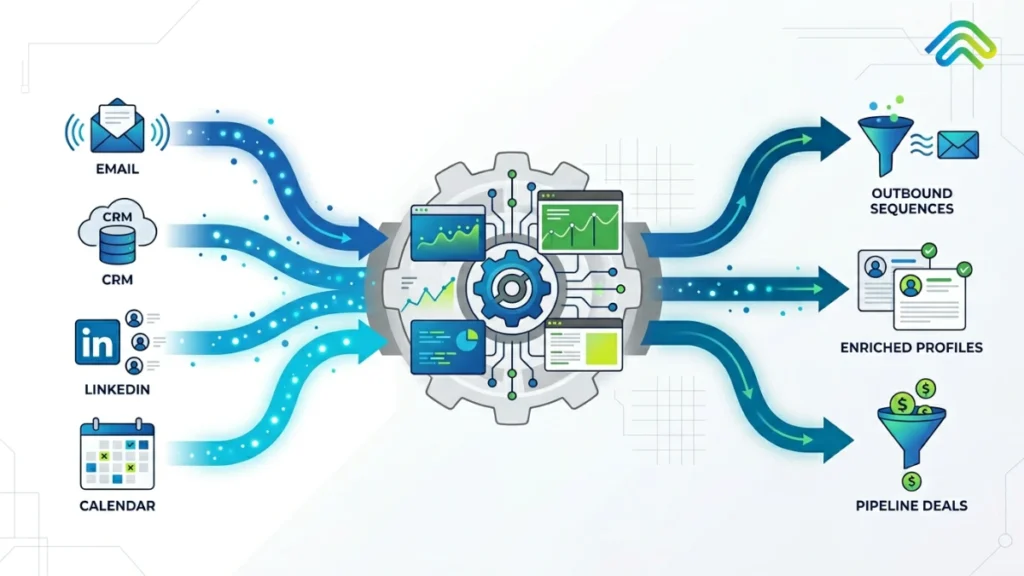
If you’ve been anywhere near B2B sales or marketing conversations lately, you’ve probably heard someone mention GTM engineering. Maybe it was a LinkedIn post about a “GTM engineer” replacing an entire SDR team. Maybe it was a job listing with a $135K median salary for a role that didn’t exist two years ago. Either way, the buzz is real. And it’s not just hype. GTM engineering is one of the fastest-growing disciplines in B2B revenue and for good reason. As customer acquisition costs climb (now roughly $2 in sales and marketing spend for every $1 of new ARR, a 14% increase since 2024), companies need a fundamentally different approach to building pipeline. This guide breaks down what GTM engineering actually is, why it emerged, how it works as a framework, the tools that power it, and, critically, where most GTM engineering setups still fall short on execution. What Is GTM Engineering? GTM engineering is the practice of designing, building, and maintaining automated systems that power B2B revenue operations. Instead of relying on manual sales outreach and disconnected marketing tools, GTM engineers create integrated workflows that connect data enrichment, lead scoring, CRM management, intent signals, and outbound sequences into a single, automated revenue engine. Think of it this way: if your go-to-market strategy is the what and why, GTM engineering is the how, the technical infrastructure that turns strategy into repeatable, scalable execution. The role sits at the intersection of sales, marketing, and engineering. A GTM engineer doesn’t just operate existing tools. They build the connective tissue between them, stitching together APIs, configuring automation workflows, setting up signal-based triggers, and designing data pipelines so that the right action reaches the right buyer at the right time. GTM Engineering in a Nutshell Aspect Description Definition The technical discipline of building automated systems that power B2B revenue operations Core Function Connects data, tools, and workflows into a unified pipeline generation engine Key Shift Moves outbound from volume-based (blast and pray) to signal-based (detect and act) Who Does It GTM engineers — a hybrid of RevOps, sales engineering, and data engineering Why Now Rising CAC, tool sprawl, and AI maturity make manual GTM unsustainable Why Did GTM Engineering Emerge? GTM engineering didn’t appear out of thin air. It emerged around 2024 as a response to three converging pressures that made traditional outbound models increasingly unsustainable. 1. Customer Acquisition Costs Are Rising Fast According to the 2025 Benchmarkit report, the blended customer acquisition cost (CAC) ratio is now 10% higher than in 2022. Companies are spending more to acquire each dollar of revenue, and simply adding more SDRs to the headcount doesn’t scale the way it once did. The math is clear: one strong GTM engineer who builds workflows that dozens of reps can leverage produces better ROI than hiring five additional SDRs to manually prospect from static lists. 2. Tool Sprawl Has Created Fragmentation The average B2B sales team now uses more than 10 different tools daily. Intent data flows in from one platform, enrichment happens in another, CRM sits separately, and outbound sequences run in yet another tool. The result is fragmented workflows, duplicated data, and reps who spend more time context-switching between tabs than actually selling. Research consistently shows that sales reps spend approximately 70% of their week on non-selling activities, admin tasks, data entry, research, and tool management. GTM engineering addresses this by creating a unified system where data flows automatically between tools, eliminating the manual glue work that eats up selling time. 3. Buyers Have Changed Over 80% of B2B buyers finalise mid-market purchasing decisions within six months, often without ever contacting a vendor directly. By the time a sales rep gets involved, the buyer has already done extensive independent research. This means outbound needs to be timely, contextual, and triggered by actual buying signals, not blasted from a static list. GTM engineering makes this possible by detecting intent signals (website visits, content downloads, job changes, funding announcements) and automatically routing them to the right action at the right time. What Does a GTM Engineer Actually Do? A GTM engineer’s day-to-day responsibilities vary depending on the company’s maturity, but the core work falls across six stages of what’s often called the GTM engineering framework. Here are the 6 stages GTM Engineering Framework: Stage 1: Data Enrichment Building and maintaining the data layer that powers everything else. This includes setting up enrichment pipelines using tools like Clay, Apollo, or ZoomInfo to automatically pull firmographic, technographic, and contact data into the CRM. Without clean, enriched data, everything downstream breaks. Stage 2: Signal Detection Configuring systems that monitor buyer intent signals, website visits, pricing page activity, content engagement, job changes, funding rounds, tech stack changes. The goal is to identify accounts showing active buying behaviour before a competitor does. Stage 3: Lead Scoring and Prioritisation Building scoring models that move beyond static firmographic rules. Modern GTM engineers use a combination of intent signals, engagement data, and contextual factors to dynamically rank which accounts deserve immediate attention. Stage 4: Workflow Automation Designing the automated workflows that connect signals to actions. When an account hits a threshold score, the system automatically triggers the right response, whether that’s adding the account to an outbound sequence, alerting a rep, or enriching the contact with additional buyer research. Stage 5: Outbound Execution Building multi-channel outbound sequences (email, LinkedIn, phone) that are triggered by signals rather than calendars. The personalisation layer is critical here, sequences pull enriched data to customise messaging at scale without losing relevance. Stage 6: Measurement and Optimisation Tracking the metrics that actually matter: meetings booked, pipeline generated, conversion rates by signal type, and cost per qualified meeting. GTM engineers run this as an iterative engineering loop, testing, measuring, and optimising continuously. GTM Engineering vs RevOps: What’s the Difference? This is one of the most common questions in the space, and the distinction matters. RevOps manages and optimises existing tools and processes. RevOps professionals maintain CRM hygiene, build reporting dashboards, manage sales territories, and ensure

who owns revenue execution
Thought Leadership, AI Strategy

Who Owns Revenue Execution Inside Your GTM Org And Why the Answer Is Costing You Pipeline

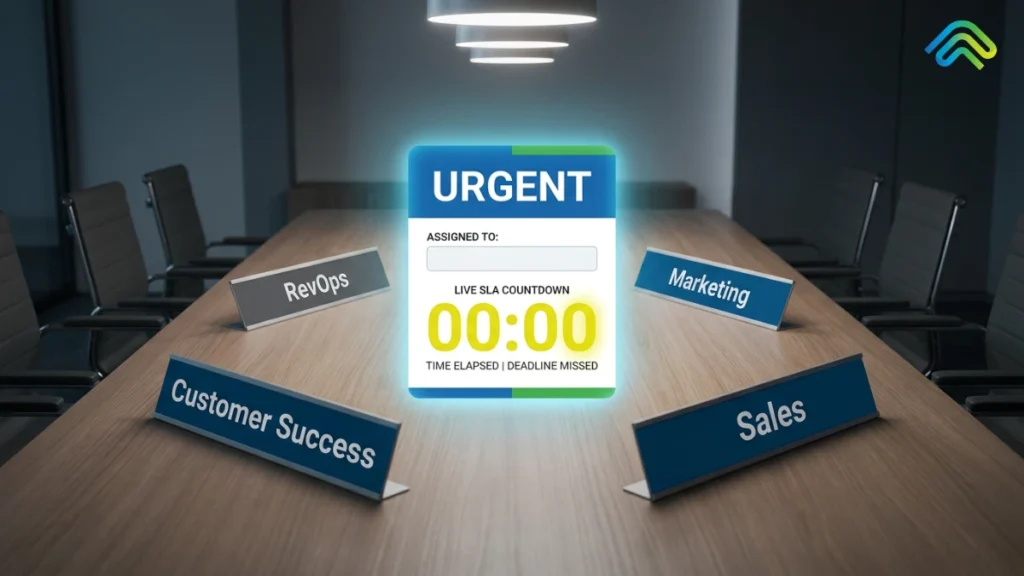
Who owns revenue execution in a B2B organization? In most companies, no one does, not explicitly, not systematically, not in a way that survives a missed quota conversation. Marketing claims the top of the funnel. Sales owns active deals. RevOps architects the CRM. Customer Success monitors retention signals. Each function holds a slice of the buyer journey, but no single team owns the real-time, systematic act of converting buying signals into immediate, accountable action. This structural fragmentation is the RevOps accountability gap, the gray zone between knowing what needs to happen and guaranteeing it does. Closing it requires more than a cleaner RACI chart or a tighter SLA policy. It requires a dedicated revenue execution layer: a system that assigns ownership at the signal level, enforces deadlines and escalates when nothing happens. Without it, B2B revenue accountability remains theoretical and revenue leakage accountability sits with everyone and no one at the same time. Walk Into Any Boardroom and Ask This Question “Who actually owns the execution of our revenue strategy?” You’ll get a confident, entirely fragmented chorus. Marketing insists they own top-of-funnel leads. Sales grabs the steering wheel for active deals. RevOps proudly points to the CRM architecture. Customer Success pulls up their health scores. On paper, everyone owns revenue execution. In practice? Nobody does. This is not a people problem or a motivation problem. It is a structural failure baked into how modern B2B GTM organizations are designed and it is the primary driver of revenue leakage that dashboards can see but cannot fix. Revenue execution ownership in B2B is not just the act of selling. It is the real-time, systematic habit of turning buying signals into immediate, assigned, time-bound action. When execution ownership in GTM gets divided across departments without a unified layer enforcing it, critical signals fall through the cracks at the exact moments they matter most. “In most B2B orgs, revenue execution is owned by everyone on paper and no one in practice.” — SpurIQ How the Modern GTM Org Distributes and Drops Revenue Execution Ownership? Modern B2B companies are built on specialization. That specialization is a genuine strength, until it fragments execution ownership GTM into four separate functions with four separate mandates, none of which includes “make sure the signal gets acted on before the buyer moves on.” Here is exactly how revenue execution ownership in B2B gets fractured: Marketing owns the top of the funnel Demand gen teams grind for MQLs. They build the bridge to the buyer. Their mandate ends the moment the lead lands in the CRM. What happens to that signal in the next 48 hours is structurally not their problem and that gap is where revenue leakage accountability first goes missing. Sales owns the conversation AEs and SDRs own the pitch and the relationship. But they are human beings managing dozens of accounts simultaneously. Administrative follow-ups get deprioritized. Signals that should trigger immediate action sit unactioned in dashboards no one opened. The result is not a performance failure, it is an execution ownership GTM failure. RevOps owns the architecture They build the stadium and ensure the data flows cleanly. They do not play the game. Even the best RevOps teams ultimately flag “Stalled Deals” in a report and wait for a sales manager to ping a rep on Slack. This is the core of the RevOps accountability gap: RevOps designs the execution playbook; it does not and was never designed to, run it. Customer Success owns retention signals CS monitors product usage and NPS scores and knows when an account is trending toward churn. But they rarely own the automated commercial triggers that force timely intervention. By the time the data reaches someone who can act, the window has often closed. That is revenue leakage accountability failing at the bottom of the funnel. Every team handles execution incidentally. No team owns it explicitly. This is what we call The Execution Ownership Gap, the most expensive structural flaw in modern B2B revenue accountability. The Revenue Execution Ownership Breakdown by Role Role What They Own What They Drop Marketing Lead gen, MQL delivery, campaign ROI, messaging Post-handoff engagement, real-time SLA enforcement Sales Pitching, relationship building, closing, forecasting Signal tracking, CRM hygiene, systemic follow-ups RevOps Tooling architecture, data alignment, analytics Actual execution of the playbook, real-time prospect outreach Customer Success Onboarding, adoption, health scoring, QBRs Commercial triggers required to act on sudden churn signals This table is not an indictment of any of these functions. Each team is doing exactly what it was designed to do. The problem is that who owns revenue execution was never answered at the organizational design level. It was assumed to happen in the spaces between four well-resourced, well-intentioned teams. It doesn’t. The RevOps Accountability Gap: Why the Tragedy of the Commons Applies to Your Pipeline In economics, the “tragedy of the commons” describes what happens when a shared resource is managed by everyone collectively and owned by no one specifically, it gets depleted. In the B2B GTM org, your buyer’s journey is that shared resource. Because every team touches the buyer’s journey, every team assumes some other team is handling the granular follow-up. This is the RevOps accountability gap made structural: the bystander effect applied to B2B revenue accountability. The more people who can see a problem on a shared dashboard, the less any individual feels personally responsible for solving it. The result is The Execution Ownership Gap: strategy is solid, data is present, tooling is expensive and the physical act of moving a deal forward dissolves in the ether between four capable, well-intentioned teams. For a deeper look at how this plays out at the signal level, see our analysis of the Signal-to-Action Gap in modern GTM stacks. The 3 Places Revenue Leakage Accountability Goes Missing in B2B Orgs Revenue leakage accountability doesn’t fail randomly. It fails at three predictable, structural handoff points, the same three points in virtually every B2B org, regardless of headcount, tech stack, or how well-defined the process looks on paper.

revenue dashboards dont fix revenue
Thought Leadership, AI Strategy

Why Dashboards Expose Problems but Don’t Fix Revenue

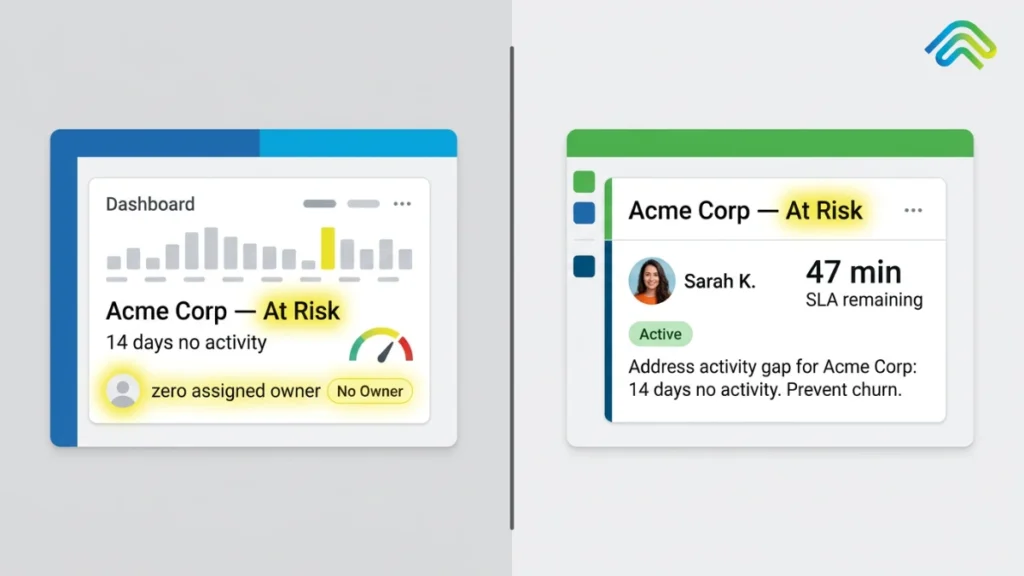
“The most dangerous dashboard is the accurate one that no one acts on. “Your Revenue Dashboard Isn’t Broken. That’s Exactly the Problem. There is a ghost that haunts the mahogany-row boardrooms of the Fortune 500 during every quarterly business review. Revenue leaders call it the Perfectly Accurate Disaster. Picture it: the BI team presents gleaming, real-time Tableau or PowerBI dashboards. The data is indisputable. It shows a 15% slippage in mid-market deal velocity, a stale pipeline in the EMEA region, and a rising tide of “no-decision” losses at the final stage. The dashboard is functioning with surgical precision, showing you exactly how, where, and why you are going to miss your year-end number. Three weeks later, nothing has changed. This is the central paradox every VP of Sales and CRO is living with right now: revenue dashboards don’t fix revenue. Perfect visibility does not produce corrective action. We have spent the last decade and billions in venture capital perfecting “Revenue Intelligence,” yet according to Gartner, a staggering number of B2B sales organizations still miss quota, not from a lack of data, but from an inability to act on it with speed and accountability.The hard truth most management consultants won’t say out loud: dashboards are diagnostic tools, not corrective systems. A thermometer tells you that you have a fever. It cannot synthesize penicillin. If your organization is relying on a dashboard to fix revenue, you are watching a GPS highlight that you are fifty miles off-route and expecting the screen to turn the steering wheel. What dashboards were designed to do? To understand why revenue dashboards don’t fix revenue on their own, you need to understand their lineage. Dashboards were born from Business Intelligence, a discipline designed entirely for reporting, not execution. The passive ledger vs. the active command center Historically, the CRM was designed as a system of record: a digital filing cabinet built for auditors and managers. Dashboards were layered on top to summarize that record. This created two fundamentally different operating models that most companies have never consciously chosen between. Most B2B organizations are deeply invested in the first model while desperately wanting the outcomes of the second. The Three CRM Dashboard Limitations Bleeding Your Pipeline In advising global GTM leaders, three recurring failure patterns surface with near-universal consistency. Together, they constitute what we call the Visibility Trap: the organizational condition of mistaking data transparency for operational rigor. Trap 1: Alert fatigue — the signal-to-noise crisis When everything is flagged as critical, nothing gets fixed. Modern CRMs are configured to flag a deal “red” if it hasn’t been touched in seven days. In a typical enterprise pipeline, this means a single sales VP is staring at 400 red deals on any given Monday morning. The result? The VP ignores the dashboard entirely. High visibility without prioritization creates cognitive paralysis. Without a system that separates noise from a genuine revenue-critical signal, the dashboard becomes background static. The most urgent deals dissolve into the same red gradient as dozens of healthy ones that just need a follow-up email. The CRM dashboard limitation here is structural: the tool was never built to rank urgency in real time. It reports equally on everything. Trap 2: Deal decay dashboard — stale data masking real risk A dashboard is only as accurate as the data entered by the least-motivated rep in your organization. If your team updates opportunities on Friday afternoon before a forecast call, your revenue dashboard is lying to you from Monday through Thursday. This is the deal decay dashboard problem, by the time a dashboard shows a deal is “stalled,” the deal has actually been dead for two weeks. The champion left the company. The competitor got a reference call. The budget got frozen. The dashboard doesn’t know. It’s still showing “Stage 3: Negotiation.“ McKinsey research indicates that companies automating data capture see material improvements in forecast accuracy, precisely because they eliminate this visibility lag. Relying on manual CRM updates is a structural recipe for revenue leakage in B2B that no reporting layer can solve. Trap 3: Insight without accountability — the bystander effect This is the most expensive trap. Because everyone can see the dashboard, there is a psychological assumption that someone is handling it. A high-value contract is stuck in legal review. It is visible on the “At-Risk Deals” dashboard. The AE thinks the Sales Manager is talking to Legal. The Sales Manager thinks the AE has it under control. The deal slips to next quarter. Both professionals are competent. The system failed them. Visibility does not assign ownership. A dashboard is a public square. An execution system is a direct assignment with a named owner, a deadline, and an escalation path if nothing happens. Why More Dashboards Make Revenue Leakage in B2B Worse, Not Better? When revenue growth slows, the instinct of enterprise leadership is to buy another tool, a “Single Pane of Glass” to unite all other panes of glass. This instinct is precisely wrong. Every new dashboard adds a layer of friction: According to Deloitte’s digital transformation research, the most successful revenue organizations are not the ones with the most tools, they are the ones with the highest Signal-to-Action Ratio. If you increase visibility (signals) without increasing capacity to act, you are not solving your revenue problem. You are increasing the stress level of your management team while the pipeline continues to leak. Revenue Visibility vs. Execution: The Distinction That Actually Matters To close the gap between seeing a problem and fixing it, GTM leaders must recognize that they are operating two fundamentally different categories of technology and most are only investing in one. Feature Revenue Visibility (Dashboards) Revenue Execution System (SpurIQ) Primary Goal Information & Reporting Action & Resolution User Experience Passive Observation (Reading charts) Active Participation (Triggered tasks) Data Flow One-way (System $\rightarrow$ Human) Bi-directional (Signal $\rightarrow$ Action $\rightarrow$ Result) Accountability Group-based (The team sees the risk) Individual-level (Assigned at the signal) Outcome “We know why we missed.” “We hit the number by

signal to action gap diagram
Thought Leadership, AI Strategy

From Signal to Action: The Missing Layer in Modern GTM Stacks

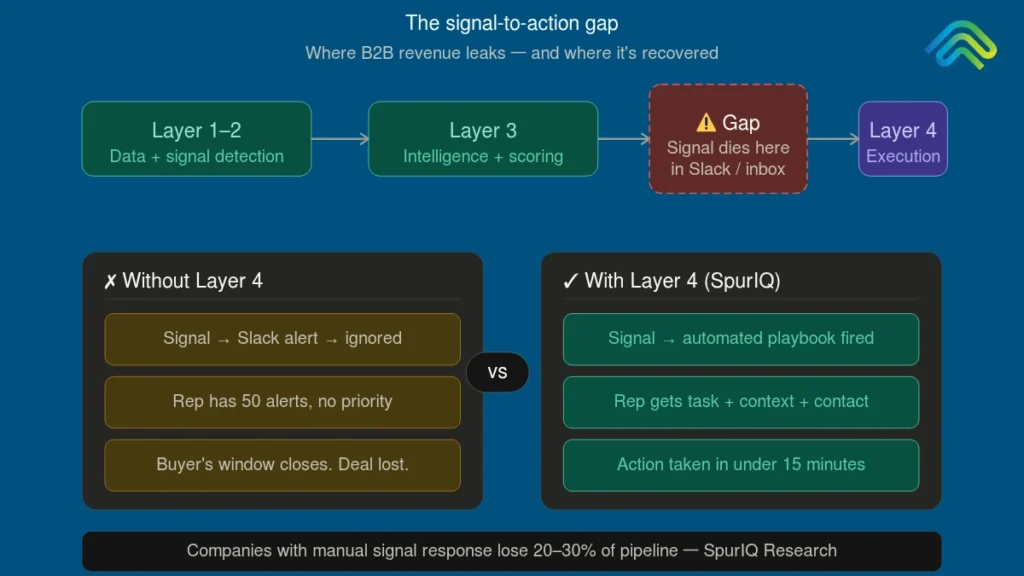
Let’s be honest about the promise we were sold over the last ten years. For a decade, Chief Revenue Officers and VPs of Marketing have operated under a comforting, yet entirely flawed, premise: if we can just see the opportunity, we can capture it. At SpurIQ, we bought into the idea of total visibility. We globally poured billions of dollars into data enrichment platforms, predictive scoring algorithms, and intent tools. We constructed cathedral-like dashboards designed to track every single click, whitepaper download, and whispered demo requests across the internet. Our RevOps teams are leaner, sharper, and more data-savvy than they’ve ever been. And yet, you can walk into almost any boardroom during a quarterly business review and hear the exact same frustrating question: Why, despite having more data and visibility than ever before, is our pipeline still leaking revenue? The reality on the sales floor is grim. We are absolutely drowning in signals, but we are starving for action. We’ve spent the last decade perfecting the science of signal detection. We know exactly who is looking at us. But we are still living in the dark ages of signal execution. This gap- this massive, silent void between knowing something is happening and actually doing something about it- is the single greatest bottleneck inside the modern B2B Go-to-Market engine today. The GTM Stack Has a Signal Problem –  And It’s Not What You Think If you pull a typical GTM leader aside and ask them about their stack’s “signal problem,” they almost always point to the same two culprits. They’ll complain about data quality, or they’ll groan about signal fatigue. They’ll tell you they desperately need better ZoomInfo enrichment to improve accuracy, or they need tighter orchestration rules to quiet the noise. They fundamentally believe their problem is informational. They are wrong. The information is fine. It’s the execution that’s broken. The False Premise of the “Complete” Stack Most revenue organizations build their technology stacks in a very linear, predictable way. They start by buying a system of record- usually Salesforce or HubSpot. Then, they add a system of engagement, like Outreach or Salesloft, so reps can send emails. Finally, they sprinkle data sources on top: a little Clearbit here, some 6sense intent data there. As Deloitte has extensively documented in their enterprise technology research, buying the technology without rewiring the operational workflow is a recipe for stalled growth. The prevailing myth in our industry is that once you achieve visibility across these different layers, the stack is “done.” The prevailing myth in our industry is that once you achieve visibility across these different layers, the stack is “done.” The assumption is that if a buying signal successfully makes its way to a sales rep’s desktop, the technology has fulfilled its purpose. This premise isn’t just naive; it’s practically operational negligence. It assumes that the moment a human being sees an opportunity flash on their screen, they will flawlessly, consistently, and immediately execute the absolute best next step. Anyone who has ever managed a sales team knows this is a fantasy. “The modern GTM stack is complete up to signal detection and broken immediately after.” – CTO SpurIQ Introducing the Gap: Signal Detection ≠ Signal Action Think about what a signal actually is. It’s just a data point. It’s a tiny indication of potential. It is not a closed-won deal. Your current stack is phenomenally good at telling you when a prospect from a tier-one target account visits your pricing page, downloads a case study, or gets flagged by an intent tool as “in–market.” But what happens next? In 90% of B2B organizations, that precious, high-intent signal is delivered as a Slack alert, an email notification, or just another line item on a sprawling Tableau dashboard. From that moment on, the signal is left entirely to the mercy of human memory. It relies on a rep prioritizing it over their coffee, figuring out the right workflow, manually typing up an email, and remembering to hit send before the prospect’s attention shifts elsewhere. This is the exact failure point. The tech stack stops the moment the signal arrives, but the actual monetary value is only unlocked when the signal is acted upon. Signal detection is necessary, sure. But signal action is what pays the bills. As McKinsey & Company notes on the future of B2B sales the organizations capturing the most market share are those that can react to customer insights with unprecedented speed. Signal detection is necessary, sure. But signal action is what pays the bills. What ‘Signal to Action’ Actually Means? If we want to fix this, we have to stop treating signal response like a random event and start treating it like a rigid operational process. In plain terms, the Signal-to-Action continuum is the specific path a data point travels from the moment your systems detect it, to the exact moment a meaningful business action is executed in response. This journey always breaks down into three critical stages: Where Most Stacks Break Down? Stage 3 is where the wheels fall off. It’s where 90% of the friction lives and where your revenue leaks out. You likely have incredible, expensive tools for Stage 1 (Intent providers) and Stage 2 (Scoring models). But the bridge connecting Stage 2 to Stage 3? It’s just a manual, rickety rope bridge. Your stack detects the fire. Your scoring model tells you how big the fire is. And then you hand a plastic bucket to a busy sales rep and just sort of hope they remember the way to the well. Why the Modern GTM Stack is Built for Visibility, Not Execution? How did we get here? The current design of the GTM stack is historically biased toward reporting, analysis, and looking backward. We have optimized everything for the view of the funnel, and completely neglected the flow through the funnel. 1. Dashboards Report What Happened –  They Don’t Prevent It The hard truth that many management consultants are hesitant to tell their clients

Deals Decay in the Pipeline
Thought Leadership, AI Strategy

Why Most Deals Don’t Get Lost — They Quietly Decay (And How to Stop It in 2026)

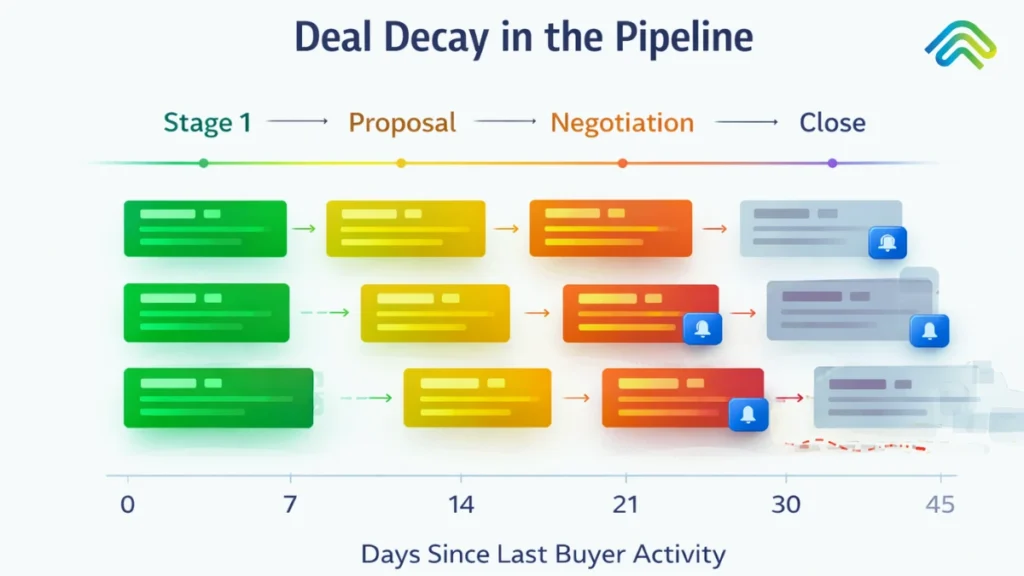
86% of B2B deals decay before they close. Most never formally die — they slowly lose momentum, one missed signal at a time, until the buyer quietly moves on. This is deal decay. And your pipeline is full of it right now. It’s week eleven of a thirteen-week quarter. You pull up the CRM. The pipeline looks respectable — $4.2 million across sixteen active deals. Seven of them are sitting in Proposal Sent or Negotiation. You scroll through. Something bothers you, but you can’t quite name it. Deal number three: last rep activity was a follow-up email, sent eleven days ago. No reply. Proposal was opened twice in the first 48 hours after delivery. Not once since. Deal number seven: champion’s last response was seventeen days ago. Before that, she replied within a few hours. The deal is still marked ‘on track.’ Deal number twelve: close date was pushed back for the second time last week. No reason logged. The rep notes say ‘waiting on procurement.’ Nobody in your system sent an alert. No escalation fired. No recovery play activated. From the outside, these deals look alive. From the inside, they’ve been deteriorating for weeks. This is deal decay and it’s the silent, invisible force behind most missed quarters in B2B sales. Not a competitor wins. Not a budget cut. Not a bad fit. Just a slow, quiet erosion of momentum that nobody’s system is built to catch. The deals killing your quarter aren’t the ones you lost. They’re the ones that are still technically open — and haven’t moved in three weeks. The uncomfortable truth is that most B2B revenue teams are extraordinarily good at diagnosing deal decay after it kills a deal. The CRM closed-lost data, the QBR postmortem, the manager coaching session — all useful, all retrospective. What very few teams have is a system that detects the early signals of decay and converts them into an automatic recovery action before the window closes. That’s what this piece is about. Not motivation. Not methodology. The execution architecture that stops deal decay before it costs you the quarter. What Is Deal Decay? A Definition Worth Owning Most sales vocabularies don’t have a clean word for this. You’ll hear ‘stalled deal,’ ‘stuck pipeline,’ ‘deal slippage,’ ‘pipeline rot.’ All of them gesture at the same phenomenon. None of them name it precisely enough to fix it. Here’s the definition: Deal decay is the gradual, often invisible deterioration of a sales opportunity — caused not by a formal rejection or competitive loss, but by the accumulation of small execution failures: missed follow-ups, stalled engagement, unanswered signals and the slow erosion of buyer momentum over time. A decayed deal never says no. It simply stops moving. That last line is the one that matters. A decayed deal never says no. There’s no rejection email. No ‘we’re going with a competitor.‘ Just silence and then more silence and then a close date that gets pushed again and then one day the deal is so cold that closing it would require starting over. And here’s what makes deal decay so dangerous: it looks fine in the CRM. The stage is still accurate. The dollar value is still in the forecast. The rep still believes it’ll close, maybe next quarter. The pipeline review passes it without a flag. And all the while, the deal is quietly dying. Deal Decay vs. Deal Loss — Why the Distinction Saves Revenue? This distinction matters more than most revenue leaders realize, because the two problems have completely different solutions. Deal Loss Deal Decay What happened? The buyer made an active decision — chose a competitor, cut the budget, or concluded it wasn’t the right fit. The buyer never made a decision. Momentum eroded. Nobody intervened. The deal quietly died of inaction. Who caused it? Often genuinely out of your control — pricing, product gap, competitive dynamics. Almost always a preventable execution failure. The signal existed. The action did not follow. How it shows up A clear closed-lost reason in the CRM. A conversation that ended. A deal stuck in a late stage for 30+ days. A forecast that never materializes. The fix Better positioning, qualification, competitive strategy. Execution infrastructure — a system that detects the decay signal and automatically recovers the deal before it’s terminal. Most revenue teams treat both as losses. They run the same postmortem, apply the same coaching, adjust the same qualification criteria. This is why pipeline stagnation is so persistent, the diagnosis is wrong, so the treatment doesn’t work. Deal decay isn’t a qualification problem or a rep performance problem. It’s an execution architecture problem. The Scale of the Problem Is Larger Than Most Teams Acknowledge 86% of B2B deals stall at some point during the buying process — not from competitive loss, but from momentum failure. (Forrester, 2024) That number should make you pause. Not 20%. Not 40%. Eighty-six percent. More than eight in ten deals experience a meaningful stall. And for the majority of those deals, the stall isn’t caused by a competitor, it’s caused by a gap in execution between a buyer signal and a corresponding action from the selling team. Consider the revenue math directly: if your team has $5M in active pipeline and your average deal touches at least one meaningful stall point, the question isn’t whether deal decay is affecting your number. It’s how much of your pipeline is already in decay right now and whether you have any system that’s watching. Why Deals Decay: 5 System Failures Nobody Talks About Most conversations about deal stagnation end up in the same place: ‘The rep needs to follow up more aggressively.‘ It’s the easiest diagnosis and it’s usually the wrong one. Deal decay is systemic. It happens across teams, across deal sizes, across industries. When something is that consistent, the cause is structural, not personal. Here are the five structural reasons deals decay and why better rep coaching doesn’t fix any of them: 1. Your CRM Records Activity. It

Revenue Intelligence vs revenue Execution
Thought Leadership, AI Strategy

Revenue Intelligence vs Revenue Execution: Why Insights Don’t Close Deals

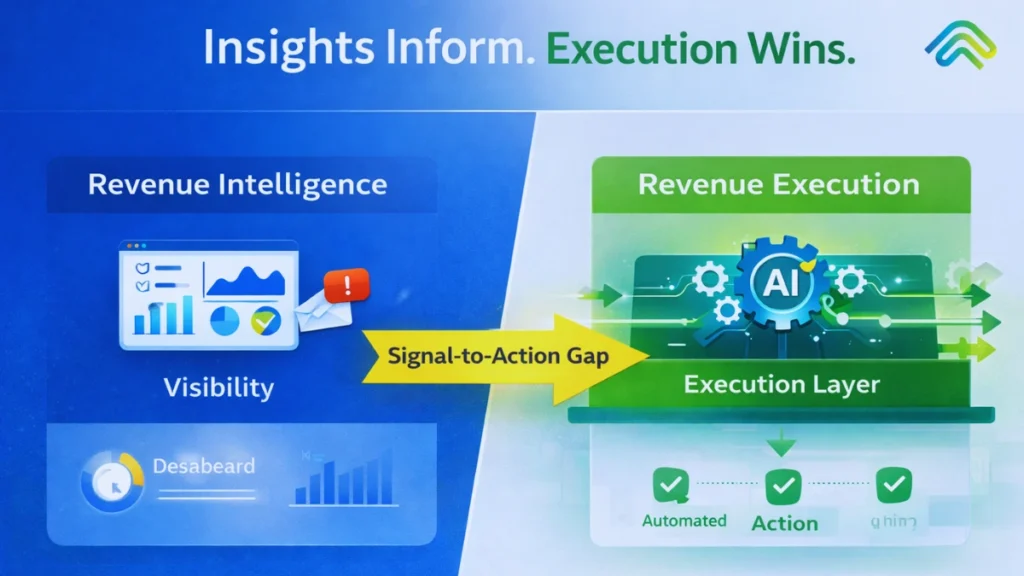
The Illusion of Visibility. Over the past five years, B2B companies have poured billions into revenue intelligence tools and revenue platforms. The promise was simple: better data leads to better revenue. As a result, dashboards improved. Forecasting accuracy improved. Executive visibility reached an all-time high. Yet, for all this visibility,revenue leakage remains a massive, systemic i`ssue. The root cause of this disconnect is a fundamental misunderstanding of what data actually does. Insight does not equal execution. And execution is what closes deals. When a buyer signals intent but the sales team fails to act immediately, revenue leaks. Industry analysis suggests that this post-signal inaction – the operational friction between knowing something and doing something about it costs B2B organizations between 20% and 30% of their potential revenue. The uncomfortable truth is that your revenue strategy likely isn’t broken. Your execution is. Welcome to the Signal-to-Action Gap. What Is Revenue Intelligence? Revenue Intelligence analyzes sales activities, pipeline data, buyer behavior, and forecasting metrics to provide predictive insights and performance visibility. It is designed to answer three critical questions: Typical Capabilities Include: Where It Lives: Revenue Intelligence is commonly integrated into CRM systems, Revenue Operations platform environments, and forecasting-centric platforms. For example, platforms like Clari and other “Run Revenue” systems do an exceptional job of optimizing forecasting visibility and providing executive oversight. But they all share one critical limitation: They stop at insight. What Is Revenue Execution? To solve the leakage problem, you must move beyond intelligence. Revenue Execution ensures that every revenue signal triggers the right action, at the right time, with strict accountability across the entire funnel. Instead of analyzing the past or predicting the future, Revenue Execution operates in the present. It answers: It operationalizes signals into automated, cross-functional action. If a deal stalls, it doesn’t just change a dashboard color to red; it triggers a workflow to fix it. The Core Distinction: Revenue Intelligence informs. Revenue Execution performs. Revenue Intelligence vs. Revenue Execution: The Core Distinction To understand why revenue leaks, you must understand the fundamental difference in how these two categories interact with your data. Revenue Intelligence is an observational layer. Revenue Execution is an operational layer. While Revenue Operations software optimizes process and reporting, Revenue Execution owns the physical outcome of that process. Consider how they compare across critical dimensions: Dimension Revenue Intelligence Revenue Execution Primary Goal Improve visibility: Understand the state of the pipeline and the accuracy of the forecast. Ensure action: Guarantee that the right steps are taken to advance or save the deal. Output Insights & forecasts: Dashboards, health scores, and predictive modeling. Triggered execution: Automated plays, mandatory tasks, and cross-functional escalations. Focus Predictive analytics: “Based on historical data, this deal has a 40% chance of closing.” Signal-to-action conversion: “This deal’s probability dropped; automatically alerting the VP to step in.” Dependency Human follow-up: Relies entirely on a rep remembering to check the dashboard and acting on it. Automated orchestration: Removes human memory from the equation, forcing the workflow. Value Moment Board reporting: Giving leadership confidence in the numbers at the end of the quarter. Revenue captured: Winning the micro-moments that prevent the deal from slipping mid-quarter. Why Insights Alone Fail to Close Deals? Having the best intelligence in the world is useless if the organization lacks the muscle memory to act on it. Insights fail to close deals due to four specific execution gaps: 1. Alert Saturation Sales leaders and reps are drowning in data. They receive deal risk scores, Slack alerts, and pipeline variance reports daily. When every notification is urgent, nothing is urgent. Without systemic enforcement of follow-up, reps simply tune the noise out. 2. Human-Dependent Execution Revenue platforms are great at flagging stalled deals. But then, they expect a busy, overwhelmed rep to manually prioritize a response. The reality is that human task prioritization breaks down under pressure. 3. Signal-to-Action Latency This is the time elapsed between a buyer engagement spike and the subsequent sales action. As documented in landmark research by Harvard Business Review, latency directly and severely reduces win probability. If you wait 24 hours to respond to a buying signal, the value of that signal approaches zero. This is the Signal-to-Action Gap. 4. Insight Without Accountability Revenue intelligence surfaces risk, but it rarely assigns ownership or enforces an intervention. If a deal slips silently and no manager is forced to intervene, the insight is worthless. The Revenue Execution Layer Missing in Modern Revenue Stacks Look at the modern B2B revenue stack: These are all excellent at surfacing intelligence. But nowhere in that stack is there a system that ensures escalation, automates play activation, closes mid-funnel dormancy, or triggers expansion actions. Insight leads to stalls. Execution leads to conversions. How Revenue (Action) Orchestration Bridges the Gap? To move from insight to execution, organizations require Revenue Orchestration. Revenue Action Orchestration converts distributed revenue signals into coordinated, cross-system action flows automatically. The Mechanism of Orchestration: This is what we call true execution ownership. Practical Example: The Deal Risk Scenario Let’s look at how the two systems handle the exact same problem: a stalling mid-funnel deal. Revenue Intelligence Platform Output: Revenue Execution Model Output: One system informs you that you are losing. The other system fights to win. Where Revenue Intelligence Still Matters? This is not to say Revenue Intelligence is obsolete. It is absolutely foundational. Revenue Intelligence is critical for: However, intelligence is upstream of performance. It sets the stage, but execution determines the realized revenue. The True Revenue Stack: Intelligence + Execution Mature B2B organizations are redesigning their tech architecture to reflect this reality: Without Layer 3, your massive tech investment remains entirely observational. Metrics That Reveal Execution Failure (Even When Intelligence Is Strong) Even if your intelligence is strong, your execution might be failing. You need to reframe your KPIs to spot the leakage: New Execution Metrics to Track: Why This Distinction Matters Now? As Gartner has extensively documented, B2B buying complexity is rising rapidly. Buying committees are larger, sales cycles are lengthening, and AI is exponentially

Revenue Execution
Thought Leadership, AI Strategy

What Is Revenue Execution? (And Why B2B Teams Lose 30% Without It)

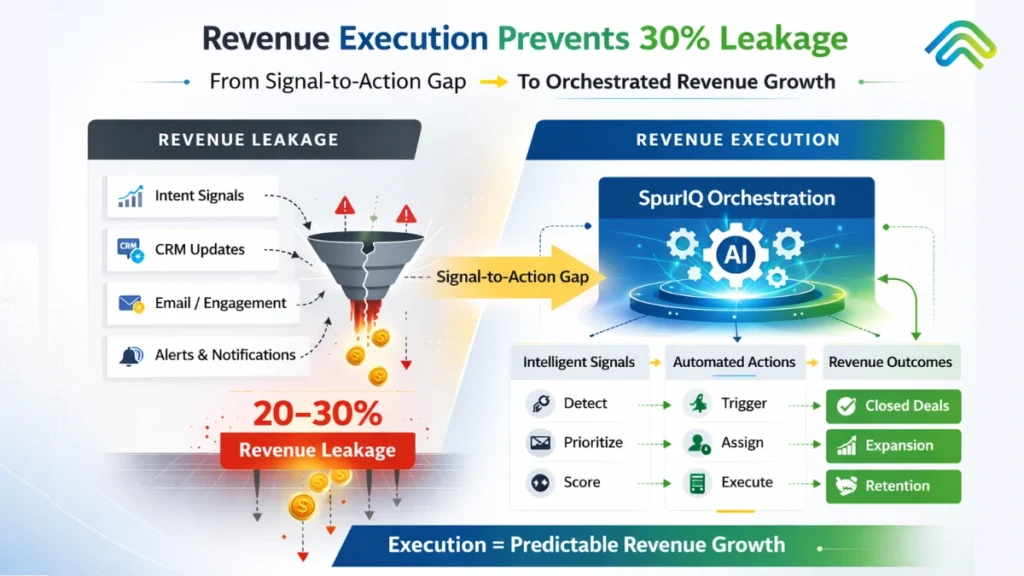
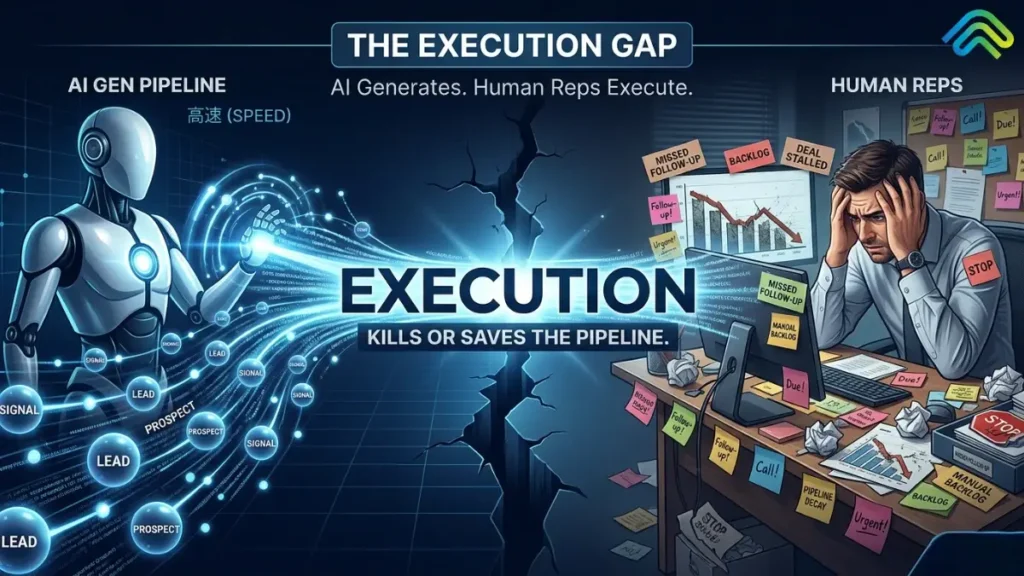
The 30% Problem: The Silent Killer of B2B Growth If you ask most sales leaders why they missed their quarter, you will hear a familiar refrain: “We didn’t have enough pipeline.” It is the standard diagnosis. The knee-jerk reaction is predictable: hire more SDRs, increase the paid search budget, and demand more activity. But for mature B2B organizations, this diagnosis is frequently wrong. B2B teams rarely lose revenue because they lack pipeline. They lose it because they fail to execute after the buyer interacts. Consider the reality of your current tech stack. It is likely overflowing with intelligence. You have intent data showing who is researching you. You have marketing automation tracking whitepaper downloads. You have product telemetry showing usage dips. The signals exist. However, the actions tied to those signals are inconsistent, delayed, or reliant on manual human memory. This phenomenon is known as the Signal-to-Action Gap. When a buying signal flashes but the corresponding sales action is delayed by 24 hours (or missed entirely), revenue leaks. Industry analysis suggests that this operational friction costs B2B organizations between 20% and 30% of their potential revenue. The uncomfortable truth? Your revenue strategy isn’t broken. Your execution is. What Is Revenue Execution? To fix the leak, you must first define the system required to plug it. Revenue Execution is the operational discipline that ensures every revenue signal – a pricing page visit, a stalled contract, a usage drop – triggers the right action, at the right time, with clear accountability across the entire funnel. It is not a philosophy. It is an operating system. And to understand it, we must ruthlessly distinguish it from the noise of general sales management. What Revenue Execution Is Not? ✗  It is not better forecast alignment meetings. Discussing a stalled deal on a Monday morning Zoom call does not move the deal. That is inspection, not execution. ✗  It is not colorful dashboards.Dashboards are passive. They depend on a human choosing to look, interpreting correctly, and then deciding to act. Dashboards observe. They do not execute. ✗  It is not a checklist of best practices.A playbook sitting in a Google Doc is not execution. If the process depends on human memory to function, it is already broken. ✗  It is not retrospective RevOps reporting.Telling a CRO they missed the quarter because pipeline velocity slowed in Week 8 is an autopsy. Revenue Execution is the intervention that prevents the death in Week 8. What are The True Essence of Revenue Execution? 1. Operationalized Action Ownership AI Revenue Execution eliminates the bystander effect inside your CRM. It removes ambiguity about who owns a signal. When a signal fires, the system explicitly assigns the ball to a specific player – an SDR, an AE, or a CSM. No handoff confusion. No diffusion of responsibility. 2. Automated Signal-to-Action Orchestration It bridges the gap between your tech stack’s intelligence and your team’s workflow – and removes the latency of human reaction time. If a buyer signals intent at 2:00 PM, the orchestration layer ensures the response happens at 2:01 PM. Not three days later when the rep clears their inbox. 3. Closed-Loop Accountability It tracks whether the action was completed – and critically, what the outcome was. If a high-priority signal goes unaddressed, the system doesn’t just log it. It escalates to management automatically. Also Read: Why AI Revenue Action Orchestration Beats Platform-Led RevOps Tools in 2026 The Core Distinction: Activity vs. Outcome Many competitors and legacy tools define execution as “managing revenue-generating activities.” That is a 2010 mindset. It focuses on logging calls, tracking email volume, and recording meeting notes. It measures effort. We define it differently. Revenue Execution is the science of converting revenue signals into accountable actions – without manual dependency. We measure outcomes. It is the difference between asking “Did you make 50 calls today?” and asking “Did we successfully engage every account that entered the buying window today?” Why B2B Teams Lose 20–30% Without AI Revenue Execution? Revenue leakage isn’t usually caused by one catastrophic event. It is death by a thousand cuts – hundreds of missed micro-moments across the customer lifecycle. Here is where the 30% disappears: 1. Post-Intent Inaction (Top of Funnel Leakage) 2. Pipeline Stagnation (Mid-Funnel Slippage) 3. Renewal & Expansion Blind Spots (Bottom of Funnel Leakage) 4. Fragmented Signal Systems Also Read: Revenue Intelligence vs Revenue Orchestration: Why Insights Alone No Longer Close Deals Revenue Execution vs. Revenue Operations (Critical Distinction) A common objection is: “We have a RevOps team, so we are already doing this.” This is a category error. Revenue Operations (RevOps) is the architect; Revenue Execution is the general contractor ensuring the work gets done. Feature Revenue Operations (RevOps) Revenue Execution Primary Goal Aligns teams, data, and processes. Ensures specific actions happen in real-time. Function Manages structure and strategy. Enforces accountability and speed. Output Creates visibility (Dashboards/Reports). Triggers execution (Plays/Tasks). Outcome Reports on past performance. Prevents future revenue leakage. The Bottom Line: RevOps optimizes the structure of your GTM motion. Revenue Execution optimizes the outcomes of that motion by engaging directly with the workflow. The Anatomy of the Execution Gap Why is this gap widening now? We identify five root causes that plague modern B2B teams: What True Revenue Execution Looks Like? To close the gap, organizations must shift from a passive data architecture to an active Execution Architecture. This involves four distinct stages: Stage 1: Signal Aggregation The system acts as a central nervous system, ingesting data from all sources: 6sense/Bombora (intent), Salesforce/HubSpot (CRM updates), Outreach/Salesloft (engagement), and product telemetry. Stage 2: Revenue Intelligence Layer The system applies logic to the noise. It evaluates buying probability and risk. It asks: Is this signal actionable? Is it high-priority? It filters out the noise so reps focus only on the signal. Stage 3: Automated Orchestration This is the engine of execution. Based on the intelligence, the system automatically triggers: Stage 4: Closed-Loop Accountability The system watches the watcher. Did the action happen? If not, the system identifies the

Scroll to Top