The 30% Problem: The Silent Killer of B2B Growth
If you ask most sales leaders why they missed their quarter, you will hear a familiar refrain: “We didn’t have enough pipeline.”
It is the standard diagnosis. The knee-jerk reaction is predictable: hire more SDRs, increase the paid search budget, and demand more activity. But for mature B2B organizations, this diagnosis is frequently wrong.
B2B teams rarely lose revenue because they lack pipeline. They lose it because they fail to execute after the buyer interacts.
Consider the reality of your current tech stack. It is likely overflowing with intelligence. You have intent data showing who is researching you. You have marketing automation tracking whitepaper downloads. You have product telemetry showing usage dips. The signals exist.
However, the actions tied to those signals are inconsistent, delayed, or reliant on manual human memory.
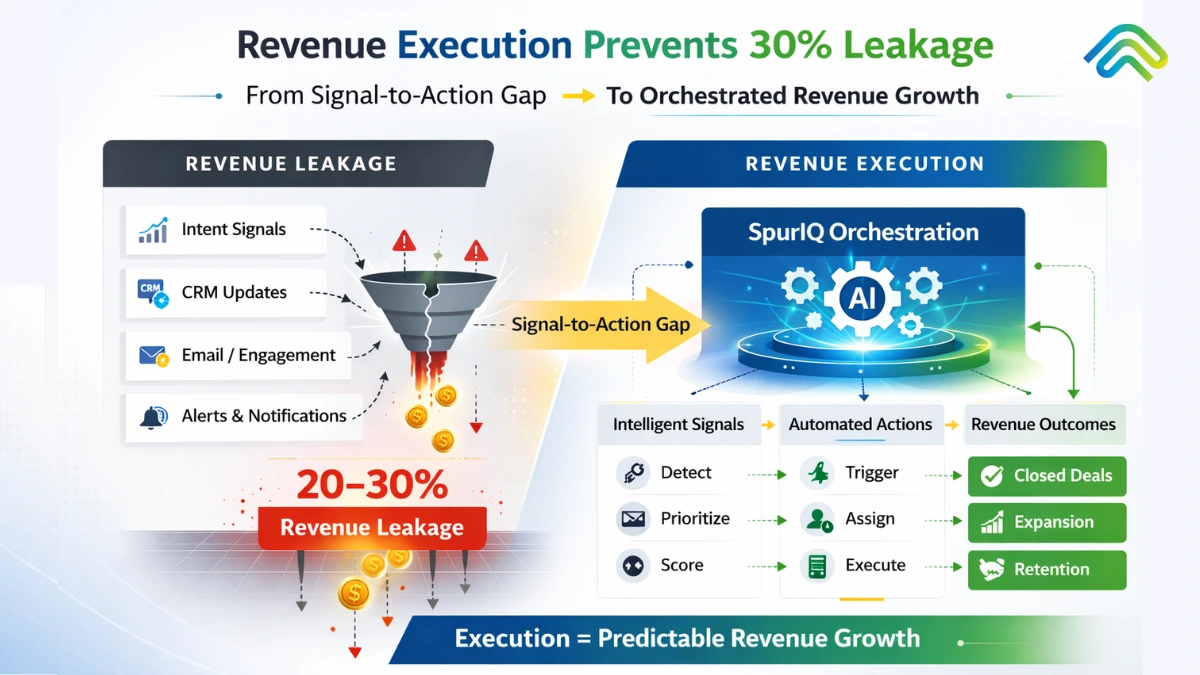
This phenomenon is known as the Signal-to-Action Gap.
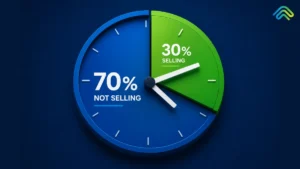
When a buying signal flashes but the corresponding sales action is delayed by 24 hours (or missed entirely), revenue leaks. Industry analysis suggests that this operational friction costs B2B organizations between 20% and 30% of their potential revenue.
The uncomfortable truth? Your revenue strategy isn’t broken. Your execution is.
What Is Revenue Execution?
To fix the leak, you must first define the system required to plug it.
Revenue Execution is the operational discipline that ensures every revenue signal – a pricing page visit, a stalled contract, a usage drop – triggers the right action, at the right time, with clear accountability across the entire funnel.
It is not a philosophy. It is an operating system. And to understand it, we must ruthlessly distinguish it from the noise of general sales management.
What Revenue Execution Is Not?
| ✗ It is not better forecast alignment meetings. Discussing a stalled deal on a Monday morning Zoom call does not move the deal. That is inspection, not execution. |
| ✗ It is not colorful dashboards.Dashboards are passive. They depend on a human choosing to look, interpreting correctly, and then deciding to act. Dashboards observe. They do not execute. |
| ✗ It is not a checklist of best practices.A playbook sitting in a Google Doc is not execution. If the process depends on human memory to function, it is already broken. |
| ✗ It is not retrospective RevOps reporting.Telling a CRO they missed the quarter because pipeline velocity slowed in Week 8 is an autopsy. Revenue Execution is the intervention that prevents the death in Week 8. |
What are The True Essence of Revenue Execution?
1. Operationalized Action Ownership
AI Revenue Execution eliminates the bystander effect inside your CRM. It removes ambiguity about who owns a signal. When a signal fires, the system explicitly assigns the ball to a specific player – an SDR, an AE, or a CSM. No handoff confusion. No diffusion of responsibility.
2. Automated Signal-to-Action Orchestration
It bridges the gap between your tech stack’s intelligence and your team’s workflow – and removes the latency of human reaction time. If a buyer signals intent at 2:00 PM, the orchestration layer ensures the response happens at 2:01 PM. Not three days later when the rep clears their inbox.
3. Closed-Loop Accountability
It tracks whether the action was completed – and critically, what the outcome was. If a high-priority signal goes unaddressed, the system doesn’t just log it. It escalates to management automatically.
Also Read: Why AI Revenue Action Orchestration Beats Platform-Led RevOps Tools in 2026
The Core Distinction: Activity vs. Outcome
Many competitors and legacy tools define execution as “managing revenue-generating activities.” That is a 2010 mindset. It focuses on logging calls, tracking email volume, and recording meeting notes. It measures effort.
We define it differently.
| Revenue Execution is the science of converting revenue signals into accountable actions – without manual dependency. |
We measure outcomes. It is the difference between asking “Did you make 50 calls today?” and asking “Did we successfully engage every account that entered the buying window today?”
Why B2B Teams Lose 20–30% Without AI Revenue Execution?
Revenue leakage isn’t usually caused by one catastrophic event. It is death by a thousand cuts – hundreds of missed micro-moments across the customer lifecycle.
Here is where the 30% disappears:
1. Post-Intent Inaction (Top of Funnel Leakage)
- The Scenario: A high-value target account (Tier 1) spikes in intent data, visiting your pricing page and reading technical documentation.
- The Failure: The alert is buried in a generic “Daily Digest” email that the SDR ignores. No direct follow-up occurs for 72 hours.
- The Revenue Outcome: The opportunity is never created. The buyer engages a competitor who responded within the “Golden Window” of interest.
2. Pipeline Stagnation (Mid-Funnel Slippage)
- The Scenario: A deal moves to the “Proposal Sent” stage but sits untouched for 14 days.
- The Failure: There is no automated trigger to prompt the AE, no escalation to the Sales Manager, and no automated marketing air-cover to reinforce value to the stakeholders.
- The Revenue Outcome: The deal stalls. This is “slipped revenue” that often gets disguised in QBRs as “forecast variance” or “bad timing.”
3. Renewal & Expansion Blind Spots (Bottom of Funnel Leakage)
- The Scenario: A customer’s product usage drops by 15% (churn risk) or a new executive joins the account (expansion opportunity).
- The Failure: The Customer Success Manager (CSM) is reactive, only checking the account health score during the quarterly review – weeks after the signal occurred.
- The Revenue Outcome: Unpreventable churn and missed upsell revenue.
4. Fragmented Signal Systems
- The Scenario: Your insights are everywhere. CRM alerts, Marketo notifications, Intent dashboards, Slack channels, and Gong snippets.
- The Failure: The rep is overwhelmed by noise. Without a centralized execution layer, they default to ignoring everything.
- The Revenue Outcome: Insight exists. Execution does not.
Also Read: Revenue Intelligence vs Revenue Orchestration: Why Insights Alone No Longer Close Deals
Revenue Execution vs. Revenue Operations (Critical Distinction)
A common objection is: “We have a RevOps team, so we are already doing this.”
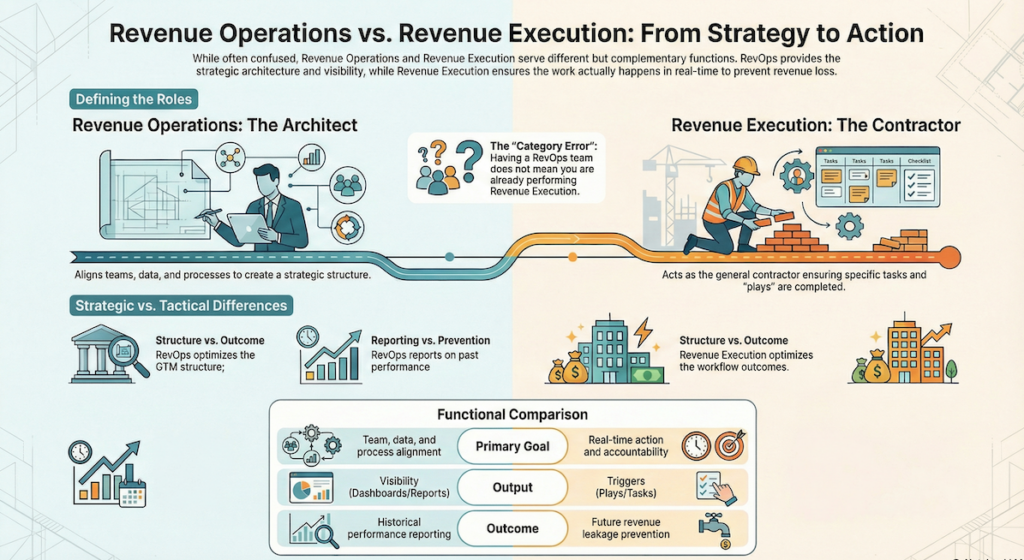
This is a category error. Revenue Operations (RevOps) is the architect; Revenue Execution is the general contractor ensuring the work gets done.
| Feature | Revenue Operations (RevOps) | Revenue Execution |
| Primary Goal | Aligns teams, data, and processes. | Ensures specific actions happen in real-time. |
| Function | Manages structure and strategy. | Enforces accountability and speed. |
| Output | Creates visibility (Dashboards/Reports). | Triggers execution (Plays/Tasks). |
| Outcome | Reports on past performance. | Prevents future revenue leakage. |
The Bottom Line: RevOps optimizes the structure of your GTM motion. Revenue Execution optimizes the outcomes of that motion by engaging directly with the workflow.
The Anatomy of the Execution Gap
Why is this gap widening now? We identify five root causes that plague modern B2B teams:
- Signal Overload Without Prioritization: When every alert is marked “Urgent,” nothing is urgent. Reps suffer from alert fatigue and tune out valuable data.
- Manual Dependency: Revenue relies on human memory and task discipline. If a human has to “remember” to follow up on a signal, the process is fundamentally fragile.
- No Execution Ownership: A signal is detected, but no specific person is accountable for resolving it. It falls into the “tragedy of the commons.”
- CRM as System of Record, Not Action: Your CRM is a library where data goes to stay, not a command center that drives behavior. It records history; it doesn’t dictate the future.
- Latency Between Signal and Action: Time kills deals. Signal-to-action latency – the gap between buyer interest and seller response – compounds revenue loss exponentially.
What True Revenue Execution Looks Like?
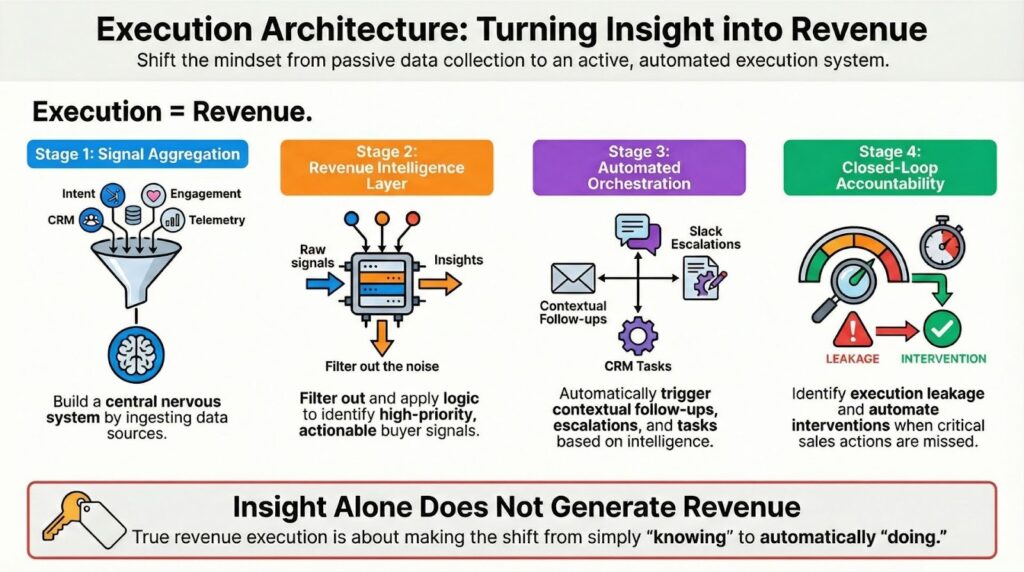
To close the gap, organizations must shift from a passive data architecture to an active Execution Architecture. This involves four distinct stages:
Stage 1: Signal Aggregation
The system acts as a central nervous system, ingesting data from all sources: 6sense/Bombora (intent), Salesforce/HubSpot (CRM updates), Outreach/Salesloft (engagement), and product telemetry.
Stage 2: Revenue Intelligence Layer
The system applies logic to the noise. It evaluates buying probability and risk. It asks: Is this signal actionable? Is it high-priority? It filters out the noise so reps focus only on the signal.
Stage 3: Automated Orchestration
This is the engine of execution. Based on the intelligence, the system automatically triggers:
- Contextual follow-up sequences.
- Manager escalations via Slack/Teams if a rep is too slow.
- Specific task assignments in the CRM.
- “Play” activation (e.g., “Competitor Takeout Play”).
Stage 4: Closed-Loop Accountability
The system watches the watcher. Did the action happen? If not, the system identifies the leakage and automates an intervention.
Key Takeaway: Insight ≠ Revenue. Execution = Revenue.
What are the Role of Revenue (Action) Orchestration?
Revenue Execution requires a mechanism to function, and that mechanism is Revenue Action Orchestration.
Revenue Orchestration converts distributed signals into coordinated, automated actions across GTM systems.
How does this differ from standard workflow automation?
- Standard Automation: “If form filled, send email.” (Linear, single-channel).
- Orchestration: “If Tier 1 account views pricing AND usage drops -> Alert CSM on Slack, Create Task for AE in Salesforce, Pause Marketing Drip, and Notify VP of Sales.”
Orchestration is cross-system, cross-role, and outcome-driven.
What are the Key Metrics That Reveal Execution Gaps?
Traditional metrics track results (lagging indicators). Execution metrics track the behaviors that lead to results (leading indicators).
1. Pipeline Velocity (Execution Lens)
Standard velocity measures how fast deals close. Execution Velocity measures the latency between a stage progression and the next rep activity. Slow velocity here is the leading indicator of a lost deal.
2. Win Rate
Win rates are heavily influenced by mid-stage execution consistency. Are we multi-threading effectively after the demo?
3. Retention Rate
Churn is rarely a surprise; it’s usually the result of missed signals. Retention is impacted by how well post-sale actions are orchestrated.
4. Revenue Leakage %
This is the percentage of high-value signal events that resulted in zero follow-up actions. (For most companies, this number is shockingly high).
5. Slipped Revenue Ratio
The ratio of deals that stall after showing clear progression signals. This metric exposes the “mid-funnel wasteland.”
Technology Enablers – But Why Tools Alone Fail?
You likely have a robust tech stack:
- CRM (System of Record)
- Marketing Automation (Top of Funnel)
- CPQ & Billing (Transaction)
- Analytics (Hindsight)
The Differentiation Moment:
These tools are designed to surface signals or record history. They do not guarantee execution. A CRM can tell you a lead is “Hot,” but it cannot force a rep to call them. Analytics can tell you that you missed your number, but only after the quarter is over.
True Revenue Execution requires a layer that sits on top of these tools to drive the action.
How SpurIQ Enables Revenue Execution?
This is the gap SpurIQ fills. We do not replace your CRM; we make it actionable.
SpurIQ acts as the Execution Owner across the funnel:
- Owns execution: We connect the dots between data and duty.
- Eliminates gaps: We ensure no signal falls into the “black hole” of manual dependency.
- Automates Plays: When X happens, Y is executed – automatically and accountably.
- Prevents Slipped Revenue: We catch the deals falling through the cracks of human error.
Whether it’s Lead IQ for top-of-funnel speed or Deal IQ for mid-funnel orchestration, SpurIQ becomes the execution owner converting revenue signals into orchestrated actions.
What is the Implementation Framework for B2B Teams?
If you are ready to stop the leakage, start with this framework:
Step 1: Map Revenue Signals Across the Funnel
Identify the top 5 digital signals that indicate buying intent or churn risk (e.g., pricing page visit, contract view, usage drop).
Step 2: Identify Manual Execution Dependencies
Where does your current process rely on a human “remembering” to check a dashboard? These are your failure points.
Step 3: Measure Signal-to-Action Latency
Calculate the average time between a signal (e.g., demo request) and an action (e.g., calendar invite).
Step 4: Automate High-Impact Revenue Triggers
Implement “High-Impact Revenue Triggers” for your top 20% of signals. Automate the assignment and the notification.
Step 5: Assign Accountability for Leakage
Ensure every signal has a designated owner. If the owner doesn’t act within a set timeframe, the system must escalate to a manager.
What are the Common Objections & Misconceptions?
- “Our CRM already does this.”
- The Reality: Your CRM records what happened. It rarely orchestrates what should happen next across multiple systems and roles.
- “We have RevOps.”
- The Reality: RevOps designs the process; Execution ensures the process is actually followed on a Tuesday afternoon when the rep is busy.
- “Our sales managers enforce the process.”
- The Reality: Managers cannot monitor thousands of signals 24/7. They need a system that surfaces exceptions, not raw data.
The Execution Ownership Era
For the last decade, the industry’s focus has been on Insight Availability – giving teams more data, more intent signals, more analytics. That mission succeeded. And now we are drowning in the result.
The companies that win over the next decade will not be the ones with the most data. Insight has become a commodity. The competitive advantage now belongs to the companies with the strongest Execution Ownership.
Revenue growth will increasingly hinge on the ability to bridge the Signal-to-Action Gap. In a market where buyers are digitally self-sufficient and competitors are a single click away, speed and precision are the only differentiators left.
| If your competitor takes 24 hours to synthesize a signal and assign a task,and your system executes that orchestration instantly – you win.It is that simple. |
The future belongs to the organization that stops admiring its data and starts automating its discipline.
Don’t let revenue leak through the cracks of manual process.
- Diagnose your execution gaps: Find where your signals are dying.
- Explore Revenue Orchestration: Move from passive dashboards to active systems.
- See SpurIQ in action: Turn insight into revenue, instantly.
FAQ:
What is revenue execution?
Revenue execution is the operational system that ensures every revenue signal (intent, usage, deal activity) is converted into an accountable action, eliminating the manual dependencies that lead to lost revenue.
What is the difference between revenue execution and RevOps?
RevOps focuses on strategy, process design, and alignment. Revenue execution focuses on the automated orchestration of actions and enforcing accountability for those processes in real-time.
What is a revenue execution platform?
A software layer that sits between your systems of record (CRM) and your teams, detecting signals and automatically triggering the necessary workflows to advance deals.
How do B2B companies lose revenue from execution gaps?
They lose revenue through “leakage”: leads that aren’t contacted fast enough, deals that stall without follow-up, and expansion opportunities that are missed due to a lack of alerts.
What is revenue orchestration?
Revenue orchestration is the process of coordinating data and actions across multiple systems (CRM, Email, Slack) and roles to ensure a seamless revenue workflow.
How do you measure execution effectiveness?
By tracking metrics like Signal-to-Action Latency, Revenue Leakage Percentage, and Execution Velocity (the speed at which signals convert to next steps).