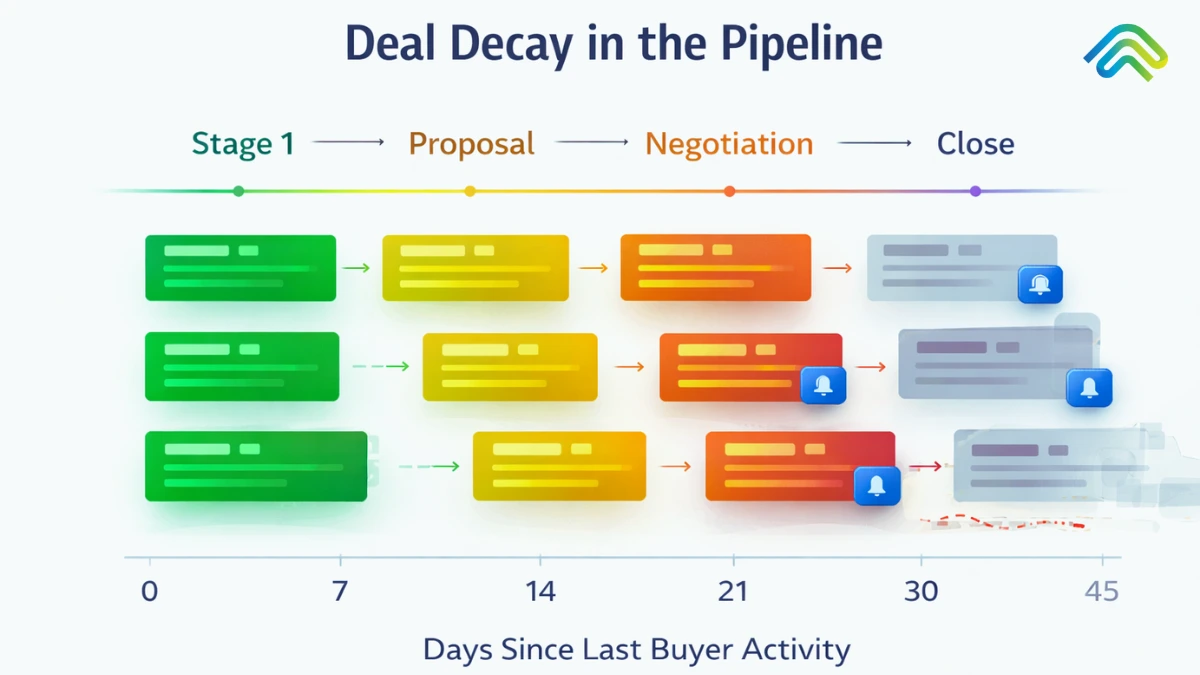
86% of B2B deals decay before they close. Most never formally die — they slowly lose momentum, one missed signal at a time, until the buyer quietly moves on. This is deal decay. And your pipeline is full of it right now.
It’s week eleven of a thirteen-week quarter. You pull up the CRM. The pipeline looks respectable — $4.2 million across sixteen active deals. Seven of them are sitting in Proposal Sent or Negotiation.
You scroll through. Something bothers you, but you can’t quite name it.
Deal number three: last rep activity was a follow-up email, sent eleven days ago. No reply. Proposal was opened twice in the first 48 hours after delivery. Not once since.
Deal number seven: champion’s last response was seventeen days ago. Before that, she replied within a few hours. The deal is still marked ‘on track.’
Deal number twelve: close date was pushed back for the second time last week. No reason logged. The rep notes say ‘waiting on procurement.’
Nobody in your system sent an alert. No escalation fired. No recovery play activated. From the outside, these deals look alive. From the inside, they’ve been deteriorating for weeks.
This is deal decay and it’s the silent, invisible force behind most missed quarters in B2B sales. Not a competitor wins. Not a budget cut. Not a bad fit. Just a slow, quiet erosion of momentum that nobody’s system is built to catch.
| The deals killing your quarter aren’t the ones you lost. They’re the ones that are still technically open — and haven’t moved in three weeks. |
The uncomfortable truth is that most B2B revenue teams are extraordinarily good at diagnosing deal decay after it kills a deal. The CRM closed-lost data, the QBR postmortem, the manager coaching session — all useful, all retrospective. What very few teams have is a system that detects the early signals of decay and converts them into an automatic recovery action before the window closes.
That’s what this piece is about. Not motivation. Not methodology. The execution architecture that stops deal decay before it costs you the quarter.
What Is Deal Decay? A Definition Worth Owning
Most sales vocabularies don’t have a clean word for this. You’ll hear ‘stalled deal,’ ‘stuck pipeline,’ ‘deal slippage,’ ‘pipeline rot.’ All of them gesture at the same phenomenon. None of them name it precisely enough to fix it.
Here’s the definition:
| Deal decay is the gradual, often invisible deterioration of a sales opportunity — caused not by a formal rejection or competitive loss, but by the accumulation of small execution failures: missed follow-ups, stalled engagement, unanswered signals and the slow erosion of buyer momentum over time. A decayed deal never says no. It simply stops moving. |
That last line is the one that matters. A decayed deal never says no. There’s no rejection email. No ‘we’re going with a competitor.‘ Just silence and then more silence and then a close date that gets pushed again and then one day the deal is so cold that closing it would require starting over.
And here’s what makes deal decay so dangerous: it looks fine in the CRM. The stage is still accurate. The dollar value is still in the forecast. The rep still believes it’ll close, maybe next quarter. The pipeline review passes it without a flag. And all the while, the deal is quietly dying.
Deal Decay vs. Deal Loss — Why the Distinction Saves Revenue?
This distinction matters more than most revenue leaders realize, because the two problems have completely different solutions.
| Deal Loss | Deal Decay | |
| What happened? | The buyer made an active decision — chose a competitor, cut the budget, or concluded it wasn’t the right fit. | The buyer never made a decision. Momentum eroded. Nobody intervened. The deal quietly died of inaction. |
| Who caused it? | Often genuinely out of your control — pricing, product gap, competitive dynamics. | Almost always a preventable execution failure. The signal existed. The action did not follow. |
| How it shows up | A clear closed-lost reason in the CRM. A conversation that ended. | A deal stuck in a late stage for 30+ days. A forecast that never materializes. |
| The fix | Better positioning, qualification, competitive strategy. | Execution infrastructure — a system that detects the decay signal and automatically recovers the deal before it’s terminal. |
Most revenue teams treat both as losses. They run the same postmortem, apply the same coaching, adjust the same qualification criteria. This is why pipeline stagnation is so persistent, the diagnosis is wrong, so the treatment doesn’t work. Deal decay isn’t a qualification problem or a rep performance problem. It’s an execution architecture problem.
The Scale of the Problem Is Larger Than Most Teams Acknowledge
| 86% of B2B deals stall at some point during the buying process — not from competitive loss, but from momentum failure. (Forrester, 2024) |
That number should make you pause. Not 20%. Not 40%. Eighty-six percent. More than eight in ten deals experience a meaningful stall. And for the majority of those deals, the stall isn’t caused by a competitor, it’s caused by a gap in execution between a buyer signal and a corresponding action from the selling team.
Consider the revenue math directly: if your team has $5M in active pipeline and your average deal touches at least one meaningful stall point, the question isn’t whether deal decay is affecting your number. It’s how much of your pipeline is already in decay right now and whether you have any system that’s watching.
Why Deals Decay: 5 System Failures Nobody Talks About
Most conversations about deal stagnation end up in the same place: ‘The rep needs to follow up more aggressively.‘ It’s the easiest diagnosis and it’s usually the wrong one. Deal decay is systemic. It happens across teams, across deal sizes, across industries. When something is that consistent, the cause is structural, not personal.
Here are the five structural reasons deals decay and why better rep coaching doesn’t fix any of them:
1. Your CRM Records Activity. It Has No Sensor for Inactivity
The CRM timestamp shows when a rep sent an email. It doesn’t show you that the last email was eleven days ago and hasn’t been replied to. It shows when a proposal was uploaded. It doesn’t track that the proposal has been opened zero times in nine days.
This is a signal blindness problem. The decay indicators exist in your data — engagement drop rates, response time changes, proposal open velocity, stakeholder activity gaps. But they’re scattered across your sequencing tool, your email client, your proposal platform and your CRM and no single system is correlating them into a coherent decay signal.
A rep with 24 active deals doesn’t have the bandwidth to manually cross-reference all of those data sources for each deal every day. Which means the decay signals go unread. Which means the deals keep rotting.
2. Execution Depends on Human Memory — and Human Memory Fails at Scale
Once a deal enters a waiting state — proposal sent, stakeholder alignment, legal review, procurement — the next action depends entirely on a rep remembering to check on it. There’s no automatic trigger. No system-generated recovery play. Just a rep with a full calendar and 23 other deals who might remember to send a ‘checking in’ email on Thursday.
This is what ‘manual execution dependency’ looks like in practice. And it’s architecturally fragile — not because reps are negligent, but because human attention has a finite capacity that scales linearly while pipeline complexity grows exponentially.
Every process that relies on a human remembering to do something has a failure rate. For a single rep managing 20+ active deals across multiple funnel stages, that failure rate compounds fast. The deals that get the follow-up are the ones that are loudest, most recent, or most personally important to the rep. The quietly decaying deals in the middle stages? They wait.
3. Alert Fatigue Has Turned Signal Platforms Into Background Noise
Many revenue teams have already invested heavily in pipeline intelligence tools, conversation analytics, intent data overlays, CRM health scores, engagement tracking. These tools have genuinely improved visibility into where decay is happening.
But there’s a problem that emerges when every signal generates an alert: reps start ignoring all of them. The Gong flag, the Clari score drop, the intent data digest, the CRM task reminder — they all land in the same cognitive space and the brain’s response to undifferentiated urgency is to treat everything as background noise.
This is the Signal-to-Action Gap at the deal level. The signal exists, the engagement drop is visible, the decay is detectable. But the orchestrated response doesn’t automatically follow. Between the signal and the action, there’s a human being who has to notice it, interpret it correctly, prioritize it above 23 other things and then act on it with the right play. That chain breaks constantly. Revenue leaks every time it does.
4. The Buying Committee Has Grown. The Thread Hasn’t
The average B2B deal in 2026 involves 13 internal stakeholders on the buyer’s side. (Forrester, 2024) The average rep has a meaningful relationship with two or three of them, typically the champion, maybe a technical evaluator, sometimes an economic buyer if they’ve been lucky.
When the champion goes quiet, a single-threaded deal has nowhere to turn. There’s no line to a secondary stakeholder who might know what changed internally. No automated outreach to the procurement lead who was always going to be involved eventually. No visibility into whether the budget conversation is the stall point or whether something bigger shifted.
Single-threaded execution is a structural decay accelerator. The moment your only contact loses internal momentum — because their priorities shifted, because they’re managing an internal blocker, because they simply got busy — the deal goes dark. And without multi-thread orchestration, it stays dark.
5. Pipeline Inflation Keeps Decayed Deals Alive on Paper
There’s a deeply human reason why decayed deals stay in the CRM: closing them feels like losing. Reps push close dates rather than mark opportunities at-risk. Managers accept optimistic updates rather than force a difficult conversation. Finance includes the deal in the forecast because removing it would make the number look bad.
The result is pipeline inflation, a CRM that shows a healthy funnel while the actual executable pipeline is significantly smaller. Decayed deals occupy forecast slots, distort velocity metrics and give leadership a false sense of security that collapses in week twelve.
Pipeline inflation isn’t a data integrity problem. It’s an execution accountability problem. When no system automatically flags a deal as decaying, reassigns it and escalates it, the path of least resistance is to keep it alive on paper.
| The Thread Running Through All Five Root Causes Every single cause of deal decay traces back to the same underlying gap: a revenue signal fired — buyer disengagement, stakeholder silence, proposal inactivity, single-thread risk — and no system automatically converted that signal into a coordinated recovery action. Deal decay is not a rep failure. It is the predictable result of building a revenue operation that can see signals but cannot execute on them. |
The 7 Deal Decay Signals Your Pipeline Is Sending Right Now
The data to detect deal decay exists in systems your team already has. The problem isn’t visibility — it’s that these signals are scattered, unweighted and not connected to automatic responses. Here’s what to watch, what each signal means in context and what a recovery action looks like when the system actually works.
| Decay Signal | What It Looks Like in Your Data | Decay Stage | Recovery Response |
| No buyer activity in 14+ days | Rep emails visible in CRM. Zero prospect opens, replies, or meeting attendance for 14+ days. | Early — window still open | Re-engagement sequence to champion. Proposal reactivation play. Check multi-thread coverage. |
| Champion response latency spike | Average reply time jumped from <6 hours to 48–72+ hours over a 10-day window. | Early to Mid | Identify secondary stakeholders. Trigger exec sponsor outreach. Schedule soft check-in call. |
| Proposal opened zero times post-send | Delivery confirmed. No document opens detected 7+ days after sending. | Mid — momentum loss | Champion re-engagement referencing specific proposal section tied to stated priority. Add ROI asset. |
| Close date manually pushed 2+ times | Deal has had close date extended twice or more — often with no reason logged. | Mid to Late | Manager escalation flag. AE prompted to request exec sponsor call. Forecast risk-adjust. |
| Single-threaded engagement only | Only one buying committee contact has had any activity in the past 30 days. | Mid — high risk | Buying committee mapping + expansion play. Automated outreach to procurement lead and economic buyer. |
| Pricing/legal stage with zero procurement contact | Deal moved to legal/procurement stage but no procurement or legal contact ever engaged. | Late — stall incoming | Procurement contact identification. CSM handoff prep. Legal accelerator play. |
| Competitor intent signal + rep inaction | Intent data shows account researching competitor tools. No rep outreach within 24 hours. | Critical — near-terminal | Immediate escalation to rep + manager. Counter-competitive response sequence. Executive touch. |
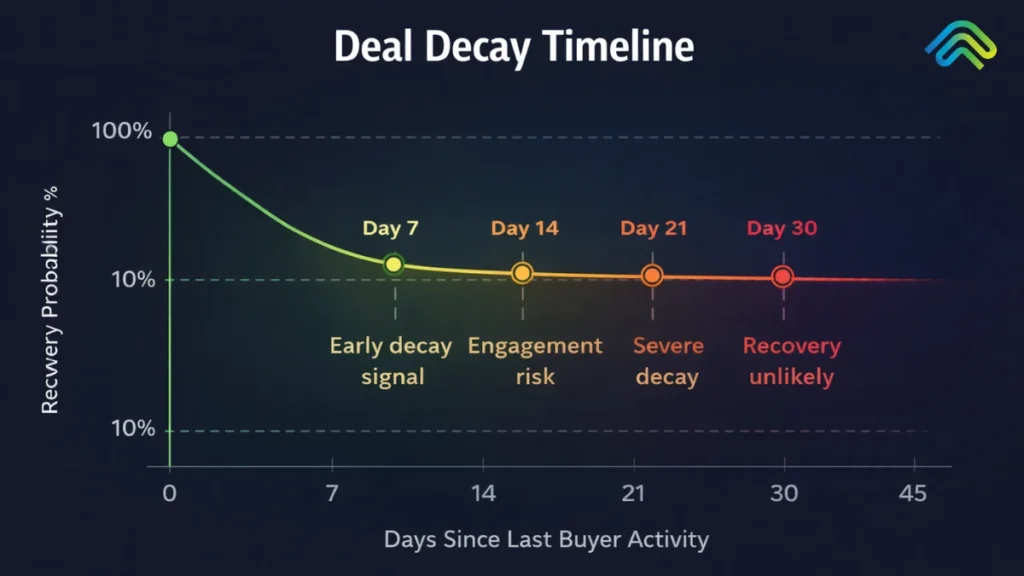
Three things to notice about this table. First, most of these signals are detectable with data your team already has — CRM timestamps, email engagement metrics, proposal tracking, intent platforms. Second, none of them require a rep to manually notice and interpret them. They can all be automated. Third and most critically: every one of these signals has a recovery window that closes. The earlier the detection, the higher the recovery probability. By the time you’re seeing Signal 7, your options are narrow.
Why Your Intelligence Tools Can See the Decay — But Can’t Stop It
If you’ve been nodding along to the signals listed above, you probably already have some version of pipeline visibility that surfaces a few of them. Deal health scores in your CRM. Engagement alerts from your sequencing tool. Conversation intelligence flagging disengagement. Forecasting tools showing pipeline risk.
These are all genuinely useful. And they all have the same ceiling.
A Gong flag that says ‘this deal has low engagement‘ doesn’t automatically trigger a buying committee expansion play. A Clari deal score that drops from 72 to 41 doesn’t automatically send a personalized re-engagement sequence to the champion. A CRM aging report showing deals 45 days past expected close doesn’t automatically escalate to a manager.
The intelligence exists. The execution doesn’t automatically follow. And every hour that passes in that gap — between a decay signal and the action that should respond to it — is an hour of compounding momentum loss.
| Dashboards tell you where the deal is dying. Revenue Execution infrastructure stops it from dying. One is a rearview mirror. The other is the intervention. |
There’s a term for this gap. It’s the same concept that drives revenue leakage across the entire funnel: signal-to-action latency. At the deal level, it’s the time between when a decay indicator fires — engagement drops, champion goes quiet, proposal sits unopened — and when a coordinated, accountable recovery action begins.
That latency is measured in hours and days. Deal recovery probability is inversely proportional to it. Every additional 24 hours of inaction after a high-priority decay signal reduces your recovery odds meaningfully. The math is uncomfortable and most teams don’t track it because tracking it would reveal how much they’re actually losing to execution delay rather than competitive displacement.
| The Insight Ceiling Insight tells you a deal is at risk. Revenue Execution converts that risk signal into an automatic, accountable action before the deal is gone. The former is necessary. The latter is what actually recovers the revenue. Most organizations have invested heavily in the former and have barely started building the latter. |
How SpurIQ Deal IQ Detects and Recovers Decaying Deals?
SpurIQ’s Deal IQ is not a deal health dashboard. It’s not an analytics layer. It doesn’t produce a weekly pipeline report. It is the execution owner for mid-to-bottom-of-funnel revenue — the system that detects deal decay signals in real time and automatically converts them into coordinated recovery actions across every tool in your GTM stack, without waiting for a rep to notice.
The distinction matters. Showing you that a deal is at risk is a solved problem. There are a dozen tools that do it well. What almost no tool does is close the loop, automatically, between the risk signal and the accountable action that follows.
That’s the gap Deal IQ fills.
The Four-Layer Execution Architecture:
Deal IQ operates through four interconnected stages. Each one is purpose-built to eliminate a specific class of deal decay failure.
| 01. AGGREGATE | Unified Signal Ingestion Across Your Entire Stack Deal IQ ingests deal-level signals in real time from every relevant system: CRM activity from Salesforce and HubSpot, engagement data from Outreach and Salesloft, conversation intelligence from Gong, document tracking from your proposal platform, intent signals from 6sense and Bombora and CS health data. No signal lives in a silo. Every buyer-side and rep-side data point contributes to a unified, continuously updated deal profile. |
↓
| 02. INTELLIGENCE | AI Decay Detection and Deal Risk Scoring The AI intelligence layer applies machine learning across the aggregated signal pool — evaluating buyer engagement velocity, champion responsiveness patterns, buying committee coverage, deal age against historical close benchmarks and competitive signal overlap. It produces a real-time Decay Risk Score for every active deal, distinguishing between a ‘healthy pause’ (budget cycle timing, procurement process) and ‘active decay’ (disengagement, momentum loss, stakeholder risk). The output is not a dashboard of concerns. It is a prioritized execution queue. |
↓
| 03. ORCHESTRATE | Automated Recovery Play Execution When a deal crosses its Decay Risk threshold, Deal IQ doesn’t send a notification. It executes a coordinated Recovery Play — automatically, simultaneously, across CRM, sequencing tool, marketing platform, Slack and management reporting. The rep may be in a call. The manager may be in a QBR. The buyer’s engagement window doesn’t wait for either of them. Deal IQ closes the loop in under 60 seconds. |
↓
| 04. ACCOUNTABILITY | Closed-Loop Outcome Tracking For every triggered recovery action, Deal IQ tracks completion, timing and outcome. If the recovery play doesn’t move the deal within the defined SLA window, it escalates — automatically — to the manager with the full signal context attached. The system watches the watcher. Deals don’t silently decay because accountability is built into the architecture, not left to manager observation. |
2 Recovery Scenarios That Show the Difference:
Architecture is easier to understand in action. Here are two concrete examples of how Deal IQ detects and recovers the exact scenarios described at the top of this piece.
| Scenario A — The Proposal That Nobody Opened The situation: Proposal sent nine days ago. Two opens in the first 48 hours. Nothing since. Champion’s last reply was eleven days ago. Close date is three weeks out. Rep has the deal marked as ‘in progress. ‘What Deal IQ detects: – Proposal engagement velocity dropped to zero at day 3 post-send. – Champion response latency spiked from 6-hour average to 11+ days. – Deal Decay Risk Score crosses threshold at day 8. Two concurrent decay signals. What Deal IQ executes — simultaneously, within 60 seconds: 1. Personalized re-engagement sequence fires to champion — references the specific proposal section most closely aligned to the priority they stated in the discovery call. 2. ROI calculator and relevant case study sent to two secondary stakeholders who were identified in the deal record but never directly engaged. 3. Generic marketing drip paused for the account. Deal-stage-specific content activated instead.AE task created in Salesforce: ‘Proposal at risk — call champion today.’ Timestamped with full signal context. 4. Manager notified via Slack with deal context and recovery play status. Automatic escalation triggers if no AE action within 24 hours. Without Deal IQ: this deal enters week three of silence and eventually becomes a close-date push. With Deal IQ: recovery started at signal, not at postmortem. |
| Scenario B — The Champion Who’s Leaving The situation: Deal in Negotiation stage. Single-threaded — only the champion has been engaged across four months of the sales cycle. Intent data cross-referenced with LinkedIn shows the champion has been viewing open positions at other companies. No rep action in six days. Close is forecast for end of month. What Deal IQ detects: – Single-thread risk flag — only one contact has had activity in 30 days. – Champion departure signal cross-referenced from intent + LinkedIn intelligence APIs. – Rep inactivity: six days with no outreach on a deal in active Negotiation stage. What Deal IQ executes: 6. Three additional buying committee members identified from firmographic data and existing CRM contacts. Outreach sequence activated to economic buyer and procurement lead immediately. 7. AE prompted to schedule a ‘relationship continuity’ call with the champion — framed as a natural check-in, not as a departure-triggered panic. 8. Deal flagged as ‘Champion Risk — Single Thread’ in Salesforce with full signal context. Manager alerted. 9. Executive sponsor play activated — connects VP-level contact on the selling side with a VP-level contact on the buying side to establish an independent relationship. Without Deal IQ: this deal dies the week the champion announces their departure. With Deal IQ: by then, the relationship has already been multi-threaded, the economic buyer is engaged and the deal has organizational continuity. |
The Execution Metrics That Reveal Your True Decay Rate
Deal IQ introduces a set of leading indicators that surface decay before it’s terminal, contrasting sharply with the lagging metrics most teams use to measure pipeline health.
| Traditional Metric (Lagging) | Deal IQ Execution Metric (Leading) | What It Reveals |
| Win Rate | Decay Recovery Rate — % of flagged deals re-engaged within SLA | Whether your execution system is actually recovering deals, not just flagging them |
| Pipeline Value | Execution Coverage Rate — % of active deals with a current, dated recovery action | How much of your pipeline has real execution ownership vs. wishful thinking |
| Deal Age | Decay Signal-to-Action Latency — hours between first decay signal and first recovery action | The single strongest predictor of deal recovery probability |
| Forecast Commit | Risk-Adjusted Pipeline — pipeline value weighted by real-time Decay Risk Score | A number that reflects execution reality, not rep optimism |
| Close Date Accuracy | Recovery Play Conversion Rate — % of activated plays that moved a deal to next stage | Enables continuous improvement of orchestration logic based on what actually works |
Why Deal Decay Is Harder to Fight in 2026 Than It’s Ever Been?
Why Most Deals Don’t Get Lost — They Quietly Decay (And How to Stop It in 2026)
Deal decay isn’t new. Pipelines have always had deals that stall, slow and fade. What’s changed in 2026 is the set of conditions that have made decay faster, harder to detect and more expensive to recover from.
Buying committees are bigger — and reps aren’t threading them
The average enterprise B2B deal now involves 13 stakeholders in the buying committee (Forrester, 2024). Most sales teams still run single-threaded execution strategies designed for the 4–5 person buying committees of a decade ago. In a 13-person buying committee, a single-threaded deal doesn’t just carry risk — it is the risk. One champion losing momentum collapses the entire deal.
Sales cycles are longer — which means more decay surface area
Enterprise sales cycles averaged 11–12 months in 2026, with complex multinational deals stretching to 16 months. Longer cycles create more entry points for decay: more stakeholder changes, more budget cycles, more internal reprioritizations, more competitive windows for a rival to insert themselves. Every additional month in the pipeline is another month for a decay signal to go undetected.
Buyers are more self-sufficient — which means inaction is fatal faster
83% of B2B buyers define their purchase requirements before they first engage a sales rep, according to Gartner research. These buyers arrive pre-convinced, pre-informed and with a compressed tolerance for slow response. When they generate an engagement signal and a seller doesn’t respond with precision and speed, they don’t wait around. They move on to the vendor who responds as if they’ve been paying attention.
Intelligence has improved. Execution infrastructure hasn’t kept up
This is the central tension of 2026 revenue operations: the tools for detecting deal decay have genuinely gotten better. Intent data, conversation intelligence, CRM automation, engagement analytics — the signal quality has improved dramatically over the past five years.
But signal quality without execution infrastructure is a diagnosis without treatment. Knowing a deal is decaying doesn’t recover the deal. An automated, orchestrated recovery play recovers the deal.
| 72%of new B2B opportunities stall in the middle-to-late pipeline stages without meaningful buyer-side action for 60+ days. (Selling Power Research) |
That number hasn’t improved despite significant investment in pipeline visibility tools. The reason is straightforward: those tools are solving the observation problem, not the execution problem. Until the execution layer is automated and accountable, visibility improvements are incremental. Deal decay continues at scale.
The Signal Already Fired. Did Your System Act on It?
Go back to the three deals at the top of this piece.
The proposal that hasn’t been opened in nine days. The champion who stopped replying seventeen days ago. The deal with the second pushed close date and no reason logged.
None of those deals are formally dead. None of them sent a rejection. None of them went to a competitor — at least not yet. They’re in a state of active decay, sitting in your pipeline, looking healthy in the forecast, waiting for someone or something to intervene before the window closes for good.
That’s the thing about deal decay that makes it so expensive. It’s not irreversible, right up until it is. There is always a recovery window, it just gets shorter every day that passes without an automated response to the signal that already fired.
| Most deals don’t die in a dramatic competitive loss. They fade quietly, one missed signal at a time, in the gap between detection and execution. |
The companies that stop losing revenue to deal decay in 2026 won’t do it by running better pipeline review meetings, or coaching reps on follow-up discipline, or building more detailed playbooks. Those interventions have been tried, consistently, across a decade of sales operations investment. The 86% stall rate hasn’t moved.
What will move it is execution infrastructure, a system that watches every deal simultaneously, detects decay signals the moment they appear and automatically executes coordinated recovery actions before the buyer loses faith or a competitor fills the silence.
SpurIQ Deal IQ is built for exactly that. Not to show you which deals are at risk. To recover them, automatically, accountably, in under 60 seconds from signal to first action.
| The Execution Ownership Era For the past decade, revenue technology investment has focused on insight — giving teams more visibility, more data, more signals. That mission succeeded. The signals exist. The execution gap remained. The organizations that dominate revenue growth in the next decade will not be the ones with the most data. They will be the ones whose systems convert signals into action — automatically, consistently and with full accountability — before any competitor can react manually. Your deals are decaying right now. Some of them are still recoverable. But only if the execution happens before the window closes. |
Stop diagnosing deal decay in Monday QBRs.
Start recovering it in real time.
SpurIQ Deal IQ detects mid-to-late funnel decay signals automatically, then executes coordinated recovery plays across your entire GTM stack — without waiting for a rep to notice, a manager to escalate, or a quarter to end.
See which of your deals are decaying right now →FAQs:
Q. What is deal decay in B2B sales?
Deal decay is the gradual, often invisible deterioration of a sales opportunity caused by accumulated execution failures rather than active rejection. A decayed deal doesn’t lose to a competitor — it loses momentum through missed follow-ups, unanswered signals and the slow erosion of buyer engagement over time. The buyer never formally says no. The deal simply stops moving until it’s no longer recoverable.
Q. What’s the difference between a stalled deal and a dead deal?
A stalled deal still has an active recovery window, the decay signal has fired, but an orchestrated response can still re-engage the buyer and restore momentum. A dead deal has passed the point of recovery: the budget has been reallocated, the champion has left, or the buying cycle has closed and a decision has been made without you. The difference matters because stalled deals can be recovered with the right execution infrastructure. Dead deals cannot. Deal IQ focuses on detecting stalls before they become deaths.
Q. Why do B2B deals stall in the mid-to-late pipeline?
Mid-to-late pipeline stalls typically stem from one or more of five structural causes: the CRM has no sensor for buyer-side inactivity; rep execution depends on human memory rather than automated triggers; alert fatigue has made signal platforms into background noise; the deal is single-threaded through a single champion in a 13-person buying committee; or pipeline inflation has kept the deal alive on paper while it decays in reality. None of these are rep performance problems. All of them are execution architecture problems and all of them are solvable with the right system.
Q. How do you detect deal decay early?
The seven most reliable early-detection signals are: no buyer-side activity for 14+ days, a spike in champion response latency (hours to days), a proposal that hasn’t been opened 7+ days post-send, close dates manually pushed twice or more, single-threaded engagement with only one buying committee contact, pricing or legal stage entry with no procurement contact engaged and competitive intent signals appearing without rep response within 24 hours. The challenge isn’t identifying these signals, it’s correlating them across disparate tools automatically and connecting each one to a specific recovery action.
Q. How can AI prevent deal decay?
AI prevents deal decay by doing three things that human attention cannot reliably do at scale: monitoring all deal-level signals continuously and simultaneously across every tool in the GTM stack; scoring decay risk in real time using machine learning trained on historical deal outcomes; and automatically executing coordinated recovery plays the moment a deal crosses a decay threshold — without waiting for a rep to notice, a manager to ask, or a QBR to surface the problem. SpurIQ Deal IQ’s four-layer architecture — aggregate, intelligence, orchestrate, accountability, applies this model to every active deal, every day.
Q. What is pipeline rot?
Pipeline rot is deal decay at the portfolio level, the condition that emerges when multiple deals across a pipeline are simultaneously in various stages of decay, creating an inflated, unreliable forecast. A pipeline with significant rot shows strong top-line numbers but delivers materially below forecast because a large portion of the ‘active’ pipeline has already deteriorated past the point of realistic recovery. Pipeline rot is not a data quality problem, it’s what happens when individual deal decay goes undetected and unaddressed at scale.