| “The greatest danger in times of turbulence is not the turbulence – it is to act with yesterday’s logic.” ~ Peter Drucker |
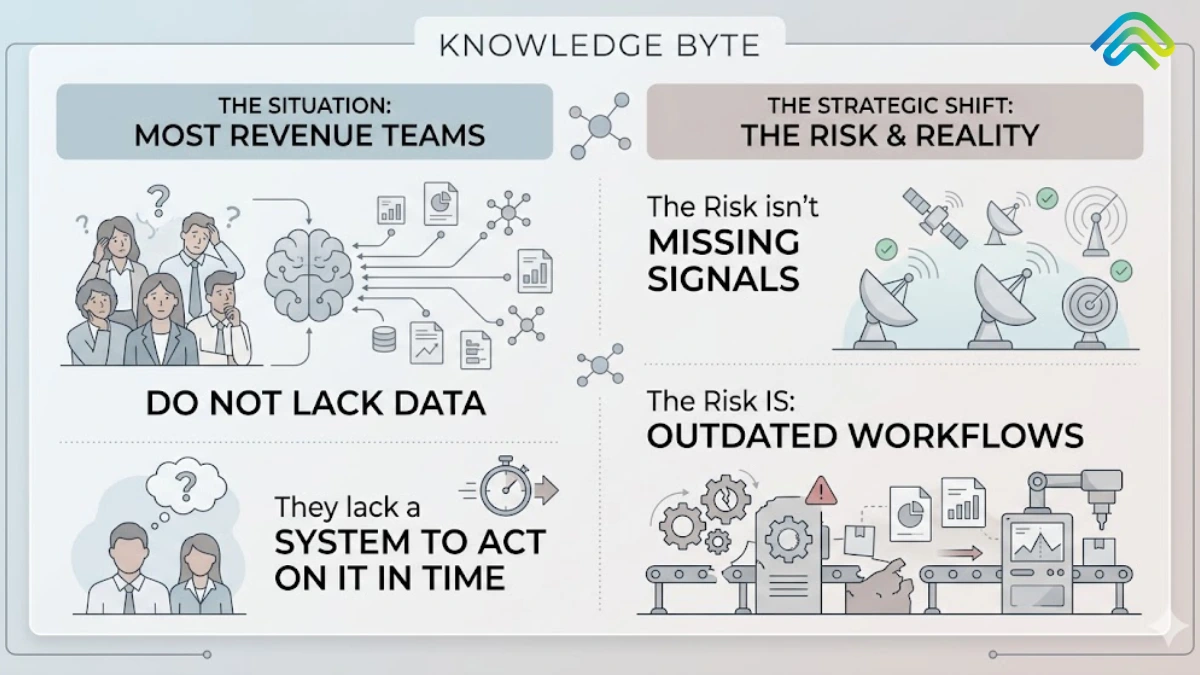
Your CRM is already screaming at you. Slack pings with intent alerts every hour. Your dashboard shows dozens of accounts “surging” on key topics. Yet, in most organizations, there is a painful silence where the revenue should be. Your sales reps are likely still grinding through static lists built six weeks ago; a structural lag that isn’t just an “ops issue,” it’s a massive leak in your capital efficiency.
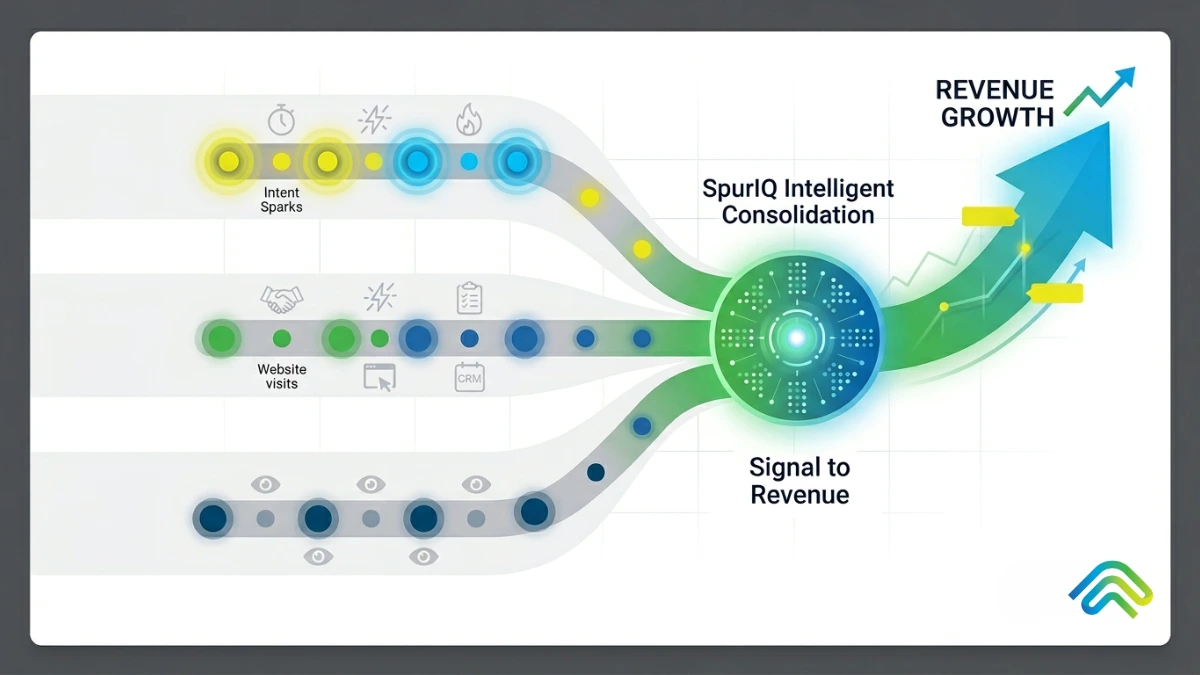
Today, detecting B2B buying signals is no longer a competitive advantage – it’s the baseline. The real bottleneck is Synthesis.
| Did You Know? According to Gartner, when B2B buyers are comparing multiple suppliers, the time they spend with any one sales rep may be as little as 5% to 6%. Instead, the majority of their journey is spent in ‘looping’ activities—independently researching, building requirements, and seeking consensus across a buying group that now typically includes 6 to 10 decision-makers. |
The disconnect between seeing a signal and acting on it creates a vacuum of Asymmetric Information. Your tech knows the buyer is ready, but your human capital remains decoupled from that reality.
This inefficiency is expensive. Ehrenberg-Bass Institute’s “95:5 Rule” states that only 5% of your market is ever “in-market” to buy. Chasing the other 95% doesn’t just waste time; it burns your most expensive resource: your people.
To solve this, we’ve curated a comprehensive list of B2B buying signals ranked by signal strength and deal velocity, the speed at which an opportunity evaporates. For the modern CRO, mastering these signals is the difference between a high-performing pipeline and a costly, underutilized tech stack.
How This List Is Structured
How this list is structured comes down to one simple idea: not every buying signal deserves the same urgency or the same response.
Think of a typical Monday morning for a sales team.
There are dozens of signals coming in – pricing page visits, webinar attendees, hiring alerts, and intent spikes. Everything looks important. Nothing feels prioritised.
So what happens?
Teams either chase everything or ignore most of it.
To keep your strategy sharp and executable, we’ve distilled the methodology into a high-signal framework. This approach ensures your revenue team focuses on buying signals B2B with the highest ROI rather than chasing low-intent noise.
| # | Signal | Tier | Strength | Decay Window |
| 1 | Pricing page visit (repeat, multi-stakeholder) | 1 | Very High | 24–48 hrs |
| 2 | Demo / contact form submission | 1 | Very High | 24–48 hrs |
| 3 | Pricing, contract, or timeline question asked | 1 | Very High | 24–48 hrs |
| 4 | Champion job change to new company | 1 | High | 48 hrs |
| 5 | Competitor displacement event | 1 | High | 48 hrs–1 wk |
| 6 | Multiple content downloads (case study + ROI calc) | 2 | Medium-High | 3–7 days |
| 7 | Funding round or M&A announcement | 2 | Medium-High | 3–7 days |
| 8 | Hiring surge in target department | 2 | Medium | 1–2 weeks |
| 9 | Third-party intent surge (Bombora/G2/6sense) | 2 | Medium | 3–7 days |
| 10 | Webinar or event attendance | 2 | Medium | 3–7 days |
| 11 | AI tool adoption (+46% purchase correlation) | 3 | Medium | 2–4 weeks |
| 12 | Leadership change in target department | 3 | Medium | 2–4 weeks |
| 13 | Social media engagement on category topics | 3 | Low | 2–4 weeks |
| 14 | Industry/regulatory shift affecting the account | 3 | Medium | 2–4 weeks |
| 15 | Repeat website visits without form fill (anonymous) | 3 | Low | 2–4 weeks |
The Scoring Framework
We evaluate each of the buying signals examples in this list using three critical dimensions:
- Signal Strength: Rated High, Medium, or Low based on its historical correlation to closed-won revenue.
- Decay Window: The “shelf life” of the intent; how quickly the window of opportunity closes before the prospect goes cold.
- Recommended Response: The specific, automated, or manual playbook triggered by the signal to ensure a relevant intervention.
Priority Tiers for Execution
By grouping our list of B2B buying signals into tiers, we establish a clear SLA (Service Level Agreement) for your sales and marketing teams:
- Tier 1 (Critical): High-intent company buying signals requiring action within 24–48 hours. These represent active buyers currently in the decision-making phase.
- Tier 2 (Strategic): Mid-range signals requiring a response within 3–7 days. These focus on shaping requirements and providing consultative value.
- Tier 3 (Observational): Low-velocity indicators added to a “Watch List.” We wait for these signals to “stack” before deploying human capital.
Tier 1 — Act Now: High-Intent Buying Signals (24–48 Hour Decay)
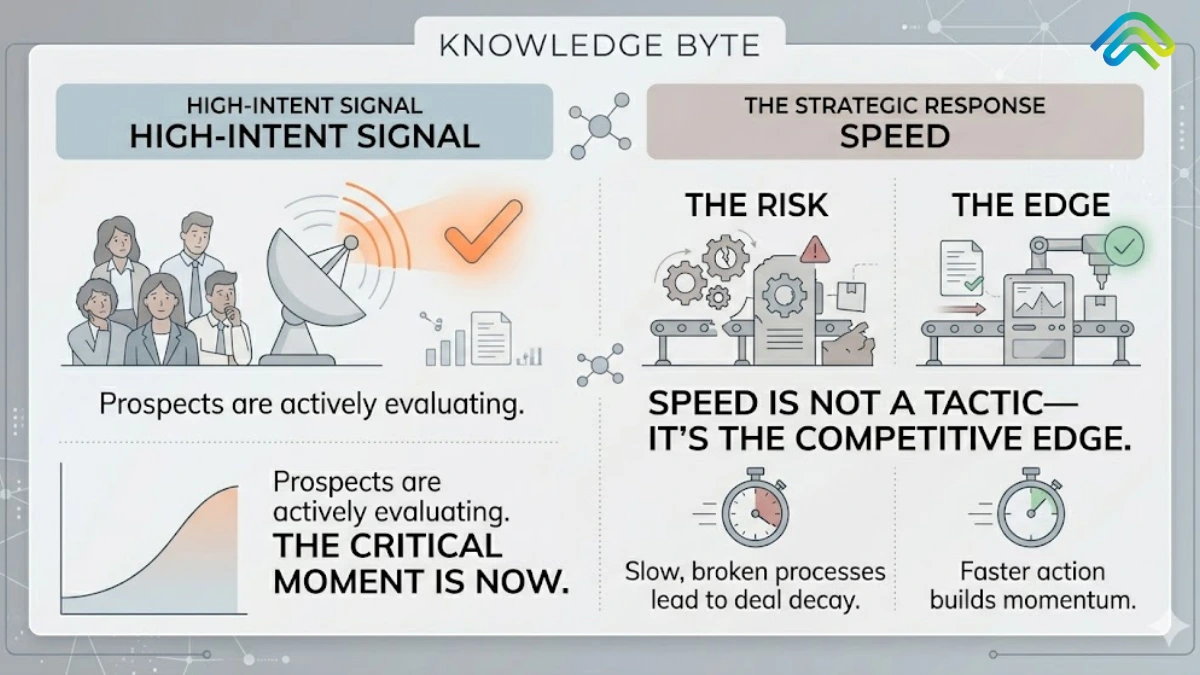
When you see these signals, someone is already evaluating your product. They’re not just browsing; they’re deciding. If you don’t move quickly, they’ll usually pick someone who did.
Signal 1: Pricing Page Visit (Repeat, Multiple Stakeholders)
If several people from the same company keep visiting your pricing page, they’re clearly comparing vendors. The right move is a personal, short message from an AE within 2 hours, mentioning the page or plan they looked at, not a generic “How can we help?” email.
Signal 2: Demo or Contact Form Submission
A demo or contact form is the strongest sign: the prospect is ready to see how you work. Respond within 5 minutes. Research shows that most buyers pick the first vendor who replies. As soon as the lead lands, assign it, add context, and lock in a meeting.
Signal 3: Pricing, Contract, or Timeline Questions
If they ask about pricing, contracts, or timelines, they’re in the final stage. They don’t need more “mightbes.” Give clear answers, share real cases‑study examples and ROI numbers that match their situation, right then, not “later.”
Signal 4: Champion Job Change to a New Company
When a past buyer or champion joins a new company, they usually bring their preferences with them. This is one of the warmest signals you’ll get. Reach out within 48 hours, mention their move, reference the earlier work, and position it as “continuing the conversation” rather than a cold call.
Signal 5: Competitor Displacement Event
If a target account drops a competitor, complains about them, or has a contract up for renewal, they’re ready to switch. Outreach here should tie directly to that change, focus on the frustration, the risk, and how you make the transition safer. No generic “Hi, I thought you might like this” pitch.
The challenge with Tier 1 signals isn’t detection, most intent tools surface these. The challenge is execution speed. When a signal has a 24-48 hour decay window and your team takes 3 days to respond, you’ve already lost the deal to a faster competitor. SpurIQ’s LeadIQ is built for exactly this: the moment a Tier 1 signal fires, the system enriches the contact, routes it to the right rep, prepares contextual talking points, and automatically ensures outreach occurs within the decay window.
.
Tier 2 — Act This Week: Medium-Intent Buying Signals (3–7 Day Decay)
Tier 2 signals are softer than Tier 1, but they still matter. These aren’t random clicks; they’re signs that a company is exploring your space and starting to build a case. You still need to act, but you have a window of about 3–7 days, not hours.
Signal 6: Multiple Content Downloads
Grabbing just one eBook is nice. But if someone downloads a case study, an ROI calculator, and a competitor comparison in the same week, they’re starting to evaluate. The right move is a personal follow‑up that mentions the exact content they downloaded and how it connects to their situation—no generic “Hope this was helpful.”
Signal 7: Funding Round or M&A Announcement
New funding or a merger usually means new budgets, new priorities, and new buying windows. Outreach should tie directly to that growth—talk about their expansion, their new goals, and how your solution fits there. Don’t send another “Congrats on the funding” message that everyone else is using.
Signal 8: Hiring Surge in Target Department
If a company suddenly posts 5+ roles in sales ops, RevOps, or engineering, they’re building or scaling. That’s a signal that they’re planning to invest in tools and processes. Reach out with a contextual message that connects to those hiring patterns—how you help teams like the ones they’re bringing on.
Signal 9: Third‑Party Intent Surge (Bombora, G2, 6sense Topic Surge)
If intent tools show that a company is researching your category across the web (G2, Bombora, 6sense, etc.), they’re in exploration mode. The right response is a multi‑channel nudge—a short email and a LinkedIn message, with content that matches exactly what they’re researching.
Signal 10: Webinar or Event Attendance
Showing up to a category‑specific webinar or event is a clear sign of active exploration. The follow‑up should be fast and relevant: send a quick recap, a recording, and a tailored next step within a day or two, not weeks later when marketing finally gets to the attendee list.
The execution gap: Tier 2 signals are where most B2B teams leak the most revenue, not because they miss the signal, but because the follow‑up happens too late or not at all.
Tier 2 signals don’t fail because they’re weak; they fail because follow-up is inconsistent or delayed. These signals indicate active evaluation, but without timely, structured action, they quietly lose momentum. In fact, 52% of reps never make a second follow-up attempt, which is where most pipeline leakage happens. The real gap isn’t signal visibility-it’s execution.
SpurIQ’s DealIQ monitors active deals and pipeline signals (stalled follow-ups, idle CRM stages, missed next steps) and automatically triggers the right action, a drafted follow-up email, a CRM update, a risk alert to the manager, before the signal decays.
Tier 3 — Watch and Stack: Early-Stage Buying Signals (2–4 Week Decay)
Tier 3 signals are the first whispers of a future opportunity. On their own, they’re not strong enough to pull a trigger, but when you stack them, they show you who’ll be buying next.
Signal 11: AI Tool Adoption (+46% Purchase Correlation)
If a company starts adopting AI tools, it’s usually in transformation mode, rethinking its tech stack. This is one of the strongest early indicators that they’ll be shopping for related solutions soon.
Signal 12: Leadership Change in Target Department
New leaders come with new priorities and budgets. In the first 90 days, they often kick off vendor evaluations and replatforming projects.
Signal 13: Social Media Engagement (LinkedIn Activity)
A single like or comment on an AI‑related post doesn’t mean much. But if the same account is regularly engaging with your category, it’s a soft signal worth tracking.
Signal 14: Industry or Regulatory Shift
New rules, regulations, or market shifts can force companies to buy. When something changes their business, they look for tools that help them stay compliant or competitive.
Signal 15: Repeat Website Visits Without Form Fill
Some prospects are interested but not ready to raise their hand. They keep coming back to your site but don’t fill out forms. Use IP‑level tools to figure out who they are and add them to your watch list.
Tier 3 signals aren’t about instant action, they’re about timing. On their own, they’re weak; together, they reveal where your next pipeline is forming. SpurIQ captures these signals across all three tiers from the tools your team already uses – CM, email, calendar, call recordings, and intent platforms, and routes them through a unified execution engine so no signal sits unactioned on a dashboard.
The Buying Signals Follow-Up Framework
The buying signals follow-up framework answers one critical question: how do you respond to buying signals before they lose value?
Most teams don’t miss signals, they miss the moment to act. A signal appears, gets noted, and then sits on a dashboard while the buyer moves forward with a faster competitor.
The difference between pipeline visibility and pipeline conversion is execution.
Here’s a simple 4-step framework to ensure every signal turns into action:
Step 1: Detect the signal
Capture signals across your stack; CRM, website activity, email, intent platforms, and sales conversations. The goal isn’t more data, but relevant buying signals data that indicates real intent.
Step 2: Score and prioritise
Not all signals are equal. Classify them into Tier 1, Tier 2, or Tier 3 based on strength and urgency, so your team knows what to act on first.
Step 3: Enrich with buyer context
A signal without context is just noise. Layer in:
- Company insights
- Contact details
- Previous interactions
This ensures outreach is relevant, not generic.
Step 4: Execute within the decay window
Timing is everything. Whether it’s outreach, follow-up, or a CRM update—execution must happen within the signal’s relevance window, not days later.
| Tier | Response SLA | Owner | Escalation If Missed |
| Tier 1 | Within 2 hours | Assigned AE/SDR | Auto-escalate to manager + Slack alert |
| Tier 2 | Within 24 hours | Assigned SDR | Auto-reassign after 24 hours |
| Tier 3 | Weekly review | RevOps / GTM engineer | Escalate to Tier 2 when signals stack |
This is what SpurIQ means by revenue execution. We don’t just detect signals or recommend actions. We ensure the action gets executed, across the existing GTM stack, within the SLA window. That’s the difference between a dashboard that shows problems and a system that prevents revenue from leaking.
Frequently Asked Questions (FAQs):
What are buying signals examples in B2B?
B2B buying signals are observable data points that indicate a company is moving from passive interest to an active purchase cycle. Top examples include:
– Pricing page visits (especially by multiple stakeholders)
– Demo or contact form submissions
– Questions about pricing, contracts, or implementation
– Multiple content downloads (case studies, ROI tools)
– Third-party intent surges (category research activity)
These signals indicate varying levels of purchase intent and help teams prioritise outreach.
What is the strongest B2B buying signal?
The strongest B2B buying signal is repeated pricing page visits by multiple stakeholders from the same company. This indicates active evaluation, internal alignment, and high likelihood of shortlisting vendors.
How do you follow up on buying signals?
The most effective buying signals follow up uses a tier-based SLA framework:
Tier 1: Respond within 2 hours (high-intent signals)
Tier 2: Respond within 24 hours (evaluation-stage signals)
Tier 3: Monitor and act when signals stack
Follow-up should be timely, contextual, and aligned with the signal’s intent.
What is buying signals data?
Buying signals data is a combination of first-party and third-party data that indicates purchase intent.
– First-party data: Website visits, form fills, email engagement, CRM activity
– Third-party data: Intent data from external platforms, content consumption, and research behaviour
Together, they help identify buying signals in B2B environments.
How do you identify online buying signals?
You identify online buying signals by tracking:
– Website behaviour (pricing page visits, repeat sessions)
– Content engagement (downloads, webinar attendance)
– Third-party intent data (category research across platforms)
Combining these sources improves accuracy in identifying real buying intent.
What is the signal-to-action gap?
The signal-to-action gap is the structural delay between when a system detects intent and when a human rep executes a relevant response. This gap is the primary cause of pipeline decay. SpurIQ solves this by automating the synthesis and routing process, ensuring that Tier 1 signals are met with contextual outreach before the “intent window” closes.